|
by Gary 'Z' McGee December 12, 2025 from Self-InflictedPhilosophy Website
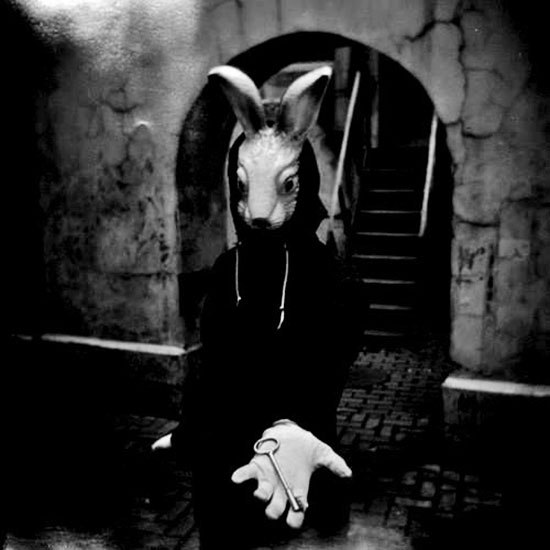
White Rabbit by 365 Days of Horror
that is, when a man is capable of being in uncertainties, mysteries, doubts, without any irritable reaching after fact and reason."
John Keats
The marriage of
Pyrrhonian Skepticism and
Negative Capability is
Skeptical Capability...
No flag, no banner; only the precise shimmer of suspended judgment. In your right hand:
It does not cut flesh, but it severs all claims. Every swing parts a dogma from its root, leaving the assertion hanging in mid-air, weightless, neither true nor false.
It's edge hums with the Ten Modes:
Each stroke is a quiet "perhaps not."
Its tip glows with a soft, colorless light that neither illuminates nor darkens.
When planted, the staff marks a threshold:
But you never cross either line.
You simply hold the tension. All around you "the gods" descend in their chariots of thunder and scripture. They demand passage, brandishing their absolutes. You lift the Razor horizontally, the Staff vertically.
The two "weapons" cross forming an X.
Time itself pauses at the intersection, caught between the blade that refuses to decide and the staff that refuses to resolve.
The
gods hesitate, their certainties flicker and flame out. You remain
elevated, nonattached, gloriously in-between. A Crossroads of Self.
Let's break it down...
"The analyst (philosopher) must be capable of sustaining a state of mind in which he does not know what is happening... without irritable reaching after certainty."
Wilfred Bion
It's about a receptive, flexible mindset that embraces ambiguity and explores ideas imaginatively without needing to accept, reject, or systematize them.
Keats saw it as essential for
creative and intellectual achievement, exemplified in figures like
Shakespeare, who could "negate" their own identity to fully inhabit
diverse perspectives.
In modern applications (e.g., in psychoanalysis or social theory), it is seen as a tool for innovation and agency,
"The Skeptic, seeing that the same thing appears differently to different people, suspends judgment as to what it really is, and by this suspension attains tranquility." Sextus Empiricus
This creates a baseline of non-commitment, where beliefs
are suspended to avoid the disquiet of holding potentially false
views.
They demonstrate how things appear differently depending on context,
leading to undecidability and tranquility (ataraxia) through
intellectual non-commitment.
Think of them as mental jiu-jitsu moves to neutralize certainty.
"The wise man knows that all things appear and disappear and therefore does not contend. He uses the light but does not lean on it." Zhuangzi
This aligns with Zen-like
nonattachment, where tranquility emerges from observing thoughts
pass without clinging, but with a Western emphasis on agency and
equanimity amid doubt.
Prioritize intuitive openness over resolution.
Tolerate the "mysteries" of others' perspectives, like Shakespeare inhabiting diverse characters without bias. Engage ideas as appearances.
Hamlet the fuck out of the Zeitgeist.
Invite wonder, not reduction - peak negative capability.
Debate without defensiveness, fostering compromise and
self-correction to stay "elevated above the battlefield" of
political polarization.
Avoid "irritable" quests for proof. Explore hypotheses like Keats' poetic mysteries. Keep curiosity ahead of certainty and imagination ahead of knowledge. Dare to levitate between worlds.
Prototype ideas without commitment,
which will lead to breakthroughs (e.g., Dewey's pragmatic testing of
provisional knowledge) and deep innovation.
Skeptical Capability ,
Endure the "half-knowledge" of self/illusion, with humility against arrogance. Entertain thoughts of identity as fleeting. Hold the tension between opposites like a trickster god. Meditate on them for tranquility.
Evade extremist traps of despair or hubris. Integrate
the shadows in Plato's Cave by seeing through the blinding light of
dogmatism.
Not certainty. Not belief. Not even doubt.
Just openness to what appears...
|