|
by Kate Wong April 15, 2026 from ScientificAmerican Website
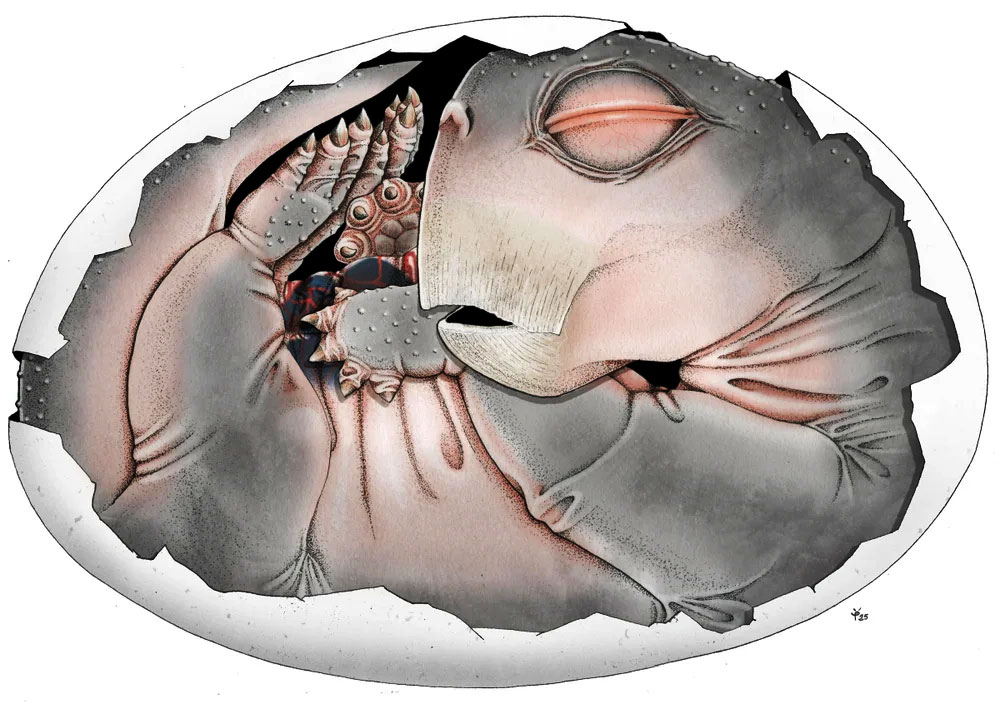
This reconstruction of a Lystrosaurus embryo shows the little creature
in its partially
preserved shell.
mammal ancestors thrive after Earth's worst mass extinction...
The discovery answers a long-standing question
about the reproductive biology of our ancient forerunners and hints
at how they managed to flourish in the aftermath of the biggest
mass extinction in Earth's history.
But they lacked any direct evidence of synapsid
eggs in the fossil record.
The team used x-ray microcomputed tomography
(CT) and synchrotron radiation computed tomography (SRCT)
to examine the bones inside the rocks noninvasively.
Multiple lines of evidence point to the biologically youngest Lystrosaurus having still been inside its egg when it died, according to the authors.
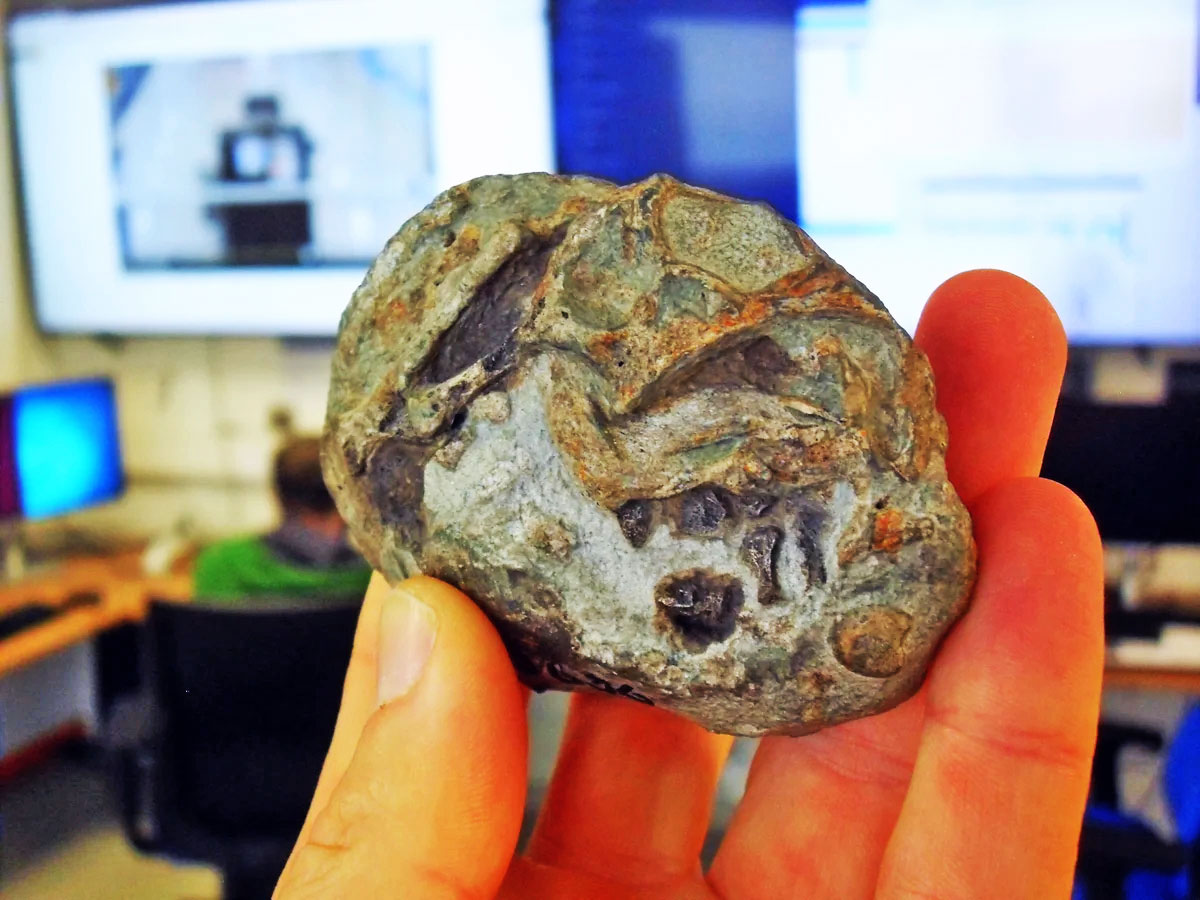
For instance, the dimensions of the rock nodule in which it is preserved are consistent with those of an egg. And the curled posture of the embryo follows an ovoid shape like that of an egg.
The disjointed nature of the pelvis, the vertebrae at the base of the spine and the ribs indicate that the pelvis and cartilage, meanwhile, could not yet support the animal's weight, as would be expected of an individual that had yet to hatch.
The fossil egg, which looks like an oval-shaped rock,
is held in front of a
camera before being scanned.
was large relative to
its owner, Lystrosaurus.
The unfused lower jaw of this Lystrosaurus is therefore another indication that the animaldied while still in its egg.
The other two specimens exhibit signs of having
been somewhat more mature; the largest one was preserved in a
splayed-out posture that shows it was not in an egg and had traveled
some distance before dying.
In the wake of the extinction, on a planet beset
by extreme swings in climate, with long periods of searing heat and
brutal drought, Lystrosaurus flourished, becoming the most
abundant terrestrial vertebrate around.
Reconstruction of the Lystrosaurus egg indicates that it was relatively large. The shell was probably soft and leathery and didn't fossilize readily, which would explain why scientists have not found signs of therapsid eggs until now.
Big eggs, with their smaller surface-to-volume ratio, are more resistant to drying out - a boon in drought conditions.
Moreover, the babies of modern-day tetrapods that lay large eggs tend to be more fully developed and capable of fending for themselves when they hatch compared with babies that develop in smaller eggs.
In contrast, the babies of mammals - even
egg-laying ones - need to be fed milk for a time after birth.
|