|
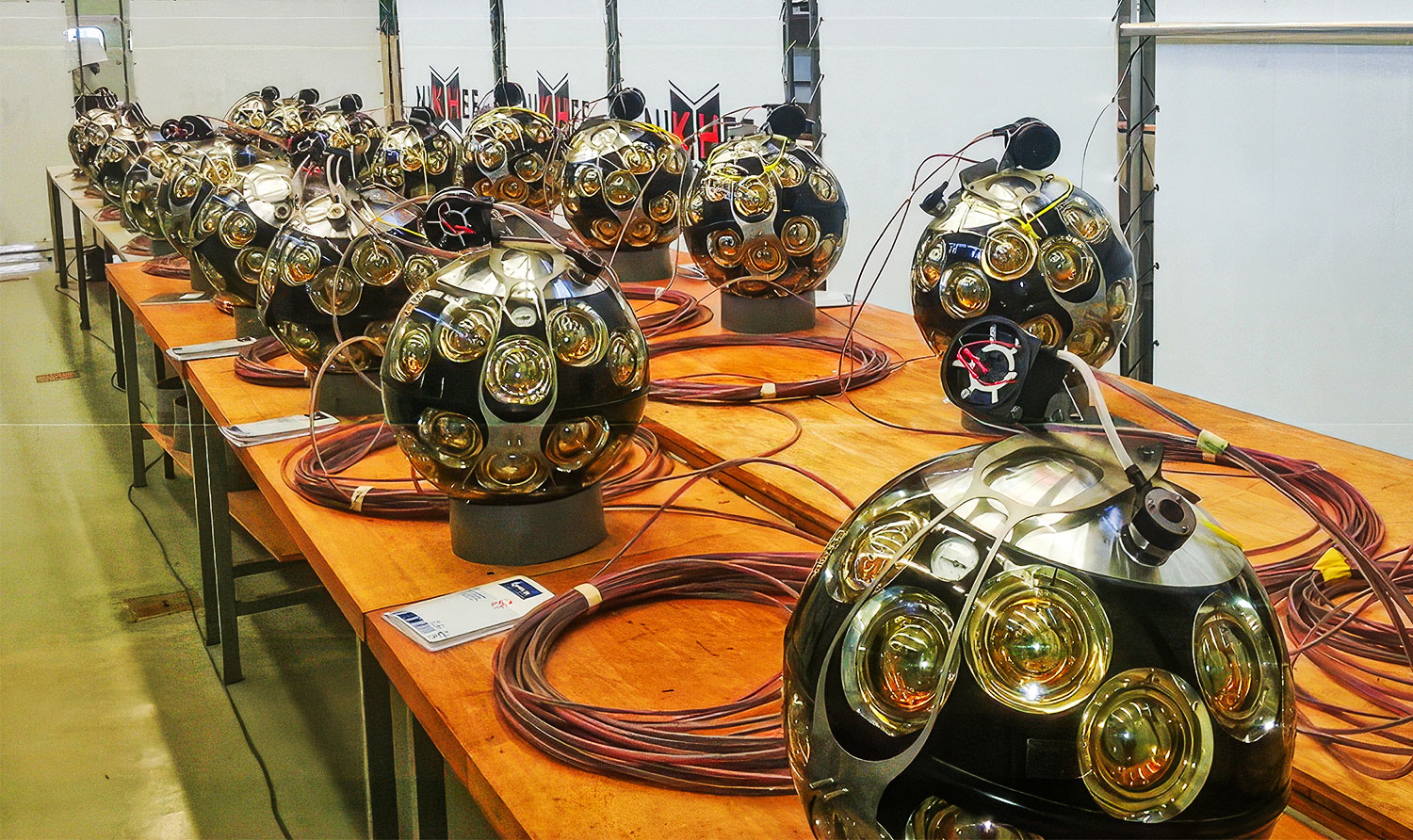
Strings of optical
modules like this
could rewrite our understanding of dark matter and the early universe.
A record-breaking detection at the bottom of the Mediterranean Sea has some physicists wondering if we just spotted one...
The particle was a neutrino, a fundamental component of matter commonly known for its ability to slip through other matter unnoticed.
The IceCube observatory in Antarctica, a comparable detector that has been running for more than a decade, has found hundreds of cosmic neutrinos - but none quite like this one.
Some 35 times more energetic than any neutrino seen before, the particle might have shot out from a highly active galaxy - a blazar - or a background source of cosmogenic high-energy particles that scientists suspect pervade the cosmos.
But those aren't the only possibilities.
The day after the KM3NET collaboration announced the detection, the physicist David Kaiser walked into a room full of his colleagues at the Massachusetts Institute of Technology with a bold proposition:
Such black holes,
The idea that the neutrino came from a primordial black hole is a long shot.
Kaiser said he was "half-joking" when he suggested it. But in the absence of a definitive explanation, it remains intriguing, not least because the existence of primordial black holes could mean they play a role in dark matter.
So the question is, did we just spot one?
In a Split Second
The idea of primordial black holes was first proposed in 1966 by the Soviet physicists Yakov Zel'dovich and Igor Novikov, and it was cemented by the British astrophysicist Stephen Hawking in 1971.
Hawking and his student Bernard Carr, of Queen Mary University of London in the U.K., then worked out the concept of primordial black holes in detail in 1974.
A primordial black hole, or PBH, is loosely defined as,
The hypothesis goes that during the rapid expansion of space, there might have been spikes in the density of space-time that were so high that they would have collapsed into black holes.
These black holes would have spanned a range of masses, depending on the size of the spikes.
Some could have been as small as an atomic nucleus.
David Kaiser, a physicist at the Massachusetts Institute of Technology,
is searching for evidence of primordial
black holes.
The idea has its problems.
The same year Hawking and Carr explained the concept of primordial black holes, Hawking also put forward his idea of Hawking radiation, a process in which,
Giving off Hawking radiation, a primordial black hole that was originally the size of an atomic nucleus would meet its doom in the modern universe, slowly dwindling before ending in a sudden, extreme burst of particles.
That process occurs,
Because the energy released in Hawking radiation doesn't favor one type of particle over another, the final burst would include all 17 fundamental particles in the Standard Model, our benchmark model explaining the cosmos.
In that moment, as the black hole was extinguished, trillions upon trillions of particles would explode into space,
Alexandra Klipfel co-wrote a paper about the
possible origins of the powerful neutrino.
The tiniest primordial black holes would have lasted only moments, but more massive ones could still be around.
Scientists have ruled out (or constrained) the possible masses of PBHs that could be hiding in the universe today.
The best window left for most PBHs, it seems, ranges from about 100 quadrillion (1017) grams - the mass of an average asteroid - to 100 sextillion (1023) grams, the mass of a moon.
A smaller subpopulation of PBHs of 100 trillion (1014) grams or lower, the mass of a small asteroid, would be in their final stages of evaporation.
If primordial black holes do exist in the asteroid-mass window, not only can they tell us about the conditions at the dawn of the cosmos, but they might also answer another open question in astrophysics.
Monster Moment
To the surprise of Kaiser's team, the idea that the neutrino that crashed into the KM3NET detector originated in the explosion of a primordial black hole worked mathematically, and on September 18, 2025, Kaiser and Klipfel published a paper in Physical Review Letters explaining the mechanism.
They found that, if a primordial black hole with the initial mass of a small asteroid exploded about 2,000 astronomical units away - 2,000 times the distance between the Earth and the sun - it could have produced the powerful neutrino.
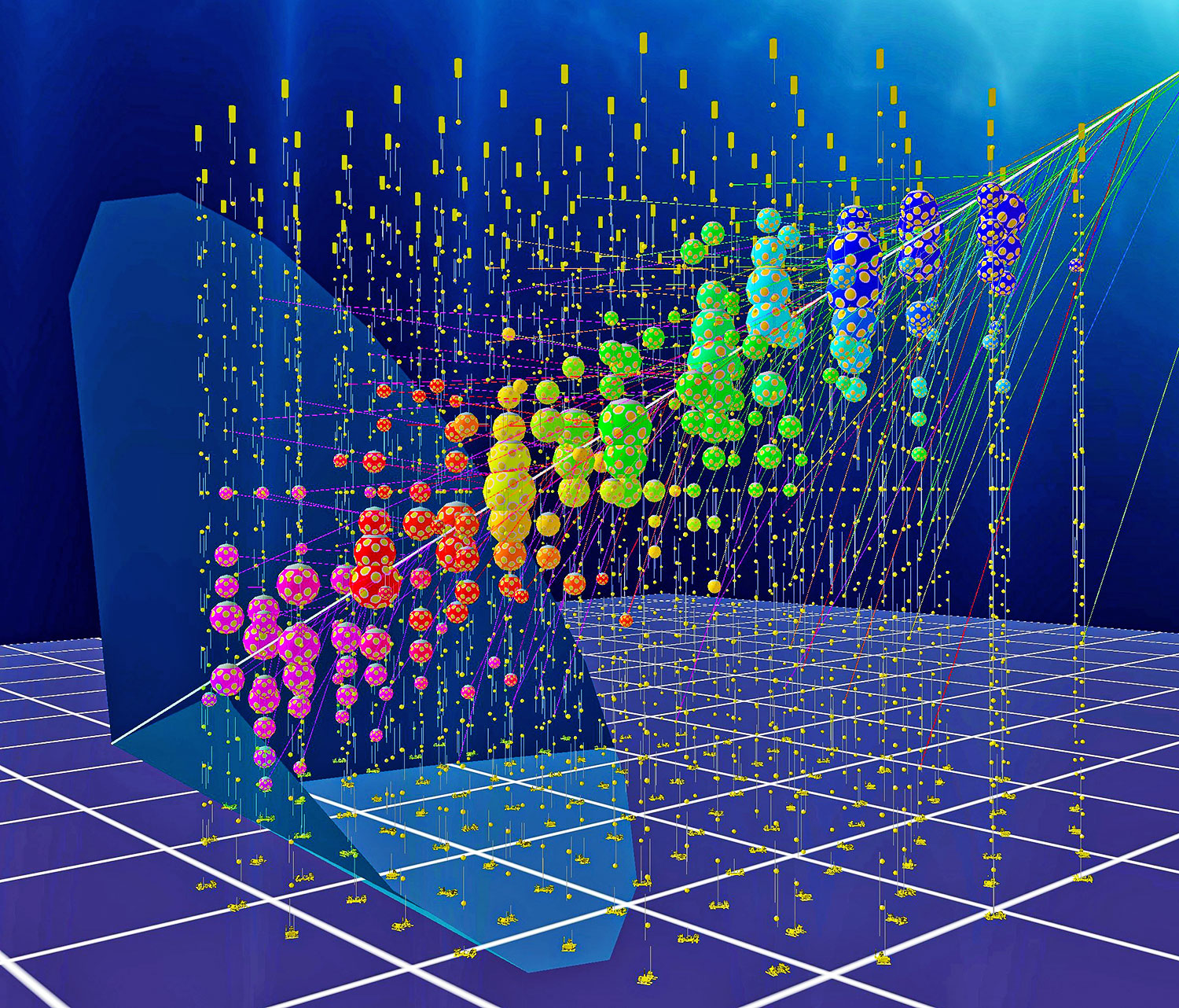
This visualization shows a particle passing through the KM3NET detector
and activating a series of optical
modules.
The PBH, at the lower 100-trillion-gram end of the asteroid-mass window, would have steadily emitted Hawking radiation over the 13.8-billion-year lifespan of the universe until its explosive finale.
Had the PBH been much closer, we likely would have seen its flash in gamma rays or other radiation that would have signaled its final explosion. If it had been too far away, the neutrinos would have been too spread out for one to hit Earth.
Models in which PBHs account for most or all of the dark matter also predict that enough of the smaller PBHs would have the correct mass for one to fly past our solar system right as it exploded, producing a burst of energetic particles, including the neutrino that hit our planet in just the right spot to trigger the KM3NET detector.
Carr, who solidified the concept of PBHs with Hawking, finds the idea enticing and is hopeful that KM3NET's spectacular neutrino is a sign that we might discover PBHs after all.
Cosmic Detection
Not everyone is convinced.
He argues that if such exploding black holes existed, they would be easy to see,
Hooper is not completely opposed to the idea of PBHs themselves, however, and he has worked to understand how they might have formed during the period of cosmic inflation.
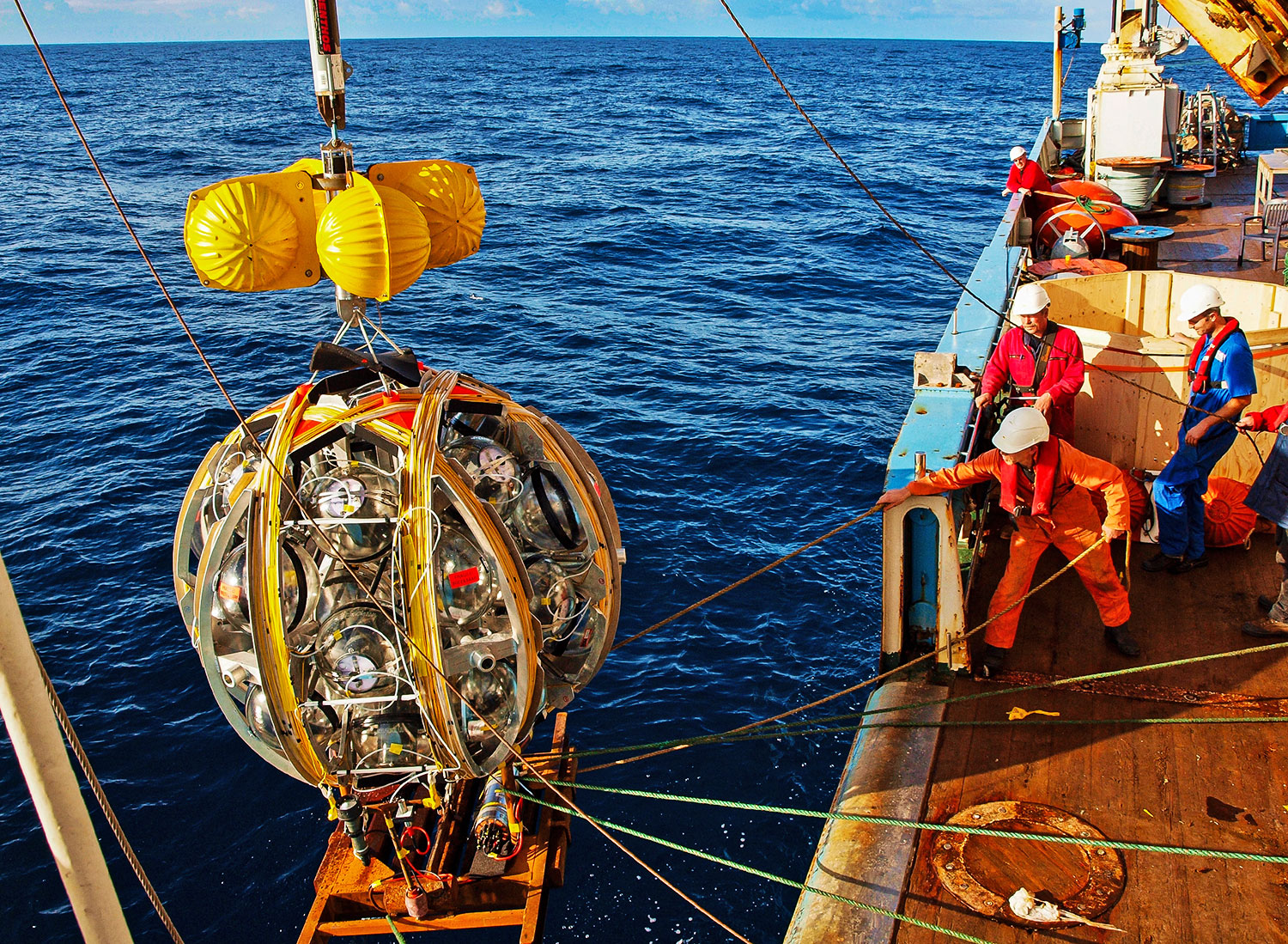
Workers prepare to deploy a string of optical sensors, which will be attached to the seafloor and unspooled
from
the spherical frame that contains them.
Others, like Evan McDonough, a theoretical physicist from the University of Winnipeg, are more confident that PBHs exist today.
Priyamvada Natarajan (Natarajan is a member of Quanta Magazine's advisory board), a theoretical astrophysicist from Yale University, says that although she thinks PBHs cannot account for more than a tiny fraction of dark matter, she is interested in them as a tool to explore ideas for dark matter outside its two most popular candidates, weakly interacting massive particles (WIMPs) and the more wavelike axions.
If primordial black holes exist, there are several ways we might find them.
For example, we might spot a signal in gravitational waves from the merger of PBHs smaller than the mass of a star but still huge enough to produce detectable gravitational waves in our instruments.
Black holes of such mass would have needed to form through primordial means.
Andrea Thamm of the University of Massachusetts, Amherst and her colleagues, meanwhile, proposed in September that exploding black holes might be more common than theorists thought and could be spotted in the near future, if we invoke some exotic physics.
In their model, they suggest that particles known as dark photons and dark electrons - dark matter variants of normal matter - could have reduced the rate at which lower-mass PBHs in the universe emitted Hawking radiation.
That could mean many more PBHs are in the final stages of evaporation today.
If that's so, Thamm and colleagues suggest that within certain constraints, there is a more than 90% chance of spotting the evaporation of a primordial black hole in the next 10 years.
A "backbone cable" connects multiple optical modules
in the KM3NET detector.
Another novel idea, proposed by Kaiser, is that if PBHs do indeed fall into the asteroid-mass range and constitute most or all of dark matter, they should occasionally fly through our solar system at hundreds of kilometers a second.
In this scenario, they might produce noticeable gravitational effects.
Using spacecraft orbiting Mars, Kaiser said, we could precisely calculate the distance from Earth to the red planet and look for any wobbles that might indicate a PBH flying past.
At any given time, he said, there would be at least one PBH in the solar system, possibly producing detectable Hawking radiation.
He is planning to work on the idea with a team of astronomers over the next couple of years.
Alongside that, Kaiser wants to keep an eye out for other high-energy neutrinos to test the idea that some might come from exploding black holes.
Proving that this is true is difficult because PBH neutrinos would look just like any other neutrinos produced from another source, unless they could be associated with a flash of gamma rays in the sky from an exploding PBH.
There is still a long way to go before we can say whether primordial black holes exist, let alone whether they make up dark matter.
But for now, scientists cannot rule out the possibility that one slipped past Earth nearly three years ago, sending a lone emissary into an underwater neutrino detector.
|