|

by Ed Whelan
February 27, 2026
from
ClasicalWisdom Website
After the Dark
Ages,
ancient Greece reborn...
It
can feel like the end of the world sometimes…
You really don't have to look far: these days, we seem
to have a fascination with the concept of social
collapse.
It's all over our movies and TV shows, and depending on
where you're looking, all over our news too.
Yet for all our modern preoccupation with collapse, we
rarely seem to consider the path back, how society can
be rebuilt after catastrophes.
And not only can societies come back from massive
disasters, they can find their feet again, and flourish.
This is what the ancient Greeks accomplished in the
Archaic Age, the time of the likes of the poetess Sappho
and the lawgiver Solon.
It's an astonishing period, when ancient Greek society
rebuilt itself after the chaos of the Bronze Age
Collapse and the subsequent Greek Dark Ages, and laid
the foundations for greater glories yet to come.
These are the often-overshadowed achievements of Greece
before its golden age in the time of Socrates and
Pericles.
So, it can help to remember that what seems like "the
end of the world" really isn't 'the end of the world'.
I truly hope your society doesn't collapse, but if it
does… remember, there's always a way back...!
Sean Kelly
Managing Editor
Classical Wisdom
I think we all have at least some familiarity with the achievements
of Classical Greece.
The era produced great art, philosophies, and
political systems that still influence us to this day...
However, the
Classical Period was born out of
the
Archaic Period, dating from the 8th
century BC until the second Persian invasion (480 BC).
This is the era when Greece emerged
from
the Dark Ages...
It was also a period that transformed Greece, laying the foundations
for not only the Classical age but all of Graeco-Roman Civilization.
The End of the Dark Ages
The 8th century BC saw several rapid socio-economic
changes in Greece.
International trade revived, and many Greek
communities began to specialize in products for foreign markets.
This, in turn, encouraged the development of a new economy based on
money, and this new economy grew.
At the same time, more arable land came under
cultivation, and the population grew rapidly.
The era also marked important cultural changes, such as the
introduction of a new alphabet based on the Phoenician model. This
led to the development of written Greek literature based on the oral
tradition.
It was at this time that the Homeric epics
were written down and
Hesiod wrote his didactic poem,
Works, and Days.
Lyric poetry also emerged, with
Sappho and
Pindar leading the way.

Sappho
by John William
Godward, 1910
In the 6th century BC, poetry contests in honor of the
god of wine led to the first dramatic performances in Athens.
It was during the Archaic period that Greek
literature began and in which some of its greatest works were
produced.
Increased international trade led to greater
cultural exchange, producing more realistic and naturalistic
sculptures.
The growing need for vessels to store food
spurred advances in pottery, and this became a Greek art form.
Decorated earthenware, often portraying mythic scenes, became
extremely popular all over the Mediterranean.
Also at this time the Greeks revived the
Olympic Games, which continued uninterrupted for a millennium.
The Age of Colonization
Due to overpopulation, many Greeks were obliged to look for
new lands.
Colonists set out to look for new opportunities,
and Greek outposts were soon established in the Black Sea area and
as far as Spain.
These communities maintained their cultural
identity, and their settlements soon grew into towns and even
cities.
The Archaic period saw the expansion of the Greek
world.
Some colonies, such as Syracuse,
went on to play a key role in the development of the Hellenic world.
Military Reforms
The Archaic period also saw changes in the way the Hellenes
engaged in conflict.
Growing prosperity ensured more soldiers could
afford armor.
The hoplite, or heavy infantryman,
came to dominate the battlefield for centuries.
The phalanx was developed.
New naval technologies also came into
play, producing the first triremes, or warships.
These allowed the Hellenes to dominate much of
the Mediterranean.
The Growth of Cities
One of the key developments of the Archaic period was
urbanization.
The Greek polis, literally "city," came
into being. In some places, such as Athens, the polis was the
result of several communities coming together.
The polis led to the development of the
city-state.
Athens, Thebes, Corinth, and Sparta all
developed as cities during the Archaic period.
Increasingly, the inhabitants of the new cities
saw themselves as citizens of the polis, instead of
identifying with a tribe or clan.
This new urban lifestyle produced important
cultural and social changes.
To govern the new cities, constitutions and
laws were developed.
The Greeks developed the art of politics
and the basic principles of law.
The Politics of the Archaic Age
While rural Greece was controlled by elites, in the cities - due to
the breakdown of tribes and clans - classes emerged.
This doesn't mean that the rich, who were often
members of the old aristocracy, didn't try to dominate the
polis. Many city-states, such as Corinth, were dominated
by oligarchies that used their wealth and prestige to maintain
power.
The poor were oppressed, and some were even
enslaved due to debts.
Meanwhile, the rising class of traders
wanted a greater say in the government.
This led to increasing social and political
unrest.
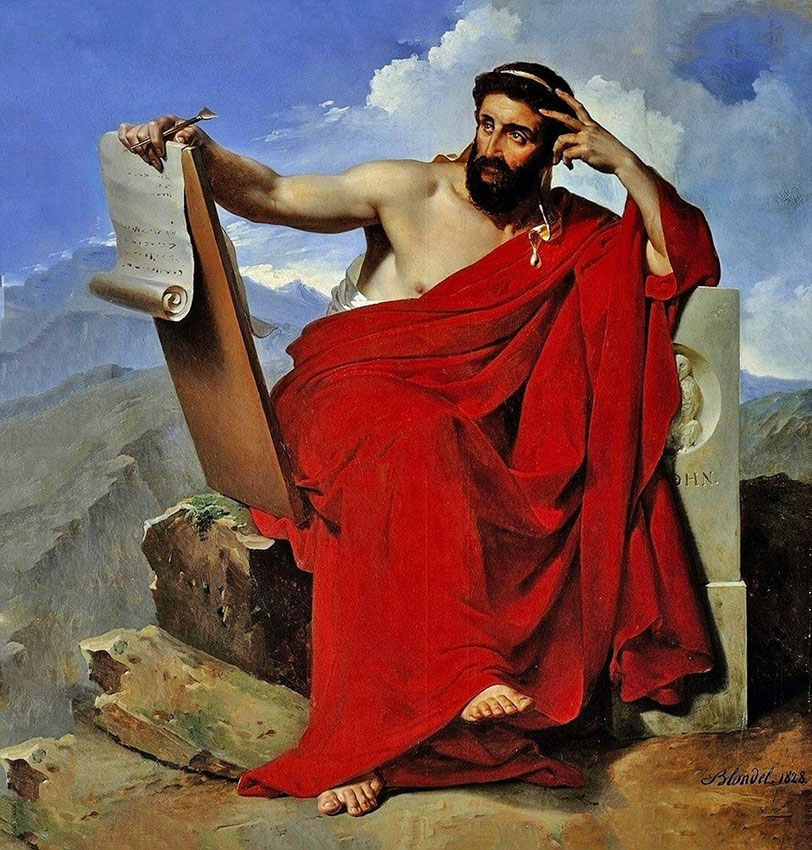
In Athens,
Solon the lawgiver issued
reforms aimed at diffusing tension by addressing inequality.

Solon
by Merry Joseph
Blondel, 1828
Not all Greek cities did likewise, opening the door for populists to
come to power in many urban centers.
Cypselus, for example, seized
power in Corinth in 655 BC.
These populists became tyrants in many
Greek cities, including Athens.
However, they were not tyrants in the
modern sense - rather, they ruled by illegal and
non-traditional means.
Indeed, the Athenian tyrant
Peisistratus did much to
improve the city and was a patron of the arts in the 6th
century BC.
However, many became corrupt over time and the population
became restive. Those who served as hoplites in the army wanted more
power.
This led to the growth of democratic
ideas in many cities:
ideas that would lead to the widespread
adoption of democratic ideas in Athens and elsewhere in Greece
in the 5th century BC.
Power and Politics in the Archaic
Age
The
Archaic age saw the rise of the two
powers that would dominate the Greek world.
Athens became a serious military and naval
power.
Sparta fought three wars with
the
Messenian, who inhabited the
southwestern Peloponnese, eventually dominating and enslaving
them.
In order to maintain control over growing territory, Sparta
developed a society based on military principals and became the
greatest land power in the region.
By 550 BC, it had dominated all of the
Peloponnese.
The Archaic period thus saw the emergence of
these two powerful Greek city-states, whose rivalry and cooperation
would determine the politics of the Hellenic world until the rise of
Macedonia.
Conclusion
The Archaic period was crucial to the civilization of Greece.
It was a time that saw the emergence of Hellenic
literature and art. The growth of cities transformed the lives of
people and led to the development of politics and the law.
The Greek military saw innovation and expansion,
and the Greeks colonized many parts of the Mediterranean.
What they achieved in the Archaic Age laid
the foundations not only for the glories and achievements of
Classical Greece, but also that of the modern world...
|