The Influence of Sea Power
Upon History
by A. T. Mahan
National Character
The effect
of national character and aptitudes
upon the
development of sea power
will next be
considered...
If sea power be really based upon a peaceful and extensive
commerce, aptitude for commercial pursuits must be a
distinguishing feature of the nations that have at one time or
another been great upon the sea.
History almost without
exception affirms that this is true. Save the Romans, there is
no marked instance to the contrary.
All men seek gain and, more or less, love money; but the way in
which gain is sought will have a marked effect upon the
commercial fortunes and the history of the people inhabiting a
country.
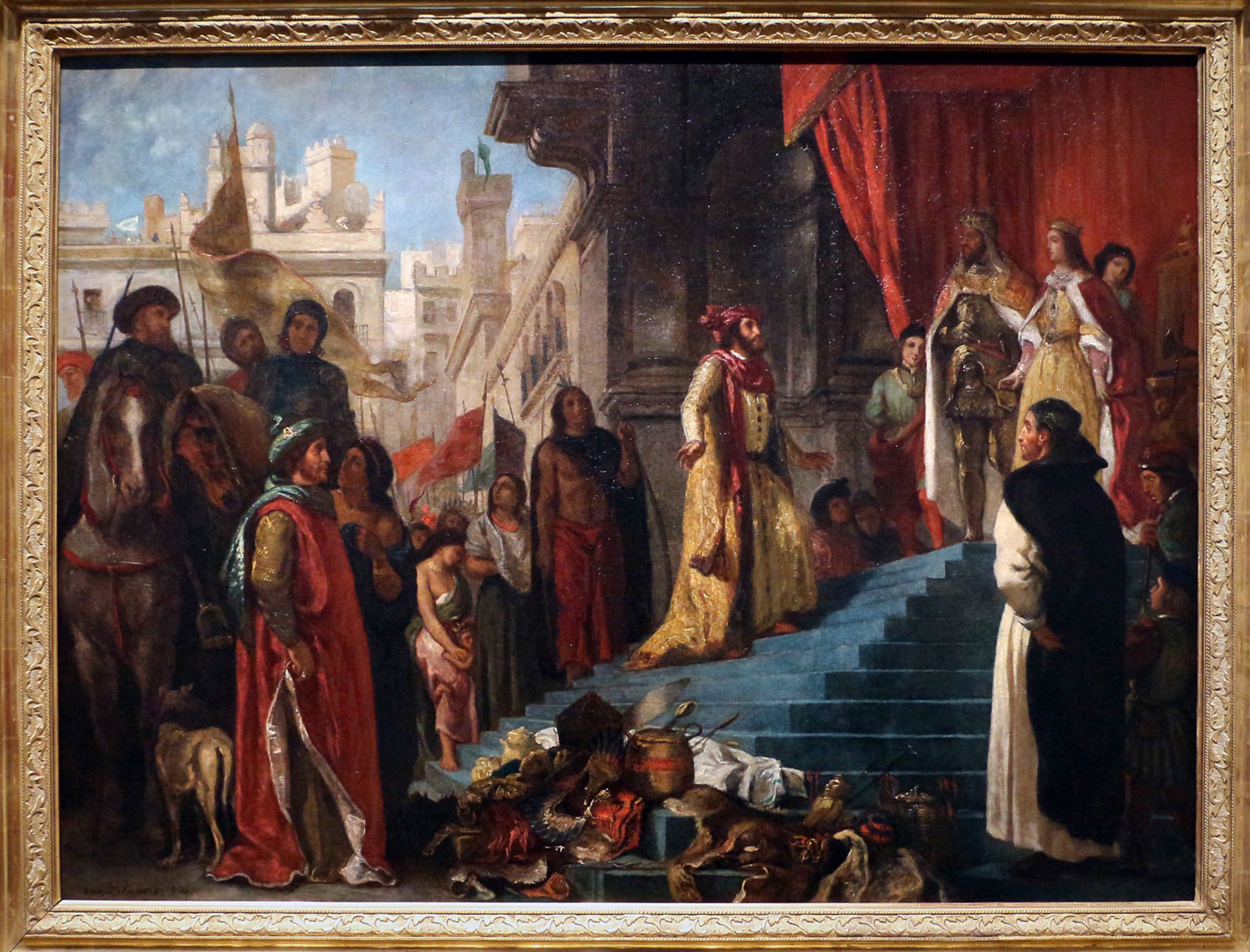
If history may be believed, the way in which the Spaniards and
their kindred nation, the Portuguese, sought wealth, not only
brought a blot upon the national character, but was also fatal
to the growth of a healthy commerce; and so to the industries
upon which commerce lives, and ultimately to that national
wealth which was sought by mistaken paths.
The desire for gain
rose in them to fierce avarice; so they sought in the new-found
worlds which gave such an impetus to the commercial and maritime
development of the countries of Europe, not new fields of
industry, not even the healthy excitement of exploration and
adventure, but gold and silver.
They had many great qualities;
they were bold, enterprising, temperate, patient of suffering,
enthusiastic, and gifted with intense national feeling.
When to
these qualities are added the advantages of Spain's position and
well-situated ports, the fact that she was first to occupy large
and rich portions of the new worlds and long remained without a
competitor, and that for a hundred years after the discovery of
America she was the leading State in Europe, she might have been
expected to take the foremost place among the sea powers.
Exactly the contrary was the result, as all know.
Since the
battle of Lepanto in 1571, though engaged in many wars, no sea
victory of any consequence shines on the pages of Spanish
history; and the decay of her commerce sufficiently accounts for
the painful and sometimes ludicrous inaptness shown on the decks
of her ships of war. Doubtless such a result is not to be
attributed to one cause only.
Doubtless the government of Spain
was in many ways such as to cramp and blight a free and healthy
development of private enterprise; but the character of a great
people breaks through or shapes the character of its government,
and it can hardly be doubted that had the bent of the people
been toward trade, the action of government would have been
drawn into the same current.
The great field of the colonies,
also, was remote from the centre of that despotism which
blighted the growth of old Spain. As it was, thousands of
Spaniards, of the working as well as the upper classes, left
Spain; and the occupations in which they engaged abroad sent
home little but specie, or merchandise of small bulk, requiring
but small tonnage.
The mother-country herself produced little
but wool, fruit, and iron; her manufactures were naught; her
industries suffered; her population steadily decreased.
Both she
and her colonies depended upon the Dutch for so many of the
necessaries of life, that the products of their scanty
industries could not suffice to pay for them.
"So that Holland
merchants," writes a contemporary, "who carry money to most
parts of the world to buy commodities, must out of this single
country of Europe carry home money, which they receive in
payment of their goods."
Thus their eagerly sought emblem of
wealth passed quickly from their hands. It has already been
pointed out how weak, from a military point of view, Spain was
from this decay of her shipping.
Her wealth being in small bulk
on a few ships, following more or less regular routes, was
easily seized by an enemy, and the sinews of war paralyzed;
whereas the wealth of England and Holland, scattered over
thousands of ships in all parts of the world, received many
bitter blows in many exhausting wars, without checking a growth
which, though painful, was steady.
The fortunes of Portugal,
united to Spain during a most critical period of her history,
followed the same downward path: although foremost in the
beginning of the race for development by sea, she fell utterly
behind.
"The mines of Brazil were the ruin of Portugal, as those
of Mexico and Peru had been of Spain; all manufactures fell into
insane contempt; ere long the English supplied the Portuguese
not only with clothes, but with all merchandise, all
commodities, even to salt-fish and grain.
After their gold, the
Portuguese abandoned their very soil; the vineyards of Oporto
were finally bought by the English with Brazilian gold, which
had only passed through Portugal to be spread throughout
England."
We are assured that in fifty years, five hundred
millions of dollars were extracted from,
"the mines of Brazil,
and that at the end of the time Portugal had but twenty-five
millions in specie,"
...a striking example of the difference
between real and fictitious wealth.
The English and Dutch were no less desirous of gain than the
southern nations.
Each in turn has been called "a nation of
shopkeepers;" but the jeer, in so far as it is just, is to the
credit of their wisdom and uprightness. They were no less bold,
no less enterprising, no less patient. Indeed, they were more
patient, in that they sought riches not by the sword but by
labor, which is the reproach meant to be implied by the epithet;
for thus they took the longest, instead of what seemed the
shortest, road to wealth.
But these two peoples, radically of
the same race, had other qualities, no less important than those
just named, which combined with their surroundings to favor
their development by sea. They were by nature business-men,
traders, producers, negotiators.
Therefore both in their native
country and abroad, whether settled in the ports of civilized
nations, or of barbarous eastern rulers, or in colonies of their
own foundation, they everywhere strove to draw out all the
resources of the land, to develop and increase them.
The quick
instinct of the born trader, shopkeeper if you will, sought
continually new articles to exchange; and this search, combined
with the industrious character evolved through generations of
labor, made them necessarily producers.
At home they became
great as manufacturers; abroad, where they controlled, the land
grew richer continually, products multiplied, and the necessary
exchange between home and the settlements called for more ships.
Their shipping therefore increased with these demands of trade,
and nations with less aptitude for maritime enterprise, even
France herself, great as she has been, called for their products
and for the service of their ships.
Thus in many ways they
advanced to power at sea. This natural tendency and growth were
indeed modified and seriously checked at times by the
interference of other governments, jealous of a prosperity which
their own people could invade only by the aid of artificial
support - a support which will be considered under the head of
governmental action as affecting sea power.
The tendency to trade, involving of necessity the production of
something to trade with, is the national characteristic most
important to the development of sea power.
Granting it and a
good seaboard, it is not likely that the dangers of the sea, or
any aversion to it, will deter a people from seeking wealth by
the paths of ocean commerce. Where wealth is sought by other
means, it may be found; but it will not necessarily lead to sea
power. Take France. France has a fine country, an industrious
people, an admirable position.
The French navy has known periods
of great glory, and in its lowest estate has never dishonored
the military reputation so dear to the nation.
Yet as a maritime
State, securely resting upon a broad basis of sea commerce,
France, as compared with other historical sea-peoples, has never
held more than a respectable position. The chief reason for
this, so far as national character goes, is the way in which
wealth is sought.
As Spain and Portugal sought it by digging
gold out of the ground, the temper of the French people leads
them to seek it by thrift, economy, hoarding. It is said to be
harder to keep than to make a fortune.
Possibly; but the
adventurous temper, which risks what it has to gain more, has
much in common with the adventurous spirit that conquers worlds
for commerce. The tendency to save and put aside, to venture
timidly and on a small scale, may lead to a general diffusion of
wealth on a like small scale, but not to the risks and
development of external trade and shipping interests.
To
illustrate - and the incident is given only for what it is worth
- a French officer, speaking to the author about the Panama
Canal, said:
"I have two shares in it. In France we don't do as
you, where a few people take a great many shares each. With us a
large number of people take one share or a very few. When these
were in the market my wife said to me, 'You take two shares, one
for you and one for me'."
As regards the stability of a man's
personal fortunes this kind of prudence is doubtless wise; but
when excessive prudence or financial timidity becomes a national
trait, it must tend to hamper the expansion of commerce and of
the nation's shipping.
The same caution in money matters,
appearing in another relation of life, has checked the
production of children, and keeps the population of France
nearly stationary.
The noble classes of Europe inherited from the Middle Ages a
supercilious contempt for peaceful trade, which has exercised a
modifying influence upon its growth, according to the national
character of different countries.
The pride of the Spaniards
fell easily in with this spirit of contempt, and co-operated
with that disastrous unwillingness to work and wait for wealth
which turned them away from commerce. In France, the vanity
which is conceded even by Frenchmen to be a national trait led
in the same direction.
The numbers and brilliancy of the
nobility, and the consideration enjoyed by them, set a seal of
inferiority upon an occupation which they despised. Rich
merchants and manufacturers sighed for the honors of nobility,
and upon obtaining them, abandoned their lucrative professions.
Therefore, while the industry of the people and the fruitfulness
of the soil saved commerce from total decay, it was pursued
under a sense of humiliation which caused its best
representatives to escape from it as soon as they could. Louis
XIV., under the influence of Colbert, put forth an ordinance,
"authorizing all noblemen to take an interest in merchant ships,
goods and merchandise, without being considered as having
derogated from nobility, provided they did not sell at retail;"
and the reason given for this action was, "that it imports the
good of our subjects and our own satisfaction, to efface the
relic of a public opinion, universally prevalent, that maritime
commerce is incompatible with nobility."
But a prejudice
involving conscious and open superiority is not readily effaced
by ordinances, especially when vanity is a conspicuous trait in
national character; and many years later Montesquieu taught that
it is contrary to the spirit of monarchy that the nobility
should engage in trade.
In Holland there was a nobility; but the State was republican in
name, allowed large scope to personal freedom and enterprise,
and the centers of power were in the great cities. The
foundation of the national greatness was money - or rather wealth.
Wealth, as a source of civic distinction, carried with it also
power in the State; and with power there went social position
and consideration. In England the same result obtained. The
nobility were proud; but in a representative government the
power of wealth could be neither put down nor overshadowed.
It
was patent to the eyes of all; it was honored by all; and in
England, as well as Holland, the occupations which were the
source of wealth shared in the honor given to wealth itself.
Thus, in all the countries named, social sentiment, the outcome
of national characteristics, had a marked influence upon the
national attitude toward trade.
In yet another way does the national genius affect the growth of
sea power in its broadest sense; and that is in so far as it
possesses the capacity for planting healthy colonies. Of
colonization, as of all other growths, it is true that it is
most healthy when it is most natural.
Therefore colonies that
spring from the felt wants and natural impulses of a whole
people will have the most solid foundations; and their
subsequent growth will be surest when they are least trammelled
from home, if the people have the genius for independent action.
Men of the past three centuries have keenly felt the value to
the mother-country of colonies as outlets for the home products
and as a nursery for commerce and shipping; but efforts at
colonization have not had the same general origin, nor have
different systems all had the same success.
The efforts of
statesmen, however far-seeing and careful, have not been able to
supply the lack of strong natural impulse; nor can the most
minute regulation from home produce as good results as a happier
neglect, when the germ of self-development is found in the
national character.
There has been no greater display of wisdom
in the national administration of successful colonies than in
that of unsuccessful. Perhaps there has been even less.
If
elaborate system and supervision, careful adaptation of means to
ends, diligent nursing, could avail for colonial growth, the
genius of England has less of this systematizing faculty than
the genius of France; but England, not France, has been the
great colonizer of the world.
Successful colonization, with its
consequent effect upon commerce and sea power, depends
essentially upon national character; because colonies grow best
when they grow of themselves, naturally. The character of the
colonist, not the care of the home government, is the principle
of the colony's growth.
This truth stands out the clearer because the general attitude
of all the home governments toward their colonies was entirely
selfish. However founded, as soon as it was recognized to be of
consequence, the colony became to the home country a cow to be
milked; to be cared for, of course, but chiefly as a piece of
property valued for the returns it gave.
Legislation was
directed toward a monopoly of its external trade; the places in
its government afforded posts of value for occupants from the
mother-country; and the colony was looked upon, as the sea still
so often is, as a fit place for those who were ungovernable or
useless at home. The military administration, however, so long
as it remains a colony, is the proper and necessary attribute of
the home government.
The fact of England's unique and wonderful success as a great
colonizing nation is too evident to be dwelt upon; and the
reason for it appears to lie chiefly in two traits of the
national character.
The English colonist naturally and readily
settles down in his new country, identifies his interest with
it, and though keeping an affectionate remembrance of the home
from which he came, has no restless eagerness to return. In the
second place, the Englishman at once and instinctively seeks to
develop the resources of the new country in the broadest sense.
In the former particular he differs from the French, who were
ever longingly looking back to the delights of their pleasant
land; in the latter, from the Spaniards, whose range of interest
and ambition was too narrow for the full evolution of the
possibilities of a new country.
The character and the necessities of the Dutch led them
naturally to plant colonies; and by the year 1650 they had in
the East Indies, in Africa, and in America a large number, only
to name which would be tedious. They were then far ahead of
England in this matter.
But though the origin of these colonies,
purely commercial in its character, was natural, there seems to
have been lacking to them a principle of growth.
"In planting
them they never sought an extension of empire, but merely an
acquisition of trade and commerce. They attempted conquest only
when forced by the pressure of circumstances. Generally they
were content to trade under the protection of the sovereign of
the country."
This placid satisfaction with gain alone,
unaccompanied by political ambition, tended, like the despotism
of France and Spain, to keep the colonies mere commercial
dependencies upon the mother-country, and so killed the natural
principle of growth.
Before quitting this head of the inquiry, it is well to ask how
far the national character of Americans is fitted to develop a
great sea power, should other circumstances become favorable.
It seems scarcely necessary, however, to do more than appeal to
a not very distant past to prove that, if legislative hindrances
be removed, and more remunerative fields of enterprise filled
up, the sea power will not long delay its appearance.
The
instinct for commerce, bold enterprise in the pursuit of gain,
and a keen scent for the trails that lead to it, all exist; and
if there be in the future any fields calling for colonization,
it cannot be doubted that Americans will carry to them all their
inherited aptitude for self-government and independent growth.