|

by Dr. Mark Sircus
June 15, 2026
from
DrSircus Website
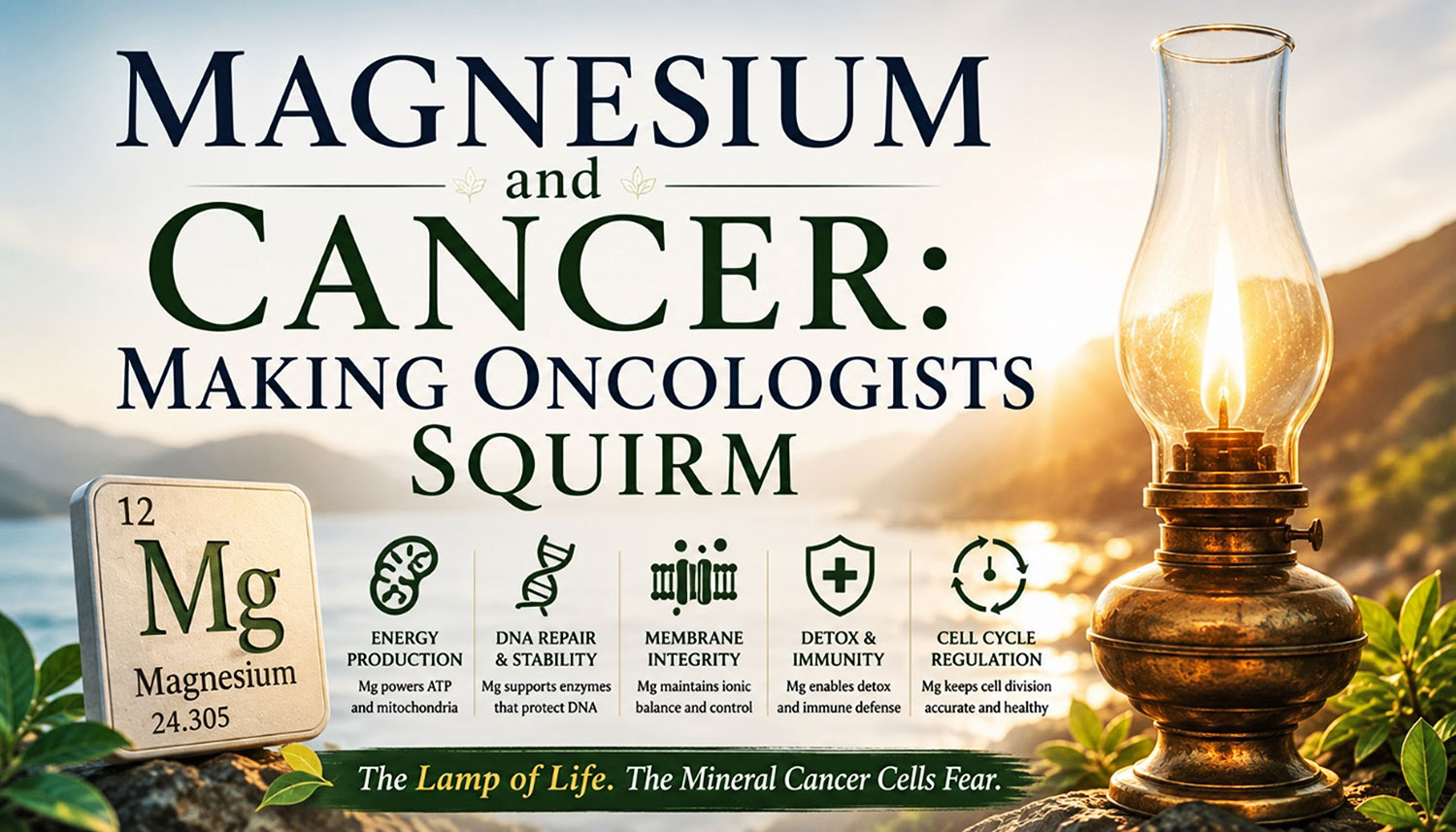
It all comes down to the ATP-Magnesium-Cancer Axis.
Dr. Boyd Haley expresses the biochemical
core of the truth about this:
“ATP without Mg²⁺ bound cannot create the
energy normally used by specific enzymes of the body to make
protein, DNA, RNA, transport sodium or potassium or calcium in
and out of cells, nor to phosphorylate proteins in response to
hormone signals.
ATP without enough Mg²⁺ is non-functional and
leads to cell death.”
This is not alternative biochemistry. It's
standard.
Every ATP molecule in the body exists as
Mg-ATP.
The magnesium holds the triphosphate in the
correct stereochemical configuration.
Without it, the phosphate backbone is
misaligned, the nucleophilic attack can't happen, and energy
transfer fails.
Cancer begins when mitochondrial
oxidative phosphorylation fails and cells revert to fermentation
- the
Warburg effect, described in the
1920s, still the most consistent metabolic signature of malignancy
across cancer types.
What causes that mitochondrial failure?
Many things.
But magnesium deficiency makes
it inevitable.
If Mg-ATP cannot be made, oxidative
phosphorylation cannot proceed.
The cell must ferment or die.
Some die.
Some survive by switching to glycolysis
permanently.
Those are cancer cells.
The 90-Year History that Vanished
The evidence that
magnesium is relevant to cancer
is not new.
It is not speculative.
It is not based on a single unreplicated
study.
It spans nine decades and multiple
continents.
-
Pierre Delbet, 1930s.
Superintendent of the Cancer Institute in
Paris. Inoculated rabbits with cancer virus. Fifty percent
received magnesium chloride. All of those recovered. The
majority of untreated rabbits died.
He advocated magnesium chloride
prophylaxis for everyone past middle life. This was
published. This was known. This was then forgotten.
-
Egypt, 1931.
Dr. Schrumpf-Pierron presented to the
Academy of Medicine in Paris on the rarity of cancer in
Egypt. The cancer rate was roughly 10% of Europe and
America. In rural populations, it was practically
nonexistent.
The magnesium intake was 2.5-3 grams
daily - ten times the Western intake. This was presented to
the French Academy of Medicine. It was published.
It was then ignored.
-
The soil and water studies.
Inverse relationship between magnesium
content of soil and drinking water and cancer rates,
documented in multiple countries over 50 years.
Ukraine: low magnesium soil, high stomach
cancer. Armenia: high magnesium soil, low stomach cancer.
Poland: three-fold higher cancer death rate in the
magnesium-poor community versus the magnesium-rich one.
These are not small differences.
They are population-level signals that
should have triggered decades of investigation.
-
Japan, 2010.
The National Cancer Center in Tokyo:
52% lower colon cancer risk in men
with the highest magnesium intake (≥327 mg/day) versus
the lowest. 87,117 people followed for eight years.
Published in the Journal of Nutrition.
This is not a case report. This is a major prospective
cohort study from a world-class institution.
-
Pancreatic cancer, 2015.
The VITamins and Lifestyle study: 76%
increase in pancreatic cancer incidence in those below the
magnesium RDA versus those meeting or exceeding it.
For every 100 mg/day decrease in
magnesium intake, a 24% increase in pancreatic cancer. And
the effect was strongest in those taking supplements -
dietary magnesium alone was not enough.
This is published in the British Journal
of Cancer.
-
Hypomagnesemia in cancer patients,
2000.
46% of patients admitted to an ICU in a
tertiary cancer center were hypomagnesemic. Nearly half. And
that's by serum testing, which as you've already established
underestimates true deficiency.
The actual intracellular magnesium
deficit in that population was almost certainly higher.
The
Membrane Mechanism
The connection between magnesium deficiency and membrane changes
is one of the more overlooked pieces of this puzzle.
Magnesium-deficient cells show
decreased membrane viscosity and increased permeability - the same
changes seen in leukemia cells. The membrane becomes smoother, more
fluid, less regulated.
Ionic flux across the membrane goes
haywire:
calcium and sodium rise inside the cell,
magnesium and potassium fall.
This is not a minor change.
The cell membrane is the cell's interface with
its environment. It controls what enters and leaves. It maintains
the electrochemical gradients that make life possible.
When magnesium deficiency degrades membrane
integrity, the cell loses control of its internal environment. This
is the kind of disruption that can push a cell from regulated
behavior to dysregulated behavior - from normal to malignant.
The lead toxicity connection reinforces this.
Lead salts are more leukemogenic in
magnesium-deficient rats than in magnesium-adequate rats.
Magnesium is protective against a known
carcinogen.
This is not because magnesium chelates lead
directly - it's because magnesium-sufficient cells have the ATP to
run detoxification systems that magnesium-deficient cells cannot
run.
The Cell Cycle Connection
Magnesium controls the timing of the cell cycle.
Intracellular magnesium concentration falls as
cells enlarge, until it reaches a level that permits spindle
formation. Then magnesium influx triggers spindle breakdown and cell
division.
This is the cell cycle's magnesium clock...
When magnesium is chronically low, this clock is disrupted. The cell
cycle becomes dysregulated. DNA replication proceeds without
adequate magnesium for DNA repair enzymes. Chromosomal instability
increases.
The conditions for malignant transformation are
created not by a single mutagenic hit but by the ongoing failure of
the cellular machinery that prevents errors from accumulating.
What This Means for Treatment
Cancer patients,
should be flooded with magnesium -
multiple forms, multiple routes - follows logically from the
evidence.
-
if magnesium deficiency is carcinogenic
-
if magnesium repletion reverses
periosteal tumors
-
if magnesium is required for every
ATP-dependent detoxification pathway,
...then a cancer patient with low magnesium
status is fighting with both hands tied.
-
IV magnesium chloride for acute
repletion.
-
Oral magnesium in bioavailable forms for
maintenance.
-
Transdermal magnesium to bypass GI
limitations.
-
Magnesium baths for systemic absorption
and pain relief.
-
Nebulized magnesium for direct lung
delivery in thoracic cancers.
This is not alternative medicine.
It's physiological support for the body's own
energy and repair systems.
The fact that 46% of critically ill cancer patients are
hypomagnesemic, and that oncologists do not routinely assess or
replete magnesium as part of cancer care, is not a gap in the
literature.
It's medical negligence on a systemic scale.
The Delbet Question
Pierre Delbet's work raises a
question that should haunt oncology:
if magnesium chloride prophylaxis prevents
cancer, and if magnesium chloride treatment helps resolve
established cancer, why did this line of investigation die?
The answer is the same for many common
substances.
Magnesium chloride cannot be patented. It
costs pennies per gram.
No pharmaceutical company will fund the
trials.
No oncology guideline will recommend it.
No medical school will teach it.
The evidence is not suppressed in the sense of
being hidden in a vault.
It is suppressed in the sense of being published
in plain sight and then ignored by a profession that has been
trained, funded, and incentivized to ignore it.
Delbet's rabbits recovered.
The untreated ones died...
That result is 90 years old.
The fact that it has not been systematically
followed up is not a scientific failure.
It is an institutional choice...!
|