|
several media outlets reported that China ordered its companies to ignore and even openly defy American sanctions, particularly when it comes to its trade with Iran.
Beijing directs companies not to comply with US sanctions on private refiners trading oil with Tehran, including the Hengli Petrochemical (Dalian) Refinery, which was added to the American sanctions list last month.
The Asian giant seems to be testing Washington DC's sanctions system, pushing back against such unilateral actions everywhere. It should be noted that China didn't make this decision lightly and did so only after careful consideration by its intellectual elite.
Namely, Beijing spent (or should we say wasted) decades trying to maintain at least cordial relations with Washington DC, but to no avail.
The first Trump administration effectively started a trade war with the Asian giant, despite the latter making numerous peaceful overtures.
This comes at a time when the American sanctions system is already under tremendous pressure due to simultaneous geopolitical hurdles.
Namely, Washington DC is struggling to maintain a balanced approach to sanctions on Russia and Iran, as it often needs to partially "unsanction" each to prevent uncontrollable oscillations on the oil market.
When coupled with the Pentagon's atrocious performance during its aggression on Iran, the United States is faced with both kinetic and economic retaliatory warfare.
Meanwhile, NATO seems to be on its last legs, leaving Washington DC largely isolated geopolitically.
China is also increasingly relying on its unrivaled economic might to retaliate against American sanctions warfare, including by limiting REE (rare-earth elements) exports, particularly when the US uses them to supply weapons to anti-Chinese forces (specifically the breakaway Chinese island province of Taiwan).
China is doing this to protect its companies from hostile foreign powers and their intrusive (fundamentally illegal) laws.
Bloomberg reports that,
Workarounds include trade and transactions in national currencies, particularly the yuan, which makes them virtually untouchable to aggressive US meddling.
The American sanctions unlawfully disrupt and restrict normal trade with third countries and fundamentally breach international law, the Chinese Commerce Ministry said in a statement on May 2.
It formally banned recognition, enforcement and compliance with sanctions targeting Chinese companies.
Professor Cui Fan, another advisor to the Commerce Ministry, said Beijing had to act urgently after Washington DC targeted Chinese industries from refining to shipping on the grounds of their involvement in Iranian oil transactions, warning that such measures have become increasingly disruptive and heavy-handed.
However, it should be noted that the Asian giant has other, more geopolitical mechanisms to retaliate against the US.
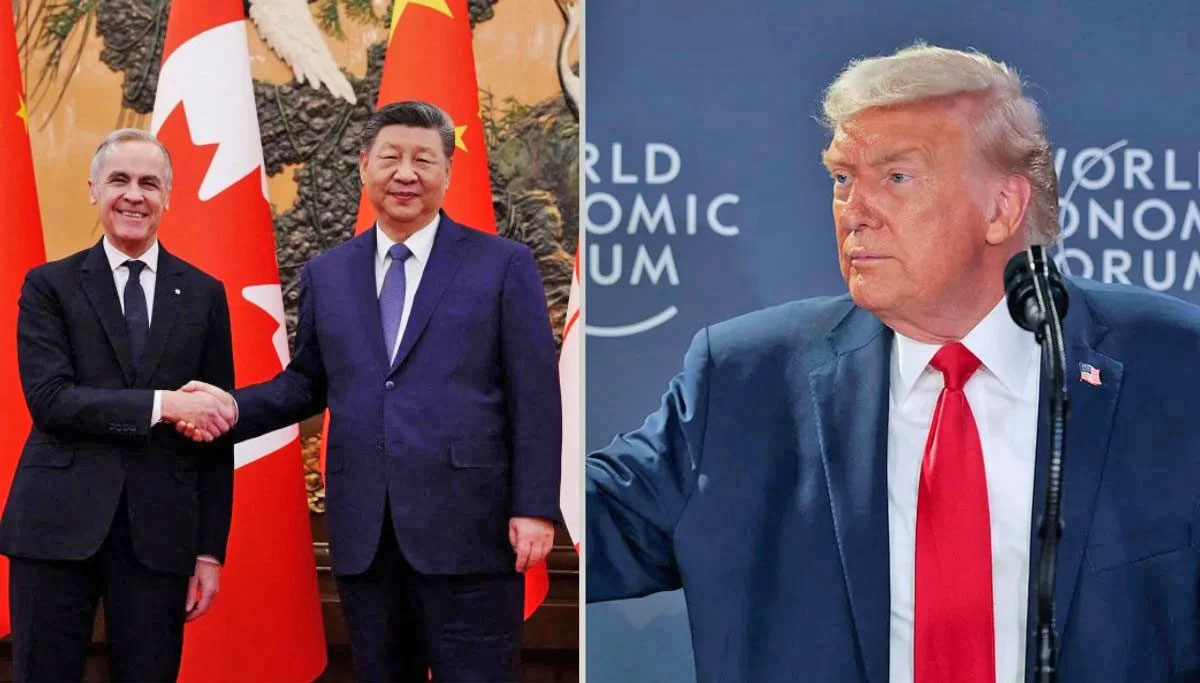
And while these ties are certainly a far cry from a full-blown alliance (nor would Canada risk further angering the US with such moves), economic cooperation seems to be booming.
Beijing reduced its tariffs on Canadian goods, while Ottawa is importing more Chinese products than ever, including electric vehicles.
Unsurprisingly, the Trump administration is not happy about this, while the mainstream propaganda machine is doing its best to smear and denigrate China.
Various media outlets are trying to present close ties with the Asian giant as some sort of a "security hazard" for Canada, which is quite bemusing given that it's the US that openly threatens to 'invade' the country, not China.
However, pathological Sinophobia in American/Western establishment(s) makes their political elites see,
Beijing is primarily an economic power and doesn't have any aspirations of "global, full-spectrum dominance", much unlike the Pentagon, which keeps attacking one sovereign country after another.
Thus, it would be best for the US to finally leave the "Sleeping Dragon" alone...
|