|

by Eric Buesing
October 22, 2026
from
GlobalResearch Website
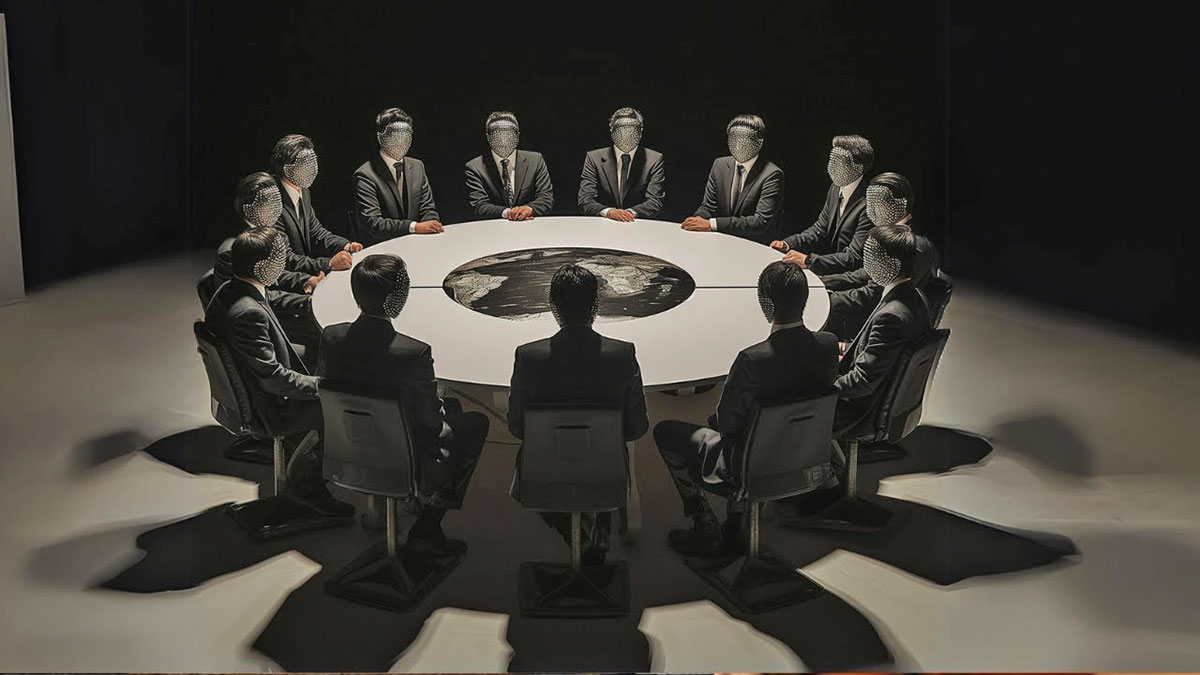
A peer-reviewed network study
showed a tightly interlocked
"super-entity"
of financial institutions controls 40%
of all
transnational corporate wealth...
In 2007, a tightly linked group of 147 firms, mostly financial, held
nearly 40 percent of the control over the economic value of the
world's transnational corporations. 1
The United States has stopped
asking domestic companies to name their owners. 2
Together,
concentrated control and hidden ownership put power where voters
can't see it or check it.
In October 2011, three systems theorists at the Swiss Federal
Institute of Technology in Zurich published "The Network of Global
Corporate Control." 3
Its authors called it the first investigation of
the architecture of the international ownership network. 4
Most
people have never heard of it.
The Map
Stefania Vitali and her coauthors James Glattfelder and
Stefano Battiston set out to put numbers on a suspicion many people already
held:
that a handful of corporations dominates the
global economy. 5
They started with Orbis 2007, a commercial database of about 37
million companies and investors.
From it they pulled 43,060
transnational corporations in 116 countries, which are companies
that operate in more than one country.
Then they traced the
ownership chains running into and out of those companies. The result
was a network of about 600,000 entities joined by just over one
million ownership ties. 6
Ownership runs in loops.
Say Company A owns shares in Company B, and
Company B owns shares back in Company A.
Control flows up through
links like that, and some shareholders end up very powerful.
7
The
researchers built a new method so the loops wouldn't inflate the
totals. 8
Who Holds the Control
The network formed a giant bow tie. At its center sat a very small,
very dense core of 1,318 companies out of 43,060. 9
Each core member was tied to about 20 others, and
about three quarters of the ownership of core firms stayed with
other core firms. 10
Inside that core sat 147 firms the authors called an economic
super entity.
They held nearly 40 percent of the control
over the economic value of all the transnational corporations in
the study, measured by operating revenue, which is the money a
company earns from its business.
They also had almost full control over
themselves. 11
That's 147 companies out of more than 43,000.
In Glattfelder's
words,
less than 1 percent of the companies controlled 40 percent of
the network. 12
The concentration held under all three models the
authors used to estimate control. 13
The 2007 top ten ran Barclays, Capital Group, FMR, AXA, State
Street, JPMorgan Chase, Legal & General, Vanguard, UBS and Merrill
Lynch.
Goldman Sachs ranked 18th and
Morgan Stanley 21st. The top 50 spanned ten
countries. 14 That list has been rearranged since, mostly by mergers.
BlackRock
isn't on it by name because it didn't own Barclays Global Investors
until it bought that Barclays unit in December 2009. 15
Lehman Brothers, ranked 34th,
collapsed in September 2008. 16
Bank of
America, ranked 25th, bought Merrill Lynch, ranked tenth, on January
1, 2009. 17
UBS, ranked ninth, took over Credit Suisse, ranked 14th,
in June 2023. 18
Franklin Resources, ranked 13th,
bought Legg Mason, ranked 20th, in July 2020.
19
On October 1, 2026, Nuveen, which TIAA
owns, completed its purchase of Schroders. TIAA ranked 29th and Schroders 32nd.
20
Four of those deals folded one top 50 firm into
another.
Three quarters of the core were financial firms.
21
Banks and
investment firms move the world's capital.
They decide who gets
loans and which industries get investment, so some thrive and others
starve.
Whoever controls that flow controls more than their
shareholdings suggest.
The authors wrote that the top holders are in
a position to exert considerable control, through votes at
shareholder and board meetings or through informal negotiation.
22
Why Concentration Matters
Tight links make a network fragile.
The authors warned that a network this dense
looks sturdy in good times and pulls many firms into distress
together in bad times, and they said the recent financial turmoil
showed that pattern. 23
In
September 2008 the failure of Lehman Brothers
and the looming collapse of AIG forced the government
to choose between risking the collapse of the financial system and a
taxpayer rescue. 24
Competition suffers too. Many firms in the core have overlapping
lines of business, and ownership ties among them open a path to
blocs that hurt competition. 25
When the same institutions hold large
stakes in supposed rivals, what does competition mean?
The concentration didn't stop in 2007.
By 2019 the three biggest
index fund managers, which run funds that track the stock market,
cast about 25 percent of the votes at S&P 500 companies on average,
and two scholars projected a path to as much as 40 percent within
two decades. 26
State Street and Vanguard were already in the ETH top
ten.
BlackRock got there by buying
Barclays Global Investors...
From the Boardroom to Washington
Now follow the power into politics.
In 2014, Martin Gilens of
Princeton and Benjamin Page of Northwestern published "Testing
Theories of American Politics: Elites, Interest Groups, and Average
Citizens," which tested four theories of American politics against
data on 1,779 policy issues from 1981 to 2002.
They found that economic elites and business
oriented interest groups have substantial independent influence on
policy, while average citizens and mass based interest groups have
little or no independent influence. 27
Proposals with high elite support passed about 45
percent of the time, and proposals with low elite support passed
about 18 percent of the time.
Policy changed about 30 percent of the time
whether a minority or a majority of citizens supported it.
28
The authors concluded that if business interests
and a small number of affluent Americans dominate policymaking, the
country's claim to democratic governance is badly undermined.
29
The first study shows how concentrated control is inside
corporations.
The second shows who wins when policy gets decided.
When a few institutions hold that much control, and business groups
outweigh ordinary citizens in Washington, power sits where voters
can't reach it.
Who Owns the Owners
Vanguard ranked eighth in 2007.
By 2017 it held stakes of 5 percent or more
in essentially all of the S&P 500, up from fifteen companies in
2007, and the three biggest index fund managers generally vote
all of their shares. 30
So who owns Vanguard?
Vanguard says The
Vanguard Group, Inc. is owned by its US funds and ETFs, and
those funds are owned by their investors. 31
The answer runs in a circle
and ends at no named owner. A firm with a stake in nearly every
major American company has nobody above it you can point to.
Vanguard isn't the only one.
Capital Group, ranked second, calls
itself privately owned. 32
Fidelity, whose parent FMR ranked third,
says it has been privately held since 1946. 33
That makes three of
the top eight owners firms whose shares the public can't buy.
A
public company has to name its large shareholders in SEC filings.
These firms aren't public companies.
A map can show everything they
own.
Above them, it shows very little.
The Owners Nobody has to Name
You can't check power you can't see.
The ETH team built its map from
the ownership records available to it, and ownership that nobody
records can't appear on any map.
American law has made that easier
to arrange.
In 2012, the study "Global Shell Games" had researchers posing as
customers send more than 7,400 emails to more than 3,700 corporate
service providers in 182 countries specifically asking them to set
up anonymous shell companies. 34
The United States was among the worst offenders,
and Delaware, Nevada, Montana and Wyoming were among the easiest
places in the world to set one up.
Researchers closed a US deal in under three hours
after about a dozen approaches, and the same job in tax havens took
more than twice the time and effort. 35
The Corporate Transparency Act required companies to report their
real owners to the Treasury Department's Financial Crimes
Enforcement Network. 36
Treasury suspended enforcement against domestic
companies in March 2025, and the network then removed the reporting
requirement for them. 37
It announced a final rule on
August 11, 2026, effective August 14, that locked in the change. Now
only certain foreign entities registered to do business in the
United States report, and they report only owners who aren't US
persons. 38
A May 2026 report from the Government Accountability
Office warned that the domestic exemption leaves gaps in ownership
information and raises the risk of illicit finance. 39
A US company
can now keep its real owners off the federal record, and the law
allows it.
The Study that Vanished
When the paper came out in October 2011, New Scientist ran a
feature as Occupy protests spread. 40
Then public attention faded...
The first
study to put numbers on the concentration of global corporate
control became a footnote. 41
Since then, policy has moved toward less
ownership disclosure, not more.
Network topology doesn't fit neatly into a news segment. The finding
also cuts against the story we tell ourselves about free markets and
fair competition.
When Charters Ran Out
Corporations didn't always work this way.
In early America a
legislature had to pass a law to create one, and the charter spelled
out what the company could do. 42
Early charters named a public
purpose, and most weren't perpetual. 43
They ran for a set number of
years, and renewal gave the legislature a chance to check how the
company had behaved. 44
In 1785 Pennsylvania revoked the charter of the
Bank of North America. 45
General incorporation laws ended that.
New York passed the first in
1811, and by 1875 more than 90 percent of states offered one.
46
State oversight of how corporations were created and monitored
shrank. 47
The trust came next.
In 1882 the stock of about forty corporations
went to nine trustees who issued certificates in return, which put
the whole combination under one control. 48
Congress answered with the Sherman Act in 1890, which declared
illegal any "combination in the form of trust or otherwise" in
restraint of trade. 49
In 1899 the same control moved into a holding
corporation in New Jersey, and the Supreme Court ruled against it in
1911. 50
The old rule fits the problem the ETH map shows. A corporation's
charter that ends on a set date, with renewal only after a public
showing of benefit, would give voters a way to review firms that no
shareholder vote can reach.
We should bring it back for the largest
corporations.
Senator Elizabeth Warren's Accountable Capitalism Act,
reintroduced in December 2024, would require corporations with more
than $1 billion in annual revenue to hold a federal charter.
51
A
charter that expires would go further.
A Republic Has to See
A republic rests on one rule:
the people can see who holds the
power.
That's why we make our laws in public and try our cases in
open court.
Yet faceless entities are taking over the economy one
merger and one acquisition at a time, and the law lets them stay
unseen. Nobody voted for it. Nobody was asked.
Each deal leaves
fewer hands on the controls, and the owners behind those hands get
harder to find. Choice is the first freedom to go.
When the same few
names sit behind rival firms, a worker or a customer has nowhere
else to turn, and the decisions that shape a life get made in rooms
no citizen can enter.
Bring back charters that end on a set date.
Make every large owner put its real owners on the public record. Our
children will inherit whatever we allow now, and a country can't
govern what it isn't allowed to see.
The map exists.
Now the owners
behind it have to step into view...
***
Eric Daniel Buesing is an independent researcher examining elite
power structures, institutional control mechanisms, and the enduring
patterns of dominance that have shaped human civilization.
With
intellectual precision, he analyzes how these forces operate across
history, revealing the architectures of influence that shape
societies, economies, and global institutions while challenging
mainstream narratives and encouraging deeper awareness.
A U.S. military veteran, he spent two decades as a licensed private
investigator and expert witness, developing specialized expertise in
voice stress analysis. This practical experience honed his ability
to trace hidden networks, scrutinize evidence, and identify
inconsistencies.
He also holds an MBA, bringing organizational
strategy and systems-level insight to his work. This rare blend of
field investigation and advanced business acumen enables uniquely
rigorous analysis of power dynamics.
His research examines how ruling elites have sustained control
through coercion, strategic alignment, induced historical amnesia,
and engineered conflict, patterns that recur through the
problem-reaction-solution paradigm, in which crises serve to
legitimize expansions of authority.
The Hidden Hand: Wealth, Power,
and Control from Pharaohs to Corporations (TrineDay, 2026)
represents the culmination of more than two decades of research,
synthesizing evidence from ancient civilizations through to
contemporary surveillance capitalism.
His forthcoming companion
volume, The Illusion Architects: How Elites Shape Culture,
Consciousness, and Reality (TrineDay, late 2026), extends that
investigation into the machinery of mass persuasion itself, tracing
how the tools of cultural control have evolved from the ceremonies
of ancient emperors to today's algorithmic recommendation engines.
Eric shares his insights on ericbuesing.com, Substack at
sleuthfox.substack.com, and X (@sleuthfox), where he explores
historical amnesia, the intersection of technology and human
freedom, and the hidden forces shaping the modern world.
References
Bank of America Corporation. Press release, Exhibit 99.1 to Form
8-K. January 1, 2009.
https://investor.bankofamerica.com/regulatory-and-other-filings/select-sec-filings/content/0000950123-09-000010/y73597exv99w1.htm.
Bebchuk, Lucian, and Scott Hirst. "The Specter of the Giant Three."
Boston University Law Review 99, no. 3 (2019). ECGI Finance Working
Paper no. 608/2019.
https://www.ecgi.global/publications/working-papers/the-specter-of-the-giant-three.
BlackRock, Inc. Form 10-K for the Fiscal Year Ended December 31,
2009. Washington, DC: US Securities and Exchange Commission, 2010.
https://www.sec.gov/Archives/edgar/data/0001364742/000119312510052764/d10k.htm.
"The Buck Stops Here." Life and Letters, University of Texas at
Austin College of Liberal Arts, April 2014.
https://lifeandletters.la.utexas.edu/2014/04/the-buck-stops-here-government-professor-shows-how-money-laundering-is-easy-as-ever-in-the-united-states/.
Capital Group. "About Us." Accessed October 20, 2026. https://www.capitalgroup.com/about-us.html.
Coghlan, Andy, and Debora MacKenzie. "Revealed: The Capitalist
Network That Runs the World." New Scientist, October 19, 2011.
https://www.newscientist.com/article/mg21228354-500-revealed-the-capitalist-network-that-runs-the-world/.
Fidelity Investments. Corporate home page. Accessed October 20,
2026. https://about.fidelity.com/.
Financial Crisis Inquiry Commission. The Financial Crisis Inquiry
Report: Final Report of the National Commission on the Causes of the
Financial and Economic Crisis in the United States. Washington, DC:
US Government Printing Office, 2011.
https://www.govinfo.gov/features/financial-crisis-inquiry-report.
FinCEN. "FinCEN Removes Beneficial Ownership Reporting Requirements
for U.S. Companies and U.S. Persons, Sets New Deadlines for Foreign
Companies." News release, March 21, 2025.
https://www.fincen.gov/news/news-releases/fincen-removes-beneficial-ownership-reporting-requirements-us-companies-and-us.
Findley, Michael, Daniel Nielson, and Jason Sharman. Global Shell
Games: Testing Money Launderers' and Terrorist Financiers' Access to
Shell Companies. 2012. Hosted by the FACT Coalition.
https://thefactcoalition.org/report/global-shell-games-testing-money-launderers-terrorist-financiers-access-shell-companies/.
Gilens, Martin, and Benjamin I. Page. "Testing Theories of American
Politics: Elites, Interest Groups, and Average Citizens."
Perspectives on Politics 12, no. 3 (2014).
https://doi.org/10.1017/S1537592714001595.
Gomory, Ralph, and Richard Sylla. "The American
Corporation." Dædalus, Spring 2013.
https://www.amacad.org/publication/daedalus/american-corporation.
Hamill, Susan Pace. "From Special Privilege to General Utility: A
Continuation of Willard Hurst's Study of Corporations." American
University Law Review 49 (1999): 81.
https://digitalcommons.wcl.american.edu/cgi/viewcontent.cgi?article=1281&context=aulr.
Holland & Knight. "What Happened to FinCEN's Corporate Transparency
Act?" June 22, 2026.
https://www.hklaw.com/en/insights/publications/2026/06/what-happened-to-fincens-corporate-transparency-act.
Journalist's Resource. "The Influence of Elites, Interest Groups,
and Average Voters on American Politics." Accessed October 20, 2026.
https://journalistsresource.org/politics-and-government/the-influence-of-elites-interest-groups-and-average-voters-on-american-politics/.
Morrison & Foerster. "FinCEN Ends Beneficial Ownership Reporting
Requirements for U.S. Companies." 2026.
https://www.mofo.com/resources/insights/260820-fincen-ends-beneficial-ownership-reporting.
Moulson, Geir, and Courtney Bonnell. "UBS Completes Takeover of
Credit Suisse in Deal Meant to Stem Global Financial Turmoil."
Associated Press, June 12, 2023.
https://www.pbs.org/newshour/politics/ubs-completes-takeover-of-credit-suisse-in-deal-meant-to-stem-global-financial-turmoil.
"Nuveen Completes Acquisition of Schroders." 401(k) Specialist,
October 1, 2026.
https://401kspecialistmag.com/nuveen-completes-acquisition-of-schroders/.
Office of Senator Elizabeth Warren. Press release on the Accountable
Capitalism Act. December 11, 2024.
https://www.warren.senate.gov/?p=28807.
Roach, Jack. "Nuveen Completes Schroders Acquisition to Create
$2.6trn Mega-Manager." Investment Week, October 1, 2026. https://www.investmentweek.co.uk/news/4536620/nuveen-completes-schroders-acquisition-create-usd26trn-mega-manager.
Sheen, Mike. "Update: Franklin Templeton Completes Legg Mason
Tie-Up." Investment Week, August 3, 2020.
https://investmentweek.co.uk/news/4010964/update-franklin-templeton-completes-legg-mason-tie-up.
Standard Oil Co. of New Jersey v. United States. 221 U.S. 1 (1911).
https://www.law.cornell.edu/supct/html/historics/USSC_CR_0221_0001_ZS.html.
Vanguard. "About Us." Vanguard Asset Services (UK). Accessed October
20, 2026.
https://www.vanguard.co.uk/adviser/adv/about-vanguard/about-us.
Vitali, Stefania, James B. Glattfelder, and Stefano Battiston.
"The Network of Global Corporate Control." PLoS ONE 6, no. 10 (2011):
e25995. https://doi.org/10.1371/journal.pone.0025995.
Vitali, Stefania, James B. Glattfelder, and Stefano Battiston.
"The
Network of Global Corporate Control." Preprint, arXiv:1107.5728.
https://arxiv.org/pdf/1107.5728.
Notes
1. Stefania Vitali, James B.
Glattfelder, and Stefano Battiston, "The Network of Global
Corporate Control," PLoS ONE 6, no. 10 (2011): e25995,
Discussion,
https://doi.org/10.1371/journal.pone.0025995.
2. Morrison & Foerster, "FinCEN
Ends Beneficial Ownership Reporting Requirements for U.S.
Companies," 2026,
https://www.mofo.com/resources/insights/260820-fincen-ends-beneficial-ownership-reporting.
3. Vitali, Glattfelder, and
Battiston, "Network of Global Corporate Control."
4. Vitali, Glattfelder, and
Battiston, "Network of Global Corporate Control," abstract.
5. Vitali, Glattfelder, and
Battiston, "Network of Global Corporate Control," Introduction.
6. Stefania Vitali, James B.
Glattfelder, and Stefano Battiston, "The Network of Global
Corporate Control," preprint, arXiv:1107.5728, Supporting
Information, sec. 2,
https://arxiv.org/pdf/1107.5728.
7. Vitali, Glattfelder, and
Battiston, "Network of Global Corporate Control," Methods.
8. Vitali, Glattfelder, and
Battiston, "Network of Global Corporate Control," preprint,
Supporting Information, sec. 3.2.
9. Vitali, Glattfelder, and
Battiston, "Network of Global Corporate Control," fig. 2C; Andy
Coghlan and Debora MacKenzie, "Revealed: The Capitalist Network
That Runs the World," New Scientist, October 19, 2011,
https://www.newscientist.com/article/mg21228354-500-revealed-the-capitalist-network-that-runs-the-world/.
10. Vitali, Glattfelder, and
Battiston, "Network of Global Corporate Control," Results,
"Network Topology."
11. Vitali, Glattfelder, and
Battiston, "Network of Global Corporate Control," Discussion.
12. Coghlan and MacKenzie,
"Revealed."
13. Vitali, Glattfelder, and
Battiston, "Network of Global Corporate Control," Results,
"Concentration of Control."
14. Vitali, Glattfelder, and
Battiston, "Network of Global Corporate Control," preprint,
Supporting Information, Table S1.
15. BlackRock, Inc., Form
10-K for the Fiscal Year Ended December 31, 2009
(Washington, DC: US Securities and Exchange Commission, 2010),
Item 1,
https://www.sec.gov/Archives/edgar/data/0001364742/000119312510052764/d10k.htm.
16. Financial Crisis Inquiry
Commission, The Financial Crisis Inquiry Report: Final Report
of the National Commission on the Causes of the Financial and
Economic Crisis in the United States (Washington, DC: US
Government Printing Office, 2011), "Conclusions of the Financial
Crisis Inquiry Commission,"
https://www.govinfo.gov/features/financial-crisis-inquiry-report.
17. Bank of America
Corporation, press release, Exhibit 99.1 to Form 8-K, January 1,
2009,
https://investor.bankofamerica.com/regulatory-and-other-filings/select-sec-filings/content/0000950123-09-000010/y73597exv99w1.htm.
18. Geir Moulson and Courtney
Bonnell, "UBS Completes Takeover of Credit Suisse in Deal Meant
to Stem Global Financial Turmoil," Associated Press, June 12,
2023,
https://www.pbs.org/newshour/politics/ubs-completes-takeover-of-credit-suisse-in-deal-meant-to-stem-global-financial-turmoil.
19. Mike Sheen, "Update:
Franklin Templeton Completes Legg Mason Tie-Up," Investment
Week, August 3, 2020,
https://investmentweek.co.uk/news/4010964/update-franklin-templeton-completes-legg-mason-tie-up.
20. Jack Roach, "Nuveen
Completes Schroders Acquisition to Create $2.6trn Mega-Manager,"
Investment Week, October 1, 2026,
https://www.investmentweek.co.uk/news/4536620/nuveen-completes-schroders-acquisition-create-usd26trn-mega-manager;
"Nuveen Completes Acquisition of Schroders," 401(k)
Specialist, October 1, 2026,
https://401kspecialistmag.com/nuveen-completes-acquisition-of-schroders/.
21. Vitali, Glattfelder, and
Battiston, "Network of Global Corporate Control," Discussion.
22. Vitali, Glattfelder, and
Battiston, "Network of Global Corporate Control," Discussion.
23. Vitali, Glattfelder, and
Battiston, "Network of Global Corporate Control," Discussion.
24. Financial Crisis Inquiry
Commission, Financial Crisis Inquiry Report, "Conclusions
of the Financial Crisis Inquiry Commission."
25. Vitali, Glattfelder, and
Battiston, "Network of Global Corporate Control," Discussion.
26. Lucian Bebchuk and Scott
Hirst, "The Specter of the Giant Three," Boston University
Law Review 99, no. 3 (2019), ECGI Finance Working Paper no.
608/2019,
https://www.ecgi.global/publications/working-papers/the-specter-of-the-giant-three.
The three managers are BlackRock, Vanguard, and State Street
Global Advisors.
27. Martin Gilens and Benjamin
I. Page, "Testing Theories of American Politics: Elites,
Interest Groups, and Average Citizens," Perspectives on
Politics 12, no. 3 (2014),
https://doi.org/10.1017/S1537592714001595.
28. Journalist's Resource, "The
Influence of Elites, Interest Groups, and Average Voters on
American Politics," accessed October 20, 2026,
https://journalistsresource.org/politics-and-government/the-influence-of-elites-interest-groups-and-average-voters-on-american-politics/.
29. Gilens and Page, "Testing
Theories," Conclusion.
30. Bebchuk and Hirst, "Specter
of the Giant Three."
31. Vanguard, "About Us,"
Vanguard Asset Services (UK), accessed October 20, 2026,
https://www.vanguard.co.uk/adviser/adv/about-vanguard/about-us.
32. Capital Group, "About Us,"
accessed October 20, 2026,
https://www.capitalgroup.com/about-us.html.
33. Fidelity Investments,
corporate home page, accessed October 20, 2026,
https://about.fidelity.com/.
34. Michael Findley, Daniel
Nielson, and Jason Sharman, Global Shell Games: Testing Money
Launderers' and Terrorist Financiers' Access to Shell Companies
(2012), hosted by the FACT Coalition,
https://thefactcoalition.org/report/global-shell-games-testing-money-launderers-terrorist-financiers-access-shell-companies/.
35. "The Buck Stops Here," Life
and Letters, University of Texas at Austin College of Liberal
Arts, April 2014,
https://lifeandletters.la.utexas.edu/2014/04/the-buck-stops-here-government-professor-shows-how-money-laundering-is-easy-as-ever-in-the-united-states/.
36. FinCEN, "FinCEN Removes
Beneficial Ownership Reporting Requirements for U.S. Companies
and U.S. Persons, Sets New Deadlines for Foreign Companies,"
news release, March 21, 2025,
https://www.fincen.gov/news/news-releases/fincen-removes-beneficial-ownership-reporting-requirements-us-companies-and-us.
37. Holland & Knight, "What
Happened to FinCEN's Corporate Transparency Act?," June 22,
2026,
https://www.hklaw.com/en/insights/publications/2026/06/what-happened-to-fincens-corporate-transparency-act;
FinCEN, "FinCEN Removes Beneficial Ownership Reporting
Requirements," news release.
38. Morrison & Foerster, "FinCEN
Ends Beneficial Ownership Reporting Requirements."
39. Holland & Knight, "What
Happened to FinCEN's Corporate Transparency Act?"
40. Coghlan and MacKenzie,
"Revealed."
41. Vitali, Glattfelder, and
Battiston, "Network of Global Corporate Control," Results,
"Concentration of Control."
42. Susan Pace Hamill, "From
Special Privilege to General Utility: A Continuation of Willard
Hurst's Study of Corporations," American University Law
Review 49 (1999): 81,
https://digitalcommons.wcl.american.edu/cgi/viewcontent.cgi?article=1281&context=aulr.
43. Ralph Gomory and Richard
Sylla, "The American Corporation," Dædalus, Spring 2013,
https://www.amacad.org/publication/daedalus/american-corporation.
44. Gomory and Sylla, "The
American Corporation."
45. Hamill, "From Special
Privilege to General Utility."
46. Hamill, "From Special
Privilege to General Utility."
47. Gomory and Sylla, "The
American Corporation."
48. Standard Oil Co. of New
Jersey v. United States, 221 U.S. 1 (1911),
https://www.law.cornell.edu/supct/html/historics/USSC_CR_0221_0001_ZS.html.
49. Standard Oil Co. of New
Jersey v. United States.
50. Standard Oil Co. of New
Jersey v. United States.
51. Office of Senator Elizabeth
Warren, press release on the Accountable Capitalism Act,
December 11, 2024,
https://www.warren.senate.gov/?p=28807.
|