|

by
Sam Sifton
January 07, 2026
from
NYTimes Website
Article also
HERE
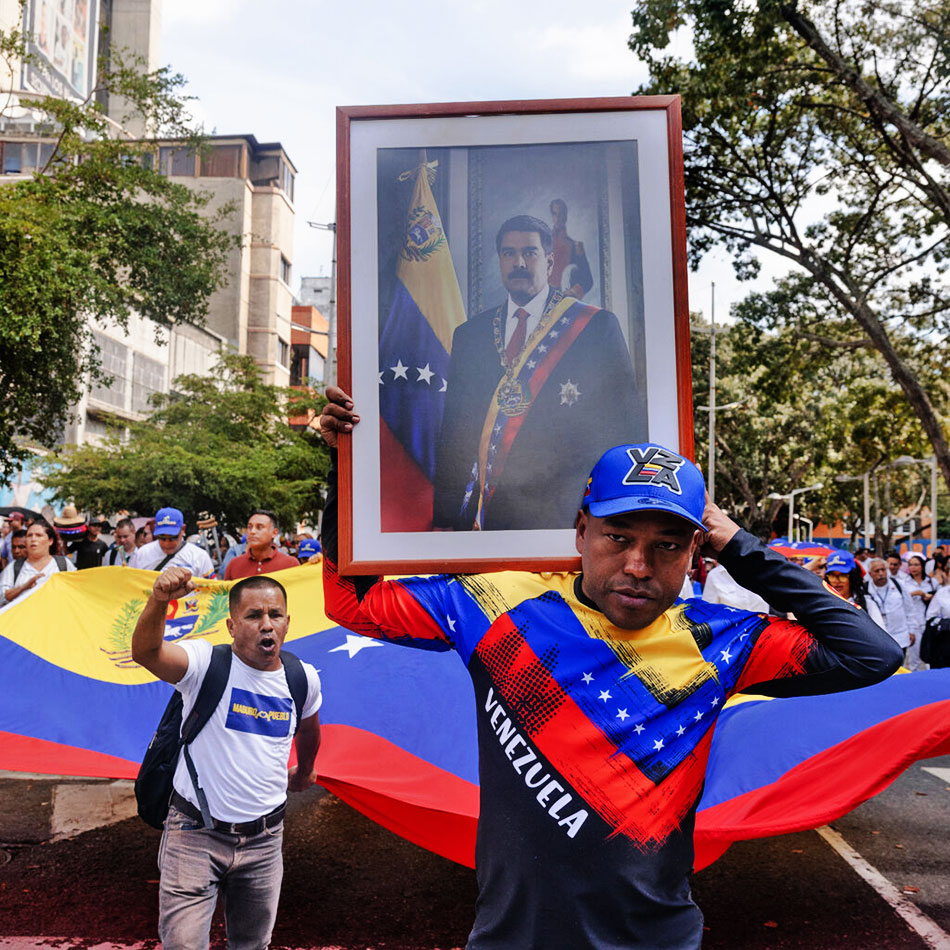
In Caracas, Venezuela, on Monday.
Credit: The New York Times
We ask where America's
new foreign policy
might take us
-
and the
world...
What are the larger lessons of the U.S. raid
on
Venezuela last weekend to
oust Nicolás Maduro, the Venezuelan
president?
Vice President JD Vance offered his answer on Saturday:
Any nation
that crosses the United States and defies its wishes does so at its
own peril.
President Trump, he said,
"was very clear throughout this process:
The drug trafficking must stop, and the stolen oil must be
returned to the United States."
Pete Hegseth, the defense secretary,
had a more epigrammatic take on Maduro:
"He effed around and he found out."
But two of my colleagues wrote recently about another takeaway that
bears watching:
the notion that a powerful nation has the right
- or
at least the ability - to command affairs in nearby, less powerful
nations.
It is the principle that stands behind the "Donroe
Doctrine," a Trumpian rebooting of the Monroe Doctrine of 1823,
which staked U.S. claims over the Western Hemisphere.
On Monday
night,
Stephen Miller, a top Trump policy adviser, gave the rawest
expression of the idea in an interview with Jake Tapper of CNN.
"We
live in a world, in the real world, Jake, that is governed by
strength, that is governed by force, that is governed by power," he
said.
"These are the iron laws of the world that
have existed since the beginning of time."
Territoriality
In the Eastern Hemisphere,
China has for years
made roughly the same argument about Taiwan, as David Pierson
reported yesterday.
"China is a big
country and other countries are small countries, and that's just a
fact," the foreign minister told Southeast Asian officials in 2010.
Sounds familiar...!
Since then, China has tightened its grip on Taiwan by punishing
nations that support it and by working to isolate it.
Barely more
than a week ago, Beijing shot rockets all around its coastline, a
warning that the Chinese military would make it difficult for any
outside force to come to the island's defense in a conflict there.
The I-can-do-what-I-want prerogative, of course, also applies to
President
Vladimir Putin's invasions of Georgia and Ukraine (twice).
Sovereign power is an argument Putin could someday use in other
parts of the former Soviet Union, like the South Caucasus and
Central Asia, which the Kremlin thinks of as within its sphere of
influence,
Anton Troianovski
reports.
"If we have the right to be aggressive in our own backyard," a
first-term Trump administration official told Anton, "why can't
they?"
Future histories
What could happen if this principle governed more of world affairs,
as it did in centuries past?
It would certainly buttress the Trump
administration's desire to,
take control of Greenland from the
Kingdom of Denmark, to say nothing of its designs on Canada.
Landlocked Ethiopia could assert a right to its own Red Sea port
- in neighboring Eritrea.
And Rwanda could annex the mines of the
Democratic Republic of Congo.
Could Serbia take back Kosovo or Sudan take back South Sudan?
Could
Israelis declare that they will run Gaza again in perpetuity?
Could
any powerful nation launch a mission into Jerusalem and execute an
arrest warrant from the International Criminal Court for Israel's
prime minister?
Could Australia grab all of Antarctica...?
Anton put it bluntly...
Trump's assault on
Venezuela, he wrote,
"has ushered in new uncertainty around the
globe, with allies and adversaries alike scrambling to reckon
with a superpower ready to use force in the service of a
transactional, might-makes-right foreign policy."
|