|

by Anton Troianovski
January 21, 2026
from
NYTimes Website
Article also
HERE
|
Anton Troianovski
writes about
American foreign policy and national security for The Times from
Washington. He was previously a foreign correspondent based in
Moscow and Berlin.
Reporting was
contributed by Isabel Kershner, Aaron Boxerman, Michael Crowley and
Zolan Kanno-Youngs. |
Israel, Saudi Arabia and other
nations
have said they
would join
President
Trump's proposed "Board of Peace,"
but France,
Norway and Sweden have said no.
Credit: Allison
Robbert for The New York Times
The
initiative is the latest example
of the
president's dismantling the
post-World War
II international system
and building a
new one,
with himself
at the center...
In the proposed charter of the "Board of Peace" that the United
States sent to national capitals in recent weeks, one man has the
power to veto decisions, approve the agenda, invite members,
dissolve the board entirely and designate his own successor.
His name is spelled out in Article 3.2:
"Donald
J. Trump shall serve as inaugural chairman."
"If Trump, then peace," Prime Minister
Viktor Orban of Hungary,
one of President Trump's closest allies in Europe,
wrote on Facebook on Sunday
after Mr. Trump invited him to join the board.
"We have, of course, accepted this honorable
invitation."
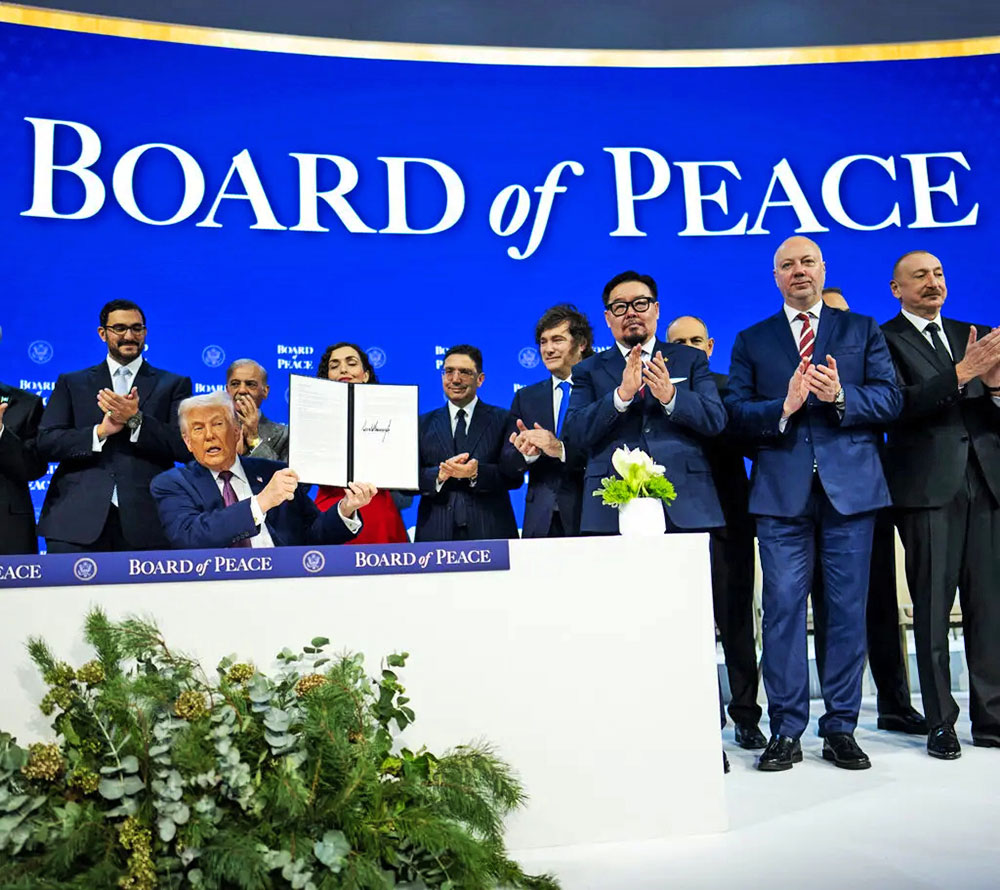
Saudi Arabia, Egypt, Israel, Belarus, Pakistan
and several more countries also said they were joining, ahead of the
signing ceremony Thursday in Switzerland.
But many officials and experts in international affairs were stunned
by the breadth of the initiative, the latest example of Mr. Trump
taking apart the American-built, post-World War II international
system and building a new one, with himself at 'the
center'...
"This is a direct assault on the United
Nations," said
Marc Weller, a Cambridge
international law professor who specializes in peace
negotiations and has worked closely with the global body.
"This initiative is likely to be seen as a
takeover of the world order by one individual in his own image."
The U.N. Security Council itself endorsed the
creation of a Board of Peace in November in a resolution
welcoming the U.S.-brokered peace plan to end Israel's war in
Gaza.
According to that resolution, the board is to
function as,
a "transitional administration" through 2027
to oversee the redevelopment of Gaza.
But in unveiling the Board of Peace in the
last week, the Trump administration has cast Gaza as only a part of
what the new institution would do.
While its powers are not defined, its mission
would overlap with the United Nations' aim of maintaining
international peace and security.
"Trump has proven himself a pretty capable
and aggressive leader," said
Fred Fleitz, the chief of
staff of the National Security Council for part of Mr. Trump's
first term.
"This is taking advantage of it."
The proposed charter, seen
by The New York Times, says the
board would seek to,
"secure enduring peace in areas affected or
threatened by conflict."
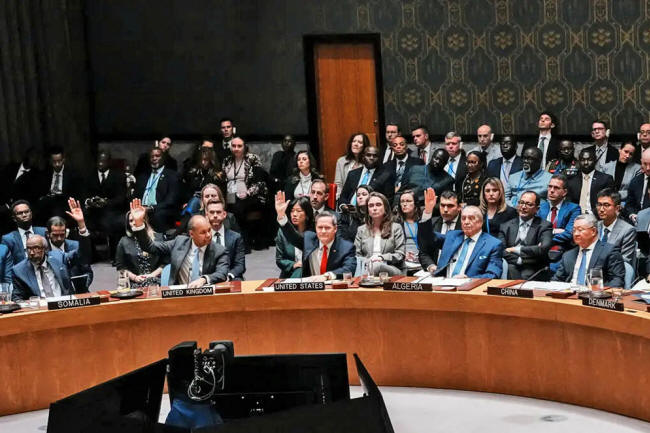
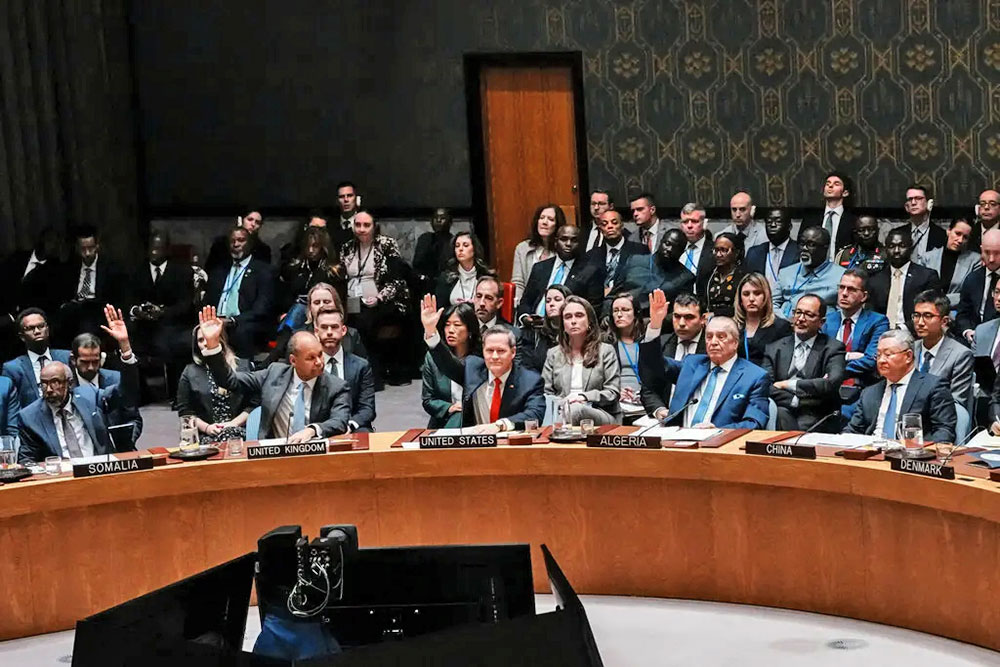
The U.N. Security Council
endorsed the
creation
of the Board of
Peace in November in a resolution
welcoming the
U.S.-brokered peace plan
to end Israel's
war in Gaza,
but the board's
mission apparently
would extend
beyond Gaza.
Credit: Eduardo
Munoz/Reuters
Steve Witkoff, Mr. Trump's peace envoy, who was named as a
member of the group's "executive board," told
CNBC that more than 20 countries
had already agreed to join and that the Board of Peace would be,
"a great group of leaders coming together" in
"sharing opinion to achieve peace."
He listed Russia, Ukraine, Iran,
Sudan and Syria as among the places in need of,
"bridging relationships."
"I wish the United Nations could do more," Mr. Trump said
Tuesday.
"I wish we didn't need a Board of Peace."
Asked whether he wanted the board to replace the
United Nations, Mr. Trump said that it "might."
He added:
"I believe you got to let the U.N.
continue because the potential is so great."
The United Nations itself has
sought to play down any tensions.
A spokesman,
Farhan Haq, told reporters that
it,
"has coexisted alongside any number of
organizations."
But the Trump administration's ambiguous
messaging about the Board of Peace has added to the
head-spinning nature of an extraordinary January in American foreign
policy.
The U.S. attack on Venezuela, the
threats of strikes on Iran and Mr. Trump's demands to
take over Greenland,
...have all sent the message that the United
States is seeking to exert its global power in a newly unilateral
way.
The Board of Peace, with its sprawling mission and with Mr.
Trump as its long-term chairman, appeared to be an attempt at
building an institution to codify the American dominance that the
president envisions.
Norway, Sweden and France have already said they
do not intend to join.
The French foreign minister, Jean-Noël Barrot,
said his country would say,
"no to creating an organization as it has
been presented, which would replace the United Nations,"
according to The Associated Press.
"The bond of trust has been broken" between the United States
and its allies, said R. Nicholas Burns, a former U.S.
ambassador to NATO, China and elsewhere.
"The overreach by the administration on
Greenland and the miscalculation they have made has really
brought about a different European view and
Canadian view."
Two weeks ago, Mr. Trump
withdrew from 66 international
organizations that his administration deemed "wasteful, ineffective,
and harmful."
He has suggested that he sees his board filling
some of that vacuum - offering the world a more assertive brand of
American engagement, personified by Mr. Trump.
The Board of Peace,
"will be established as a new international
organization",
...Mr. Trump wrote in his letter to Mr. Orban,
which the Hungarian prime minister posted online.
The organization's charter says in its opening
line that "durable peace" requires,
"the courage to depart from approaches and
institutions that have too often failed."
Mr. Fleitz, who is now at the America First
Policy Institute, a conservative think tank close to the
administration, said the decision to include Russia and China among
the invited members reflected the intended "broad-based" nature of
the board.
"They want to reduce the possibility that
various countries will try to sabotage it," he said.
Russia and China have veto power on the U.N.
Security Council, so they would be likely to look askance at any
weakening of the body.
But both have also tried to curry favor with Mr.
Trump.
China has
said it was invited but not
whether it would accept.
President Vladimir V. Putin of Russia
also stopped short of accepting the invitation, saying his
foreign ministry needed to analyze the matter.
But in an example of how countries can try to use
Mr. Trump's ambitions to advance their own interests, Mr. Putin
added that Russia was prepared to contribute $1 billion to the board
- as long as the money comes out of the Russian assets that were
frozen in the West after Mr. Putin "invaded" Ukraine.
The draft charter for the board stipulates the $1 billion fee for
countries that seek to stay on for longer than a three-year term.
A U.S. official said on Tuesday that the board,
"will implement the highest financial
controls and oversight mechanisms" for the cash it collects, and
that "funds will sit only in approved accounts at reputable
banks."
The U.S. official confirmed that Mr. Trump
'could' play a central role in the board even after leaving
the presidency.
Mr. Trump can hold the chairmanship,
"until he resigns it," the official said.
"A future U.S. president, however, may choose
to appoint or designate the United States' representative to the
board."
Mr. Weller, the peace negotiations specialist,
argued that the expected $1 billion contributions could further sap
funding from the United Nations, whose agencies were told by the
United States in December that they needed to "adapt,
shrink or die."
And he said that the central personal role envisioned for Mr. Trump
was unlike any other agreement he had seen in his experience in
international affairs.
It was, he said, unlikely to represent a
sustainable pathway to world "peace"...
"Peace in the world requires a broad,
international consensus," Mr. Weller said.
"That can hardly be created through a new
institution that is entirely dependent on the will of one
man"...
The Board of Peace
by Sam Sifton
February 19, 2026
from
NYTimes Website
Article also
HERE
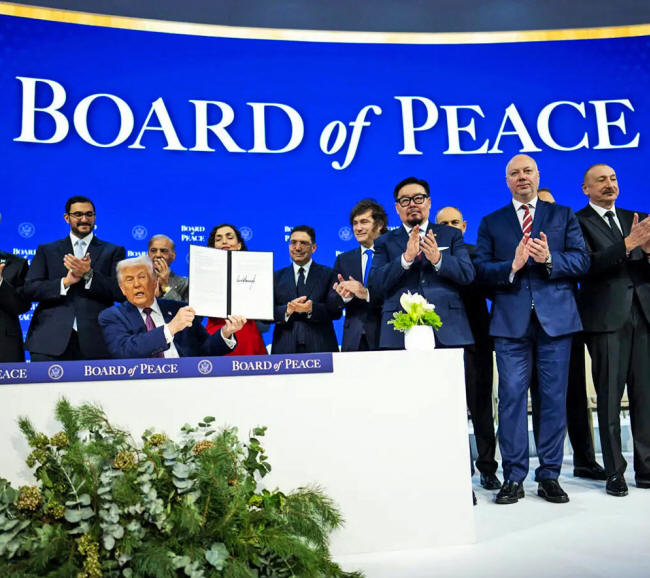
President Trump in Davos last
month.
Credit: Doug
Mills/The New York Times
Today we look at
President
Trump's
new
diplomatic initiative...
Today, President Trump greets his creation.
The Board of Peace will hold its first
gathering since more than 20 nations signed the board's founding
charter last month.
Delegates will talk about how to rebuild
Gaza.
But the board, a kind of Trump-aligned
alternative to
the United Nations, is aiming
much higher.
It wants to,
"secure enduring peace in areas affected or
threatened by conflict," according to the charter.
That's a lot of places beyond Gaza.
It also promises to be a nimble peacekeeping
body, presumably unlike the diplomats at the United Nations.
It sounds like something off a pitch deck:
a start-up meant to disrupt international
statecraft.
Trump has offered many out-of-the-box ideas, and
some of them have succeeded.
Will this one...?
How the Board Works
Member nations must cough up $1 billion to secure a permanent board
seat.
If they don't pay, they lose their spot after
three years.
The recruits are an odd assortment - not all
America's traditional friends.
They include Argentina, Hungary, Indonesia,
Pakistan, Qatar, Saudi Arabia, Turkey and the United Arab
Emirates.
Seven European nations, including France and
Britain, have declined the offer.
Trump rescinded Canada's invitation after the
prime minister criticized U.S. foreign policy.
Russia said it would pony up if the United
States thawed its bank accounts.
Trump is the chairman - not just while he's
president, but for life..!
He can invite new countries to join or expel
others.
He decides who is on the executive committee.
Among them are Jared Kushner, his
son-in-law; and Tony Blair, a former British prime
minister.
Trump is the "final authority" on all matters
related to the board and its operations.
There are not a lot of checks and balances.
He makes the calls...
What is the Board Doing?
The original idea was to execute Trump's blueprint for postwar Gaza,
which he outlined in a 20-point peace plan in September.
Trump says member nations have already pledged $5
billion toward rebuilding the territory. (The United Nations has
estimated the cost at more than $50 billion.)
The Trump administration concedes that the
challenges in Gaza are enormous.
For 60 million tons of rubble to be cleared,
the cease-fire between Israel and Hamas must hold.
Israel has killed more than 600 Palestinians
since the ostensible peace began, and Hamas has yet to agree to
disarm, as Trump envisions.
American officials hope both sides will agree to
the board's proposal for this, but they caution not to expect any
overnight miracles.
"There are big chunks of this plan where the
rubber just hasn't hit the road yet," Aaron Boxerman, who
covers Israel and Gaza, told me yesterday afternoon.
So, we'll see...
The U.N. Security Council approved Trump's
20-point plan and blessed the creation of the Board of Peace
last November. But now some nations feel buyer's remorse,
Farnaz Fassihi, who covers the
U.N., told me.
Some, like France and Britain,
won't join it.
"Very awkward," Farnaz said.
What's Next?
Many experts in international affairs worry about what they see as a
worst-case scenario:
The Trump administration could weaken the
multilateral diplomatic system that the United States helped build
after World War II - and replace it with something more rapacious
and less stable, led by Trump...!
Scholars point to a country trying to flex its global power in a new
and unilateral way.
They cite threats against Iran, the saber
rattling with Denmark over Greenland and the U.S.
attack on Venezuela earlier this year.
Not to mention tariffs that rise
and fall on short notice.
"Peace in the world requires a broad,
international consensus," an international law professor (Marc
Weller) who specializes in peace negotiations told The
Times in above article.
"That can hardly be created through a new
institution that is entirely dependent on the will of
one man"...!
|