|
from ForeignAffairs Website
Adam Maida
Ever since Donald Trump first became U.S. president, in 2017, commentators have searched for an adequate label to describe his approach to U.S. foreign relations.
Writing in these pages, the political scientist Barry Posen suggested in 2018 that Trump's grand strategy was "illiberal hegemony," and the analyst Oren Cass argued last fall that its defining essence was a demand for "reciprocity."
Trump has been called a realist, a nationalist, an old-fashioned mercantilist, an imperialist, and an isolationist.
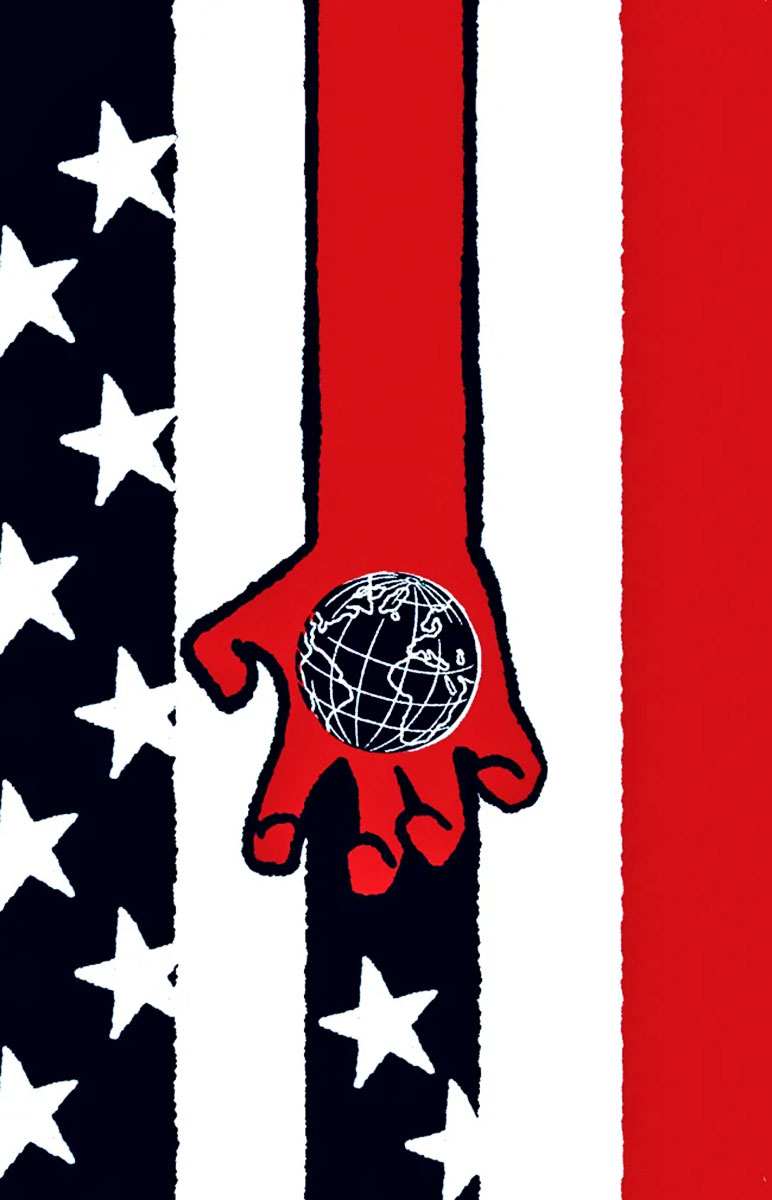
Each of these terms captures some aspects of his approach, but the grand strategy of his second presidential term is perhaps best described as "predatory hegemony."
Its central aim is to use Washington's privileged position to extract concessions, tribute, and displays of deference from both allies and adversaries, pursuing short-term gains in what it sees as a purely zero-sum world.
In the long run, however, it is doomed to fail. It is ill suited for a world of several competing great powers - especially one in which China is an economic and military peer - because multipolarity gives other states ways to reduce their dependence on the United States.
If it continues to define American strategy in the coming years, predatory hegemony will weaken the United States and its allies alike, generate growing global resentment, create tempting opportunities for Washington's main rivals, and leave Americans less secure, less prosperous, and less influential.
In the bipolar world of the Cold War, the United States acted as a benevolent hegemon toward its close allies in Europe and Asia because American leaders believed their allies' well-being was essential to containing the Soviet Union.
They used American economic and military supremacy freely and sometimes played hardball with key partners, as President Dwight Eisenhower did when Britain, France, and Israel attacked Egypt in 1956 or as President Richard Nixon did when he took the United States off the gold standard in 1971.
But Washington also helped its allies recover economically after World War II; created and, for the most part, followed rules intended to foster mutual prosperity; collaborated with others to manage currency crises and other economic disruptions; and gave weaker states a seat at the table and a voice in collective decisions.
U.S. officials led, but they also listened, and they rarely tried to weaken or exploit their partners.
Facing no powerful opponents and convinced that most states were eager to accept American leadership and embrace its liberal values,
...eventually provoked a domestic backlash that helped propel Trump to the White House.
To be sure, Washington sought to isolate, punish, and undermine several hostile regimes during this period and sometimes paid scant attention to other states' security fears.
But both Democratic and Republican officials believed that using American power to create a global liberal order would be good for the United States and for the world and that serious opposition would be confined to a handful of minor rogue states.
They were not averse to using the power at their disposal to compel, co-opt, or even overthrow other governments, but their malevolence was directed at acknowledged adversaries and not toward U.S. partners.
Under Trump, however,
This strategy is not a coherent, well-thought-out response to the return of multipolarity...
It is instead a direct reflection of Trump's transactional approach to all relationships and his belief that the United States has enormous and enduring leverage over nearly every country in the world.
The United States is like,
Or as he said in a statement shared by White House Press Secretary Karoline Leavitt, the American consumer is,
During Trump's first term, more experienced and knowledgeable advisers such as Defense Secretary James Mattis, Treasury Secretary Steven Mnuchin, White House Chief of Staff John Kelly, and National Security Adviser H. R. McMaster ,
But in his second term, his desire to exploit other states' vulnerabilities has been given full rein, empowered by a cadre of appointees selected for their personal loyalty and by Trump's growing if misplaced confidence in his own grasp of world affairs.
A predatory hegemon's primary goal is not to build stable and mutually beneficial relations that leave all parties better off but to ensure that it gains more from every interaction than others do.
An arrangement that leaves the hegemon better off and its partners worse off is preferable to an arrangement in which both sides gain but the partner gains more, even if the latter case yields larger absolute benefits for both parties.
A predatory hegemon always wants the lion's share...
What distinguishes predatory hegemony from typical great-power behavior, however, is a state's willingness to extract concessions and asymmetric benefits from its allies and adversaries alike.
In other words,
By contrast, a predatory hegemon is as likely to exploit its partners as it is to take advantage of a rival.
It may use embargoes, financial sanctions, beggar-thy-neighbor trade policies, currency manipulation, and other instruments of economic pressure to force others to accept terms of trade that favor the hegemon's economy or to adjust their behavior on noneconomic issues of interest.
It will link the provision of military protection to its economic demands and expects alliance partners to support its broader foreign policy initiatives.
Weaker states will tolerate these coercive pressures if they are heavily dependent on access to the hegemon's larger market or if they face still greater threats from other states and must therefore depend on the hegemon's protection, even if it comes with strings attached.
They might be expected to pay a formal tribute or be called on to openly acknowledge and praise the hegemon's virtues.
Such ritual expressions of deference discourage opposition by signaling that the hegemon is too powerful to resist and by portraying it as wiser than its vassals and therefore entitled to dictate to them.
Although these cases differ in important ways, in each one a dominant power sought to exploit its weaker partners to secure asymmetric benefits for itself, even if its efforts did not always succeed and if some clients cost more to acquire and defend than they provided in wealth or tribute.
Some predatory efforts may fail, of course, and there are limits to what even the most powerful states can extract from others.
For a predatory hegemon, however, the overriding objective is to push those limits as far as possible.
Trump has repeatedly said that trade deficits are a "rip-off" and a form of looting; in his view, countries that run surpluses are "winning" because the United States pays more to them than they pay to Washington.
Accordingly, Trump has either imposed tariffs on those countries, ostensibly to protect U.S. manufacturers by making foreign goods more expensive (even though the cost of a tariff is mostly paid by Americans who purchase imported goods), or threatened such tariffs to force foreign governments and firms to invest in the United States in exchange for relief.
in front of the U.S. embassy in Brasília, August 2025. Mateus Bonomi / Reuters
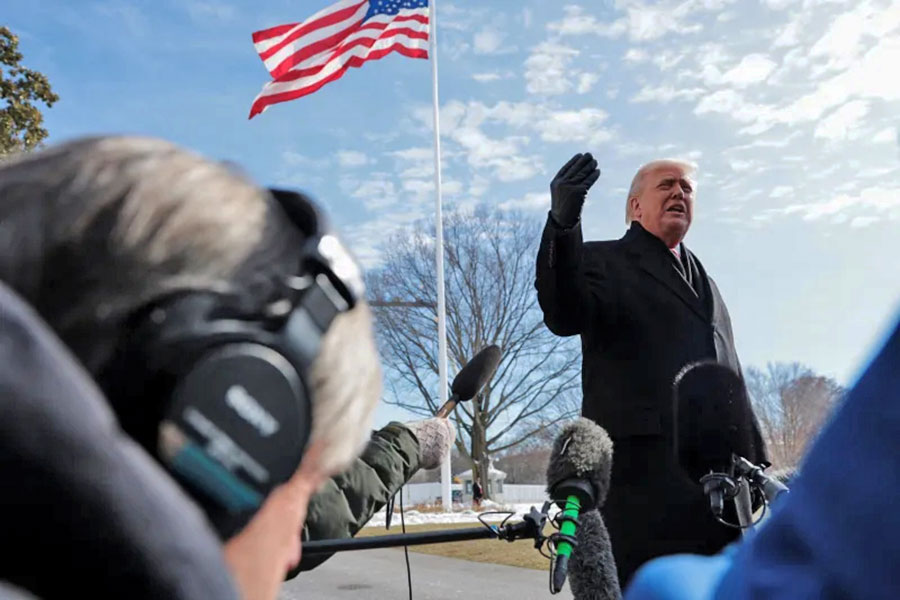
Trump is as likely to coerce traditional U.S. allies as acknowledged adversaries, and the on-again, off-again quality of his threats underscores his desire to extract as many concessions as possible.
Trump believes unpredictability is a powerful bargaining tool, and his endlessly shifting set of threats and demands is intended to force others to keep searching for new ways to accommodate him.
Threatening to impose a tariff costs Washington very little if the target caves quickly, but if the target stands firm or if markets are spooked, Trump can defer action.
This approach also keeps
attention riveted on Trump himself, helps the administration portray
any subsequent agreement as a victory regardless of its precise
terms, and creates obvious opportunities for corruption that benefit
Trump and his inner circle.
contains the seeds
of its own destruction...
He has insisted that allies should pay for American protection and suggested that the United States,
But his goal is not to make U.S. partnerships more effective by getting allies to do more to defend themselves - and, in fact, drastically increasing tariff levels will damage partners' economies and make it harder for them to meet higher defense spending targets.
Instead, Trump is using the threat of U.S. disengagement to extract economic concessions.
This strategy has paid some short-term dividends, at least on paper.
A predatory hegemon prefers a world where, in Thucydides's famous phrase,
That is why such a country will be wary of norms, rules, or institutions that might limit its ability to take advantage of others.
Not surprisingly, Trump,
He prefers to conduct trade talks bilaterally rather than deal with institutions such as the EU or the rules-based World Trade Organization because dealing one-on-one with individual countries further enhances U.S. leverage.
Trump has also sanctioned top officials of the International Criminal Court and launched a furious assault on an emission pricing scheme developed by the International Maritime Organization.
The IMO proposal sought to slow climate change by encouraging shipping companies to use cleaner fuels, but Trump denounced it as a "scam" and deliberately sabotaged it. After his administration threatened tariffs, sanctions, and other measures against those who supported the measure, the vote on its formal approval was postponed for a year.
The U.S. delegation was "behaving like gangsters," one IMO delegate said in October.
No discussion of Washington's predatory hegemony would be complete without mentioning Trump's expressed interest in territory that belongs to other states and his willingness to intervene in other countries' domestic politics in violation of international law.
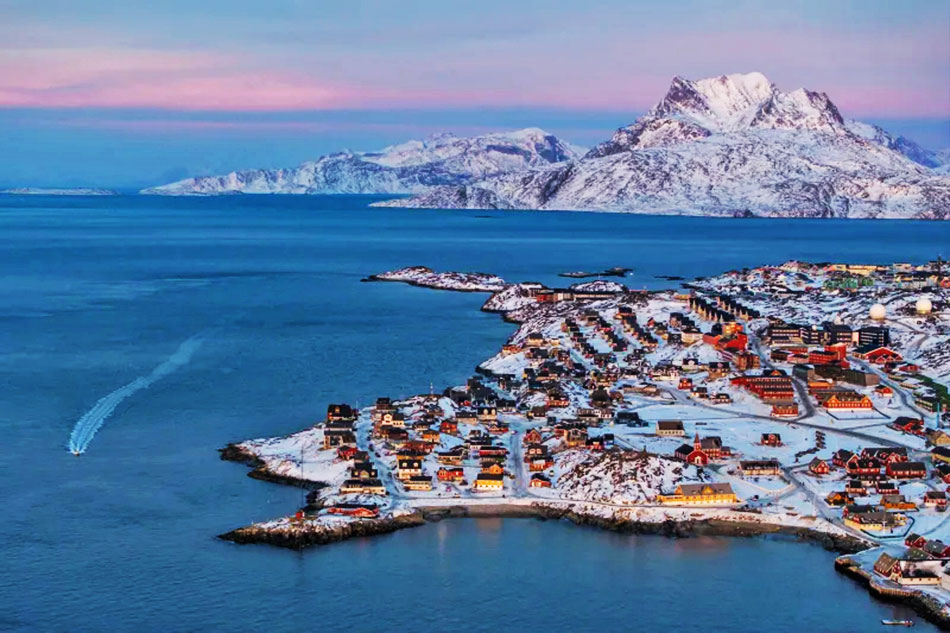
His repeated desire to annex Greenland, and his threats to impose punitive tariffs on European states that oppose this action, is the most visible example of this impulse.
As Danish military intelligence warned in its annual threat assessment, released in December,
Trump's musings about making Canada the 51st state or reoccupying the Panama Canal zone suggest a similar degree of geopolitical avarice and opportunism.
His decision to kidnap Venezuelan President Nicolás Maduro - an act that sets a dangerous example for other great powers to follow - reveals a predator's disregard for existing norms and a willingness to exploit others' weaknesses.
The predatory impulse even extends to matters of culture, with the administration's National Security Strategy declaring that Europe is facing "civilizational erasure" and that U.S. policy toward the continent should include "cultivating resistance to Europe's current trajectory within European nations."
In other words, European states will be pressured to embrace the Trump administration's commitment to blood and soil nationalism and its hostility to nonwhite and non-Christian cultures or religions.
To a predatory hegemon, no issue is off-limits...!
Qatar has already gifted him a plane, which will cost U.S. taxpayers several hundred million dollars to refurbish and may end up at his presidential library after he leaves office.
The Trump Organization has signed multimillion-dollar hotel development deals with governments seeking to curry favor with the administration, and influential figures in the United Arab Emirates and elsewhere have purchased billions of dollars of tokens issued by Trump's World Liberty Financial cryptocurrency operation - around the same time that the UAE secured special access to high-end chips that are normally subject to strict U.S. export controls.
No president in American
history has managed to monetize the presidency to anywhere near the
same extent or with such obvious disregard for potential conflicts
of interest.
January 2026. Marko Djurica / Reuters
How else can one explain the cringeworthy behavior of NATO Secretary-General Mark Rutte, who told Trump that,
Rutte also declared, in March 2025, that,
Rutte is not alone:
Not to be outdone, South Korean President Lee Jae-myung gifted Trump with an enormous gold crown during his recent visit to Seoul and capped off an official dinner by serving him a dish labeled "Peacemaker's Dessert."
Even Gianni Infantino, the president of soccer's global governing body, has gotten into the act creating a meaningless "FIFA Peace Prize" and naming Trump as its first recipient at a gaudy ceremony in December 2025.
Leaders who challenge Trump get a dressing down and threats of harsher treatment - as Ukrainian President Volodymyr Zelensky has experienced on more than one occasion - while leaders who shamelessly flatter Trump get gentler handling, at least for the moment.
In October 2025, for example, the U.S. Treasury extended a $20 billion currency swap line to bolster Argentina's peso, even though Argentina is not an important U.S. trading partner and was supplanting U.S. soybean exports to China (which had been worth billions of dollars before Trump launched his trade war).
But because Argentine President Javier Milei is a like-minded leader who openly praises Trump as his role model, he got a handout instead of a list of demands.
Even convicted drug traffickers, including former Honduran President Juan Orlando Hernández, can win a presidential pardon if they appear to be aligned with Trump's agenda.
Trump is also quick to hit back at leaders who depart from the script.
To avoid such humiliations, many leaders have chosen to bend the knee preemptively - at least for now.
As Anna Kelly, a White House spokesperson, put it in August,
The administration appears to believe it can prey on other states forever, and that doing so will make the United States even stronger and further increase its leverage.
They are mistaken:
The first problem is that the benefits touted by the administration have been exaggerated.
Trump, his family, and his political allies may be benefiting from his predatory policies, but most of the country is not...!
As Trump's recent decisions to suspend the trade war with China and to shelve plans to sanction China's Ministry of State Security for a cyber-espionage campaign targeting U.S. officials have demonstrated, he cannot bully other great powers the way he has bullied weaker states.
Washington, D.C., January 2026. Jonathan Ernst / Reuters
Shortly after Trump raised the tariff rate on Indian goods to a draconian 50 percent, in August 2025,
India wasn't formally aligning with Moscow, but Modi was reminding the White House that New Delhi has options.
Japan and South Korea convinced Trump to lower tariff rates by agreeing to invest billions in the U.S. economy, but the pledged payments will be strung out over many years and may never be fully realized.
In the meantime, Chinese, Japanese, and South Korean officials held their first trade negotiations in five years in March 2025, and the three countries are considering a trilateral currency swap intended to,
Over the past year, Vietnam has expanded its military ties with Russia, reversing previous efforts to move closer to the United States.
Trump's vaunted unpredictability has a clear downside: it encourages others to look for more reliable partners.
The European Union has already signed new trade deals with Indonesia, Mexico, and the South American trading bloc Mercosur, and as of late January was close to finalizing a new trade pact with India.
If Washington keeps trying to take advantage of other states' dependence, such efforts will only accelerate.
But such tolerance has limits. The level of predation practiced in Trump's first term was limited, and U.S. allies had reason to hope that his time in office would be an isolated episode that would not be repeated.
That hope has now been shattered, especially in Europe.
The administration's National Security Strategy, for example, is openly hostile to many European governments and institutions. Together with Trump's renewed threats to seize Greenland, it has raised additional doubts about NATO's long-term viability and shown that European leaders' efforts to win Trump over by accommodating him have failed.
If Trump keeps threatening to disengage but never actually does so, his bluff will be called and will lose its power to coerce.
If the United States does withdraw its military commitments, however, the leverage it once had over its former allies would evaporate.
We will never know what foreign leaders forced to kiss Trump's ring were thinking as they sat mouthing flowery platitudes, but some of them undoubtedly resented the experience and went away hoping for an opportunity to deliver a little payback in the future.
Foreign leaders must also reckon with public reaction back home, and national pride can be a powerful force.
It is worth remembering that Carney's electoral victory, in April 2025, owed much to his anti-Trump "elbows up" campaign and to voter perceptions that his Conservative Party rival was Trump lite.
Other heads of state, such as Brazilian President Luiz Inácio Lula da Silva, have seen their popularity soar when they defied Trump's threats.
As humiliation builds, other world leaders
may find that pushing back can make them more popular among their
electorates.
the way he has bullied
weaker
states...
The Trump administration appears to have belatedly realized that China never purchased all the U.S. exports it agreed to buy in the Phase One trade deal it signed with the United States in 2020, during Trump's first term, and launched an investigation into the matter in October.
Multiply the task of monitoring compliance across all of Washington's bilateral trade arrangements, and it's easy to see how other states can promise concessions now but renege on them later.
Under Xi, China has repeatedly tried to portray itself as a responsible and unselfish global power seeking to strengthen global institutions for the benefit of all mankind.
The confrontational "wolf warrior" diplomacy of a few years ago, which saw Chinese officials routinely insult and bully other governments to no good purpose, is out.
With rare exceptions, Chinese diplomats are now an
increasingly energetic, active, and effective presence at
international forums. China's public declarations are obviously self-serving, but some countries see this posture as an appealing alternative to an increasingly predatory United States.
In a survey of 24 major countries, published by the Pew Research Center last July, majorities in eight countries held a more favorable opinion of the United States than they did of China, whereas respondents from seven countries viewed China more favorably.
The two powers were viewed similarly in the remaining nine. But the trends are in Beijing's favor.
As the report notes,
It is not hard to see why...
Some states will work to reduce their dependence on Washington, others will make new arrangements with its rivals, and more than a few will yearn for a moment when they have an opportunity to get back at the United States for its selfish behavior.
Maybe not today, maybe not tomorrow, but a backlash could come with surprising swiftness.
To quote Ernest Hemingway's famous line about the onset of bankruptcy, a consistent policy of predatory hegemony could cause U.S. global influence to decline,
Blessed with favorable geography, a large and sophisticated economy, unmatched military power, and control over the world's reserve currency and critical financial nodes, the United States has been able to build an extraordinary array of connections and dependencies and gain considerable leverage over many other states during the past 75 years.
They worked with like-minded countries to create mutually beneficial arrangements, understanding that others would be more likely to cooperate with the United States if they did not fear its appetite.
No one doubted that Washington had a mailed fist.
But by cloaking it in a velvet glove - treating weaker states with respect and not trying to squeeze every possible advantage out of others - the United States was able to convince the world's most consequential states that aligning with its foreign policy was preferable to partnering with its main rivals.
To be sure, the United States is not about to face a vast countervailing coalition or lose its independence - it is too strong and favorably positioned to suffer that fate.
It will, however, become poorer, less secure, and less influential than it has been for most living Americans' lifetimes.
Future U.S. leaders will operate from a weaker position and will face an uphill battle to restore Washington's reputation as a self-interested but fair-minded partner.
Predatory hegemony is a losing strategy, and the sooner the
Trump administration abandons it, the better...
|