|

by Ancient Code Team
June 07, 2025
from
Ancient-Code Website
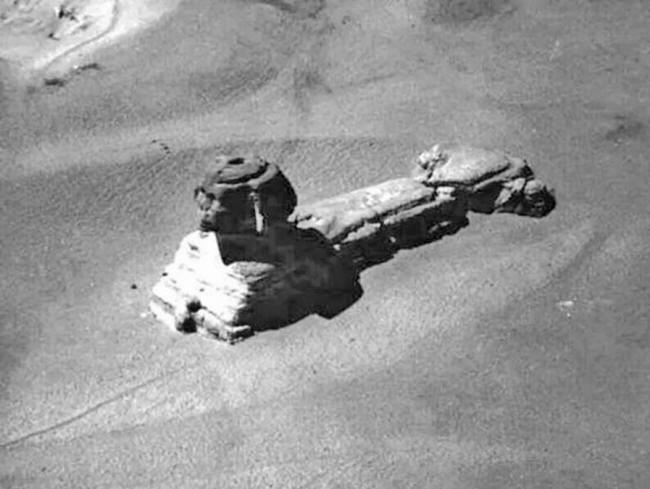
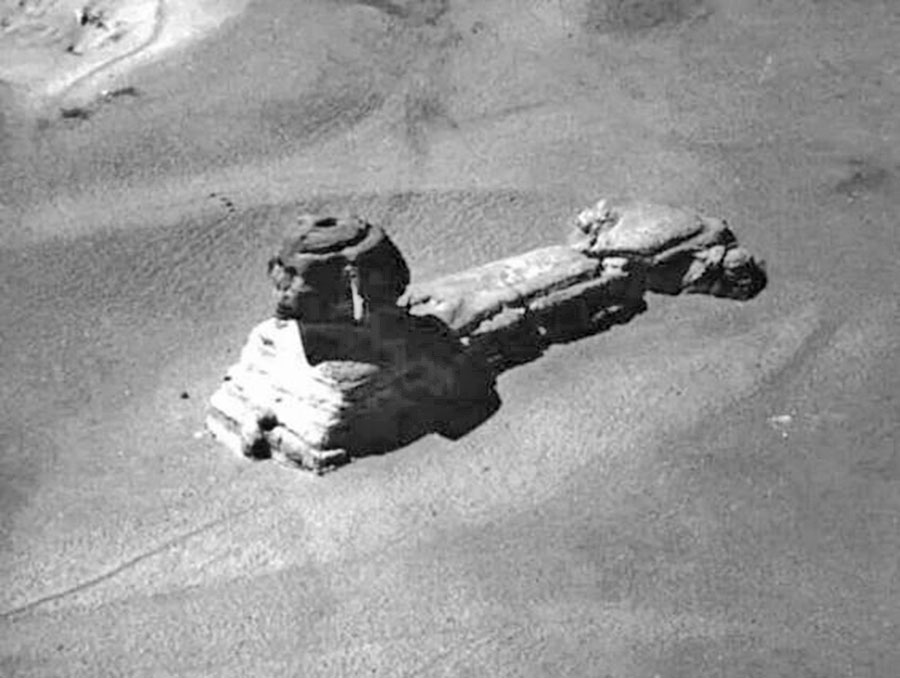
Rare image of the
Sphinx
taken from a hot air
balloon,
in the early 19th
century.
This is before
excavation and
restoration.
One
of the most controversial subjects
among many
people today is
the
ancient Anunnaki and their influence
in modern
day civilization.
Just as we
ventured into the story
behind the
enigmatic 200,000-year-old city in Africa,
we take a
look at the Great Sphinx of Giza
and its
'possible' connection to the Ancient Anunnaki.
What if there is more about
the Anunnaki than what
'history' is telling us?
What if thousands of years ago mysterious Gods called the
Anunnaki came down from heaven and helped kick start modern day
civilization?
And what if during their long stay on Earth some structures were
left behind in order to honor their time on Earth?
According to many authors, proof of the existence
of the Ancient Anunnaki can be found all around the globe.
The Ancient Egyptians have no records about the Sphinx being built
and curiously, this ancient monument was discovered - almost
entirely buried in Sand - in 1817, when the first modern
archaeological dig, led by Giovanni Battista Caviglia managed
to uncover the Sphinx's chest completely.
What if one the reasons behind the lack of
'ancient texts' mentioning the Sphinx is because it predates
the Ancient Egyptian Civilization?
What if the origin of the Great Sphinx can be
traced back hundreds of thousands of years, at the time when the
Anunnaki ruled the Earth?
After a couple of decades, the entire Sphinx was
finally excavated in 1925 to 1936 by an archaeological expedition
led by Émile Baraize.
Many authors have at lest partially accepted the idea that the
Great Sphinx of Giza may be one of
the best examples of pre-flood civilization and
pre-flood architecture around the globe.
Curiously, according to a study presented at the International
Conference of Geoarchaeology and Archaeomineralogy held in Sofia
titled 'Geological
aspect of the problem of Dating the Great Egyptian Sphinx
construction,' authors,
-
Manichev Vjacheslav I. (Institute
of Environmental Geochemistry of the National Academy of
Sciences of Ukraine)
-
Alexander G. Parkhomenko
(Institute of Geography of the National Academy of Sciences
of Ukraine),
...propose that the great sphinx is in fact
around 800,000 years old...
A revolutionary theory that is backed up by
science.
Curiously, there are several
extremely rare
and old images of the Sphinx,
which show what
appear to be
numerous
entrances into the enigmatic monument.
But who could have been on Earth
creating such structures 800,000 years ago?
Millions of people around the globe are convinced that hundreds of
thousands of years ago, advanced beings lived on our planet.
Many authors and researchers refer to them as the
Anunnaki:
"those who from the heaven came to Earth."
Supposedly, and according to some authors,
the
ancient Anunnaki were an
extremely advanced 'alien' civilization that originated from an
elusive planet in our solar system...
These mysterious beings came to Earth over
hundreds of thousands of years ago and kick-started the human
civilization...!
But what are/were the Anunnaki?
Are they mere mythological inventions from
people thousands of years ago?
Or is it possible there is evidence to support that they did, in
fact, exist on Earth?
Interestingly, if we look back at the countless
discoveries that have been made in the last couple of decades, we
will understand that history as we know it is completely different
from the reality.
The Great Sphinx of Giza is one of the most elusive archaeological
structures on the planet.
Elusive we say because archaeologists have completely failed to
explain who, what, and how this structures came into existence.
Interestingly, Gaston Maspero, a
French Egyptologist known for popularizing the term "Sea
Peoples" in an 1881 paper, wrote in the book the
Dawn of Civilization,
"...the Sphinx could have existed since
the days of the" followers of Horus, "a race of predynastic
and semi-divine beings, which, according to beliefs of the
ancient Egyptians had ruled thousands of years before the
Pharaohs of Egypt."
There are no written
records whatsoever about the Sphinx nor its creators
The biggest clues the Sphinx offers us is traces
of water erosion which has led many authors and researchers to
believe that this magnificent ancient statue predates the ancient
Egyptian civilization.
But what makes the Great Sphinx of Giza even more impressive are
its cavities and alleged chambers that are located within the
monument.
Many researchers have long proposed that not only
are there a few chambers located beneath the Sphinx; there are said
to be a number of
tunnels and complex rooms located
within the Great.
Among the most extraordinary claims connected with the Sphinx is
that the mythical hall of records is located right
below this mysterious ancient monument.
It is said that the Hall of Records holds the key to
understanding our civilization and the real history of humanity.
Mythologically, it is said to be a library buried somewhere in
Egypt, and many people believe it could be located under the
enigmatic Sphinx of Giza, watching tall and proud over the
Pyramids of the Giza Plateau.
In the book
Message of The Sphinx,
Graham Hancock, and Robert Bauval state that the Egyptian
government together with American archaeologists have blocked any
investigations around or underneath the Sphinx, preventing anyone
from locating the underground cavities and finding out what is
located beneath the Sphinx.
References
|