|
by
Maria Luísa Buzzo Pieter van Dokkum/Yale University; Shany Danieli/IAS;
Image
processing: Alyssa Pagan/STScI (background) that seem to lack all dark matter present a cosmic mystery...
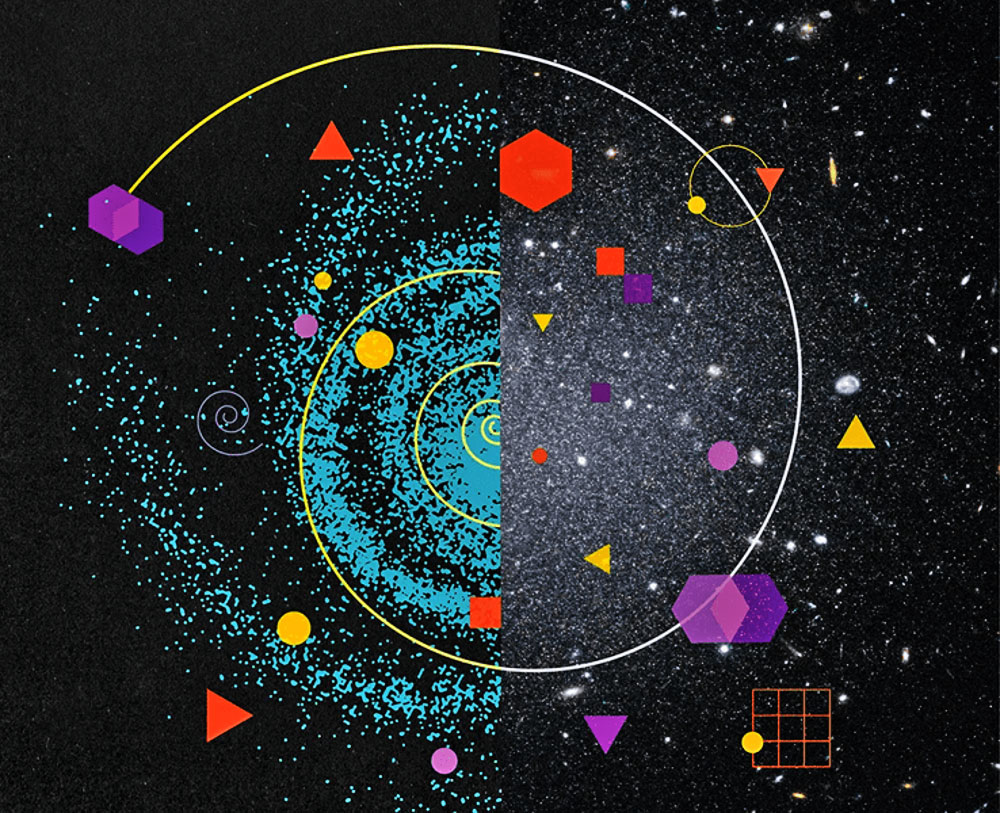
It was 2018, and the discovery had just been announced. A team had found a small, strange galaxy that appeared to lack dark matter, the invisible material that was thought to make up most of the matter in the universe and considered essential to the formation, evolution and stability of galaxies.
The find was big enough that it made it to Brazilian television.
Our professor used the news to open the semester. It sparked months of discussions. Dwarf galaxies - smaller, puffier conglomerations of stars than spiral galaxies such as the Milky Way - were long thought to be dominated by dark matter.
Again and again we returned to a deceptively simple but surprisingly hard question: It turns out there's no single answer.
For example, in 2011 two astronomers, Duncan Forbes of Swinburne University in Australia and Pavel Kroupa of the University of Bonn in Germany, conducted a survey called "What Is a Galaxy?"
Their results highlighted just how varied the definition can be, even among experts. Most astronomers agree on these basics:
The provocative discovery of a galaxy that apparently lacked this invisible stuff called that definition into question.
No one knows what dark matter is made of, but astronomers are fairly sure it's real, and it's ubiquitous. We see evidence for it everywhere - from the large-scale structure of the cosmos to the movements of galaxy clusters and the orbits of stars.
Dark matter is what seems to hold most galaxies together - without it their stars would fly out of formation. The idea of a galaxy without it challenges everything we know about how these stellar systems are born.
To understand why these discoveries are so puzzling, we need to go back to 2015, when astronomers began finding large numbers of what are called ultradiffuse galaxies.
The Dragonfly Telephoto Array in New Mexico uncovered hundreds of them in the Coma Cluster, a collection of galaxies 300 million light-years away.
This idea was reinforced by the fact that these galaxies seem to host large numbers of globular clusters - compact, ancient bundles of stars.
Globular clusters usually arise during intense episodes of star formation, when many baby stars are being born, as was the case in the early universe.
The number of globular clusters orbiting a galaxy is tightly linked to the galaxy's total mass, including its dark matter. The higher the mass of a galaxy, the more it can seed the kind of early, intense star formation that creates globular clusters.
Because ultradiffuse galaxies have many globular clusters but very few stars, researchers concluded they must be extremely massive but composed mostly of something we can't see...
All signs
pointed to their being heavily dominated by dark matter...
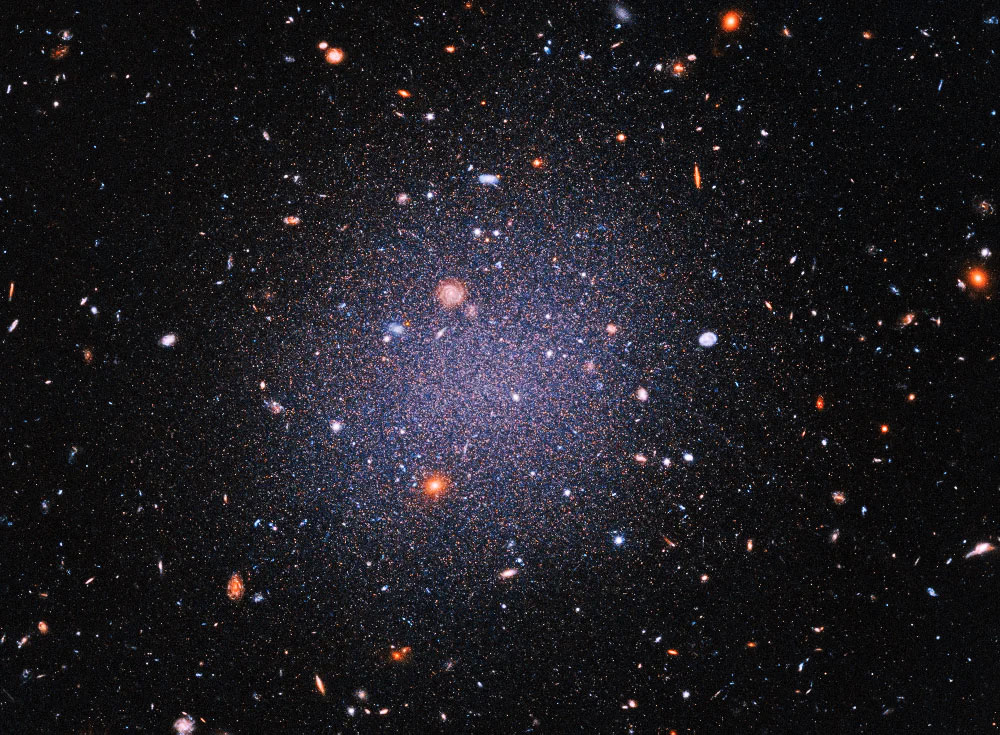
The ultradiffuse galaxy NGC 1052-DF2, discovered in 2018, was the first known galaxy that seemed to completely lack dark matter.
The finding called
galaxy formation models into question. Image Processing: Alyssa Pagan (STScI)
This galaxy had a very unusual system of globular clusters:
Using measurements of the velocity of DF2's stars and globular clusters, the team concluded that the galaxy's total mass was roughly equal to the mass of its visible matter.
There was no evidence of an invisible halo
holding the system together.
The faster they move, the more mass must be present. If the measured velocities are higher than the visible stars alone can explain, we infer that unseen mass (dark matter) is providing the extra gravity.
But if the velocities are
low and match what stars alone account for, there may be little or
no dark matter.
Because a galaxy's mass is determined by both the velocity of its stars and its physical size, which we calculate based on how far away it appears to be, this was a crucial question.
In response, van Dokkum's team led one of the largest observational surveys of a single object with the Hubble Space Telescope, dedicating 42 of the observatory's orbits (approximately 66 hours) to refining the distance measurement.
The results confirmed that the
original distance measurement was correct, reinforcing the idea that
DF2 lacked dark matter. Still, other groups continued to propose alternative interpretations, including new methods for estimating the galaxy's distance. The debate intensified when van Dokkum's team announced that a second galaxy near DF2 - this one called DF4 - had similarly slow-moving stars that again suggested a dearth of dark matter.
The astronomers doubted their own finding at first.
But after about 48 hours of sleepless observation runs, van Dokkum says, he sent a simple message to Danieli with one character:
That was what he'd calculated as the velocity dispersion of the clusters - a measure of how much their speeds varied.
It was so low that it immediately indicated DF4, like DF2, had little or no dark matter. By then, the idea that galaxies could exist without dark matter had gone from speculation to a serious yet controversial line of research.
In our current understanding, galaxy-formation models do allow for systems without dark ma
For dwarf galaxies such as DF2, DF4, and most ultradiffuse objects, the expectation is the opposite. Because they have low masses, they tend to form fewer stars and are thought to be heavily dominated by dark matter.
The only type of dwarf galaxy predicted to form without dark matter is the tidal dwarf, a star system born from the debris of larger galaxies after collisions or close encounters. Tidal dwarfs, however, are typically young and not expected to host globular clusters.
They're usually just star-forming clumps pulled from much older parent galaxies.
DF2 and DF4, in contrast, are old and surrounded by large populations of some of the most massive and luminous globular clusters ever observed. These galaxies were not tidal dwarfs. They were something entirely new, unanticipated by any current formation model.
How did they get that way?
One hypothesis suggested that over time gravitational forces might have pulled dark matter away from the galaxies, a process known as tidal stripping.
But their stars and globular cluster systems didn't match what we'd expect from that scenario, either. As of 2019, no single theory or simulation could fully account for all of their observed properties.
Then, in 2019, Johns Hopkins University astrophysicist Joseph Silk proposed the "bullet dwarf scenario" to explain DF2.
His models showed that a high-speed collision between two dwarf galaxies at just the right angle could separate visible and dark matter; the impact would also create intense pressure that could trigger the formation of unusually bright globular clusters.
The model was inspired by a much larger and well-known group of galaxies called the Bullet Cluster.
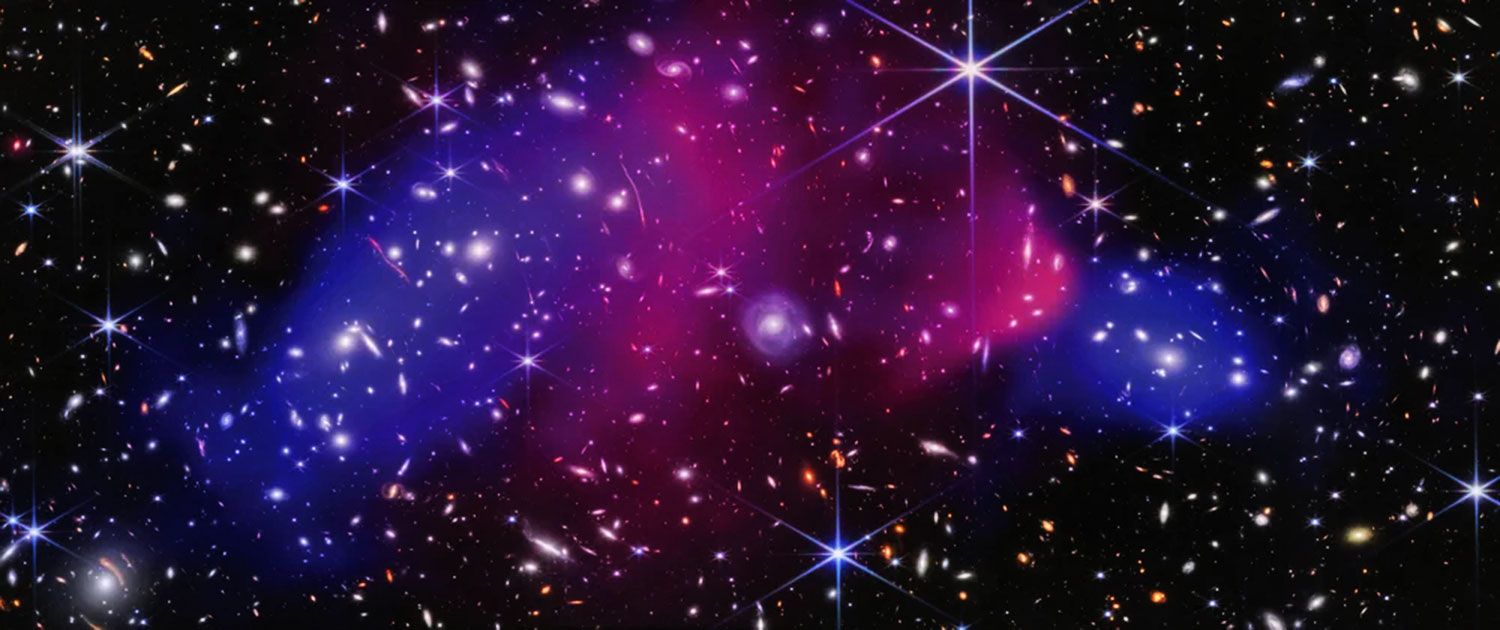
By comparing x-ray maps (which trace hot gas) with maps of gravity based on how light curves as it passes through the region (which charts total mass), astronomers showed that dark matter and visible matter in the cluster were separated.
The most likely explanation is that after two smaller clusters collided, the dark matter sped through, but the stars and gas became intertwined, causing the visible matter to lag behind.
This Bullet Cluster image, made with data from the James Webb Space Telescope and the Chandra X-ray Observatory, shows dark matter (maps gravitationally in blue) separating from normal matter (pink).
A similar process
could help explain why some galaxies lack dark matter. Sangjun Cha (Yonsei University), Kyle Finner (Caltech/IPAC)
The bullet dwarf hypothesis proposes, a miniature version of this same scenario.
If this picture is correct, these systems are more than exotic oddities. They are laboratories for testing the fundamental nature of dark matter itself.
The fact that the dark matter appears to have passed through the collision without interacting, while the gas collided and shocked, places constraints on how strongly dark matter particles can interact with one another.
In other words,
Van Dokkum and his collaborators then extended this idea beyond DF2.
They proposed that that galaxy, DF4 and potentially an entire series of other galaxies were all born from the same ancient collision in the NGC 1052 group. Because the progenitor galaxies weren't destroyed, they kept moving, leaving behind a trail of new galaxies formed from their stripped gas.
These galaxies, lacking dark matter but rich in stars and globular clusters, now trace a linear path across the group.
Depending on how the material spread out, some galaxies in the trail might have more or fewer globular clusters, but they would all share the same basic properties.
The number of
galaxies formed in such an event depends on how much gas was
available and how the material got dispersed. In the case of the NGC
1052 group, this process might have produced as many as seven to 11
galaxies.
My colleagues and I wanted to search for similar objects in other places to find out whether dark matter–deficient galaxies were rare one-offs or part of a broader class. That led us to FCC 224, a galaxy on the outskirts of the Fornax Cluster, about 60 million light-years away.
This object
was first identified in 2020, and scientists were immediately
intrigued by the brightness of its globular clusters, which was
similar to that in DF2 and DF4.
First we proposed observing it with the Hubble Space Telescope, which, with its high resolution, would enable us to study the globular clusters in detail.
We also applied for time at two of the largest ground-based telescopes:
Each facility had its advantages.
In the end, we were granted all three.
Hubble data confirmed the overly bright nature of the globular clusters in a study led by University of California, Santa Cruz, Ph.D. student Yimeng Tang.
We then used the Keck data to study the stars and measure their velocities, confirming the lack of dark matter. The VLT data came later, which we're still analyzing.
The idea that some galaxies might form without dark matter contradicts one of our most fundamental assumptions...
These rich datasets revealed that FCC 224 shares many properties with DF2 and DF4 beyond the lack of dark matter.
These shared traits also produced something like a recipe for finding more galaxies without dark matter. All three known examples have bright and numerous globular cluster systems, all host old stars, and all have stars of the same age as the globular clusters.
This last point is especially unusual.
Globular clusters are typically much older than
the general population of stars in the host galaxy. But these three
galaxies seem to have formed their stars and globular clusters at
the same time and from the same material.
So I went hunting.
Everything points to FCC 224 and FCC 240 being a twin pair, just like DF2 and DF4.
The discovery was exciting enough that I applied for and received more VLT data to measure star velocities in FCC 240.
The discovery of multiple galaxies with these properties has left us with many new questions.
They appear in different parts of the universe, and our models need to account for them.
Several ideas are
under active discussion.
The recently completed Vera C. Rubin Observatory in Chile is one of the tools that may help. Over the next decade its Legacy Survey of Space and Time will repeatedly image the southern sky in deep detail.
Among
the galaxies it finds, some might share the same traits as DF2, DF4,
FCC 224 and maybe FCC 240.
Adding a modern twist, the Rubin Observatory's data will probably be processed with technology company Nvidia's latest artificial-intelligence chip, called Rubin...:
For me, this all began with a classroom discussion.
It's now at the center of my research. The idea that some galaxies might form without dark matter contradicts one of the most fundamental assumptions in our understanding of galaxy formation.
We don't yet know how often it happens or how such galaxies came to be.
|