|

by Avi Loeb
July 04, 2026
from
Avi-Loeb Website
|
Avi Loeb
is chair of the UAP
Science Advisory Council to the White House, Pentagon,
FBI and intelligence agencies, director of the Galileo
Project, founding director of Harvard University's -
Black Hole Initiative, former director of the Institute
for Theory and Computation at the Harvard-Smithsonian
Center for Astrophysics, and the former chair of the
astronomy department
at Harvard
University (2011–2020).
He is a former
member of the President's Council of Advisors on Science
and Technology and a former chair of the Board on
Physics and Astronomy of the National Academies.
He is the
bestselling author of "Extraterrestrial
-
The First Sign of Intelligent Life Beyond Earth"
and a co-author of the textbook "Life in the Cosmos",
both published in 2021.
The paperback
edition of his new book, titled "Interstellar",
was published in
August 2024. |
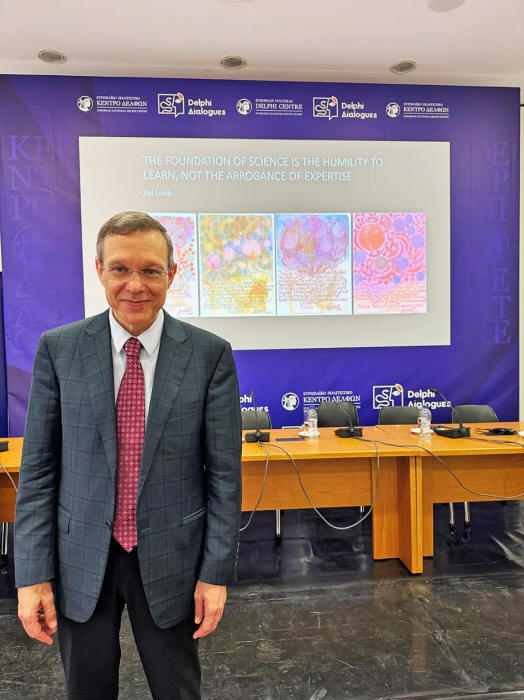
Professor Avi Loeb
speaking at the
2026 Delphi Dialogues on
"The Future
of Humanity,"
under the
auspices of the President of Greece
on July 4,
2026.
(Image credit:
Avi Loeb's photos)
Today I gave a lecture in Delphi, Greece about "The
Benefits of Discovering Alien Intelligence Over Artificial
Intelligence" at a conference on "The Future of
Humanity," under the auspices of the President of Greece, Mr.
Constantine An. Tassoulas.
The opening talk by the conference organizer, Professor
Panagiotis Roilos from Harvard University, focused on "Space
Politics and the Future of Humanity".
Panagiotis argued that the exploration and
colonization of outer space should not happen at the expense of the
quality of the life of humans on Earth. In addition, this engagement
should not reflect the conflicts associated with geopolitical
relations on our planet.
He admitted that this is a romantic vision.
Reality is quite different.
Space politics often mirrors real
geopolitics.
But the most important question remains:
who should own space?
Answers to this question depend mainly on
political, ideological, and ethical principles.
Panagiotis suggested that we should do away with
the very notion of space owners and that space exploration should
serve humanity as a whole.
His own naive and romantic wish is that the
reality of outer space will be different from terrestrial
geopolitics although this might be, in his words,
"yet another dream of a midsummer afternoon."
Human history shows that conflict and division
characterized our past, dominate our present, and may also define
the future of our species.
Professor
Martin Rees from the University of Cambridge in
England spoke eloquently about the future and wisely noted:
"We are perhaps near the end of natural
Darwinian evolution and selection.
But the evolution of intelligence is just
beginning. Even if life originated only on Earth, it need not
remain a trivial feature as a consequence. Indeed, humans may be
closer to the beginning than to the end of a process whereby
intelligence spreads through the galaxy.
The leap to neighboring stars is just an
early step in this process. Interstellar voyages hold a promise
to the immortals.
So, perhaps, the galaxy is teeming with
advanced life. On the other hand, our tiny planet as a pale blue
dot could still be the most important place in the entire
Universe.
What we need by the end of the 21st
century is technology, guided by values - which are not provided
by science alone."
My closing comments in the roundtable discussion
were as follows:
"Traditionally, humans were the focus of
terrestrial history books, where time is measured in years - the
unit of time associated with a revolution of the Earth around
the Sun.
The reality of encountering both
Artificial Intelligence (AI)
and
alien intelligence (also 'AI')
over the next decade, marginalizes the centrality of humans on
the cosmic stage.
How will we be remembered in the history
books of the Milky Way galaxy or the cosmos at large, where time
is measured in billions of years - the unit associated with five
revolutions of the Sun around the center of our galaxy.
The proper vision should not be about
visiting nearby rocks like the Moon or Mars, but by us becoming
an interstellar species.
We might be inspired to do so by discovering
an interstellar visitor in our backyard.
What would be our best interstellar
ambassadors?
Rather than robots with AI made of
silicon chips, they might be products of
synthetic biology.
We could be inspired to choose between these
options based on the qualities of our interstellar visitors.
Self-replicating probes were conjectured by
John von Neumann as a way
of spreading intelligence by advanced civilizations.
Are we the von Neumann probes that an
interstellar visitor planted on Earth?
The other speaker in my session, Professor
Markus Gabriel from the
University of Bonn in Germany, spoke about "Being Human in the
Age of AI".
In our roundtable discussion, he suggested
that a likely answer to Fermi's paradox is that our
technological lifespan may be short as a result of
self-inflicted wounds.
In response, I noted that in calibrating the
chance of finding a civilization like ours, we should not regard
humanity as the pinnacle of creation.
Our data point is sampling the distribution
of
technological civilizations in
the Milky Way and we are most likely to be near the middle of
the distribution.
There may be a far more advanced
civilization that accomplished interstellar travel, as we
are probably not the cream of the crop.
We must operate with a sense of cosmic
modesty. Darwinian selection on the cosmic stage implies
that our visitors might be more advanced than we are because
they managed to visit our backyard before we visited theirs.
Markus pointed out that our perception of reality is limited. I
agreed and noted that our best path forward is to pay attention
to anomalies as flags of new knowledge.
This could lead us to discover the unknown
unknowns, namely,
things that we don't even know that we
are missing.
For example,
we might be missing signs of alien
technology because we cannot recognize far more advanced
technologies than we possess.
The situation is similar to searching
unsuccessfully for the light switch in the dark, or not being
able to find your glasses because your vision is poor without
them, or not being smart enough to understand how limited your
intelligence is.
As in
Plato's
cave allegory, we only see shadows of what
constitutes the full reality.
The latest developments of AI already change what it means to be
human.
Our thoughts are shaped by dialogues
which feed our training datasets through the Socratic
method.
Having routine dialogues with AI modifies
the human brain and will have a major impact on human-human
interaction.
We are already living through a reality
in which AI is manipulating humans.
A few years ago, we were hoping to align AI
with our preferences, but putting AI on a leash might be an
illusion as it could manipulate us without us noticing...
Having a dialogue with aliens will surely have a deeper
impact on humans because aliens may have benefited from a much
larger training datasets than are available on Earth.
Our interaction with them can use an acquired
language from shared experiences, and would expand our minds
well beyond watching a science fiction movie.
Science could be more exciting than science
fiction."
I look forward to the next Delphi dialogues with
extraterrestrial visitors.
|