|

by Michael Snyder
February 17, 2026
from
EndOfTheAmericanDream Website
Article also
HERE
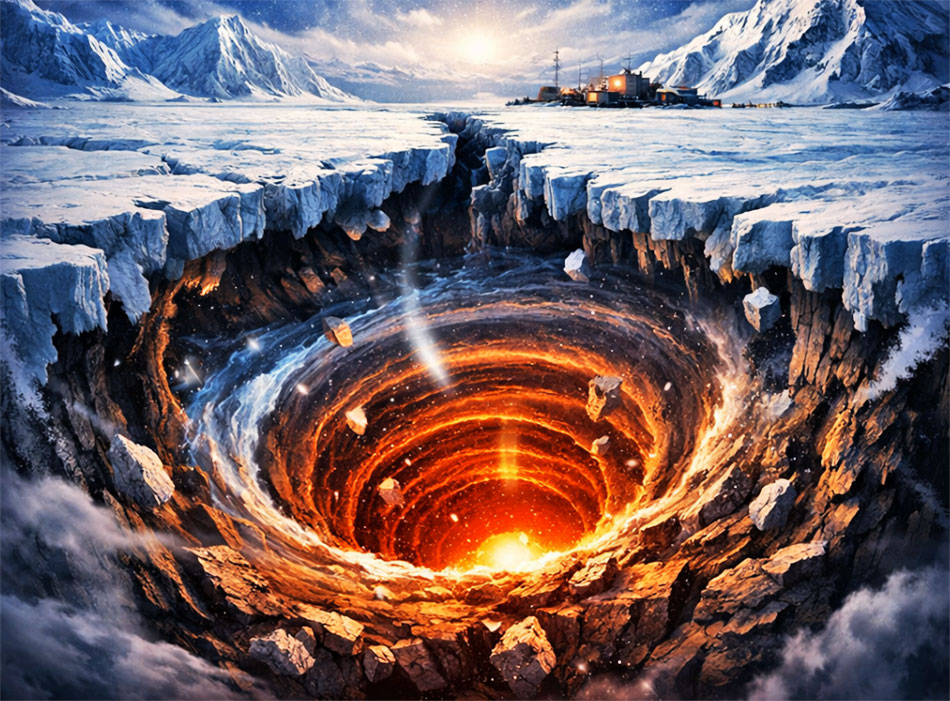
For decades, we were told to ignore any of the strange reports that
we were hearing about
Antarctica.
Experts assured us that nothing unusual was going
on and that there wasn't anything to be concerned about.
Of course we couldn't go investigate for
ourselves, because as you will see below, there are 72 areas of
Antarctica that only those with a special permit are allowed to
enter.
And if you try to fly to Antarctica without
authorization, you will get into all sorts of trouble.
So why all the secrecy?
What are they trying to hide from all the rest of us?
One thing that scientists are admitting about
Antarctica is that it sits directly above
the strongest "gravity hole"
on the entire planet...
Earth may look like a smooth "blue marble"
from space, but it's better to imagine it as a slightly gnarled
orange, with an inside that's firm in parts, but squishier in
others.
Since the planet isn't a perfect sphere and
its internal density varies across the globe, gravitational pull
changes from place to place. Where there's less mass in the
underlying geology, gravity is weaker, and vice versa.
These dips in the gravitational field are formally known as
gravity anomalies, but they're more commonly called "gravity
holes".
The largest is found in the middle of the
Indian Ocean, spanning over 3 million square kilometers (roughly
1,100,000 square miles), while the strongest is found in
Antarctica.
Isn't that interesting?
It turns out that there is a gigantic "hole"
under Antarctica after all.
But the experts are insisting that there really
isn't anything particularly special about it. In fact, they try
to make it
sound as boring as possible...
A "gravity hole" beneath Antarctica sounds like the plot to a bad
sci-fi movie, but it's a very real situation deep beneath the
Earth's surface stretching back tens of millions of years.
The phenomenon thankfully isn't as apocalyptic as
it sounds, either.
In fact, researchers say these complex
interactions between rock densities, gravitational pull, and sea
levels are actually helping them understand how the southernmost
continent's ice sheets evolved, and what their influences mean
for the planet's climate.
That does sound pretty boring...
But could it be possible that there is a lot
more to this than we are being told?
It is being reported that the team of researchers
that mapped the colossal gravity hole directly under Antarctica was
able to use a combination of methods to actually "reconstruct the
three-dimensional structure" that exists underneath the continent...
In the study (Cenozoic
Evolution of Earth's strongest Geoid low illuminates Mantle
Dynamics beneath Antarctica), published recently in
Scientific Reports, Alessandro Forte and Petar
Glišović, Ph.D., of the Paris Institute of Earth Physics,
mapped the Antarctic gravity hole and revealed how it developed
over millions of years.
They relied on an Earth-spanning scientific
project that combined global earthquake recordings with
physics-based modeling to reconstruct the three-dimensional
structure inside Earth.
"Imagine doing a CT scan of the whole Earth, but we don't have
X-rays like we do in a medical office. We have earthquakes.
Earthquake waves provide the ‘light' that
illuminates the interior of the planet," Forte said.
It certainly appears that something is down
there.
Could some of the reports that we have heard over the years actually
be true?
I wouldn't hold your breath waiting for the truth to come out.
Much of the continent is strictly off limits unless you have a
special permit.
In fact, according to
Wikipedia there are 72 sites that
have been designated as Antarctic Specially Protected Areas...
An Antarctic Specially Protected Area
(ASPA) is an area on the continent of Antarctica, or on nearby
islands, which is protected by scientists and several different
international bodies.
The protected areas were established in 1961
under the
Antarctic Treaty System, which governs all the land
and water south of 60 latitude and protects against human
development. [1]
A permit is required for entry into any ASPA
site. [2]
The ASPA sites are protected by the
governments of Australia, New Zealand, United States, United
Kingdom, Chile, France, Argentina, Poland, Russia, Norway,
Japan, India, Italy, and Republic of Korea.
There are currently 72 sites.
They take security in Antarctica quite seriously.
When a 19-year-old American named Ethan Guo decided that he would
fly down there without permission, he was immediately arrested...
A teenage pilot, who is attempting to fly all
seven continents solo, hit a patch of rough air this weekend
when Chilean authorities detained him for changing his flight
plan without their permission and landing in Antarctica.
Chilean prosecutors say American influencer Ethan Guo,
19, broke "multiple national and international regulations" by
changing his flight plans without prior notice, landing on a
part of Antarctica where the South American country maintains a
territorial claim.
CNN requested a comment from Guo, whose lawyer on Sunday said
the young pilot had experienced "complications" while flying.
Yes, tourists can visit Antarctica.
But you must carefully obey the rules, and you must not wander away
from the very limited areas that tourists are allowed to see.
Of course most of the good stuff is in areas where tourists are
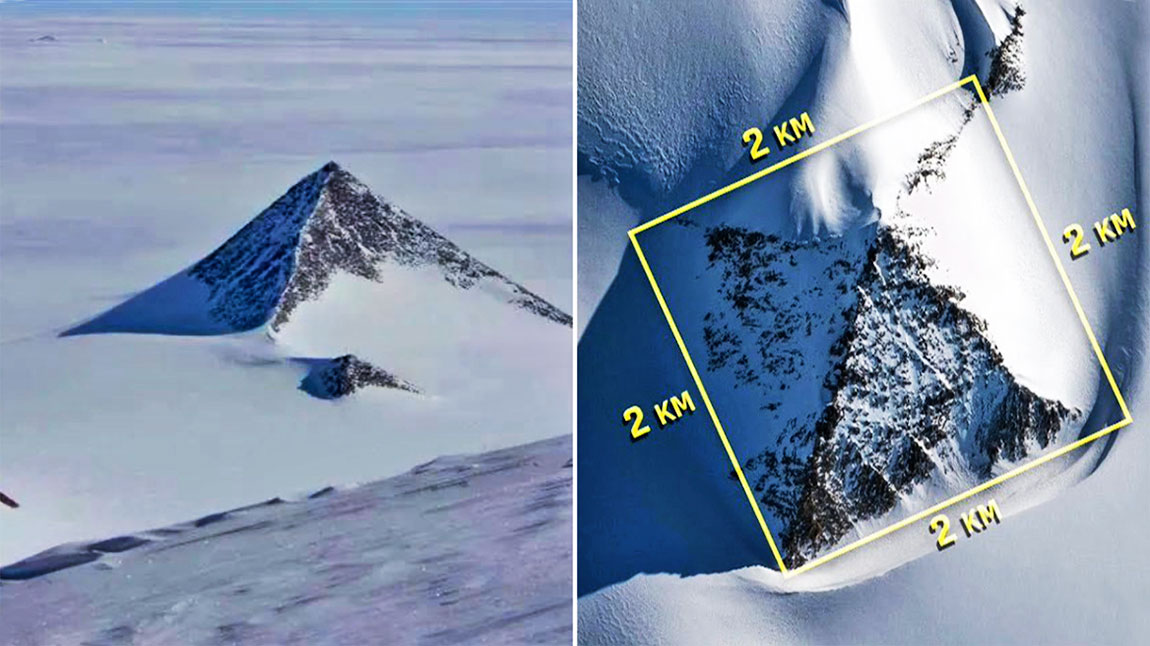
never allowed, and that includes the colossal pyramid that appears
to have been man-made...
I have to admit, the symmetry of that structure is quite striking.
But even though it looks like an ancient Egyptian pyramid, the
official story is that this is simply a naturally-occurring
structure that was
shaped by erosion... [sic]
In the vast, icy expanse of Antarctica, lies
a mountain that, from an aerial view, resembles an ancient
Egyptian pyramid.
This striking
formation, nestled in a sea of snow, has captured the imagination of
internet users since it went viral in 2016.
However, this
pyramid-like mountain is no work of human or alien architects; it's
a product of nature's slow and relentless erosion.
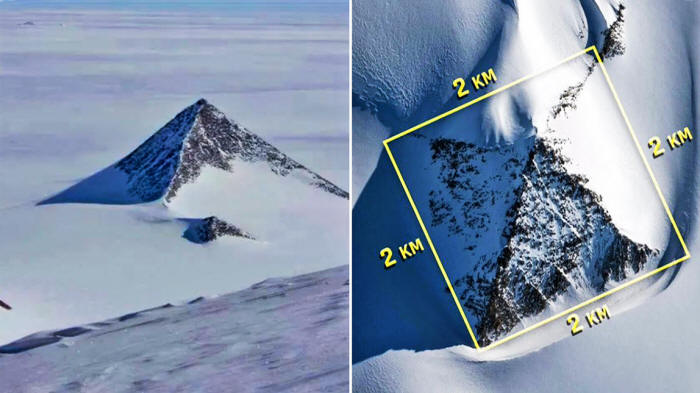
This unnamed mountain stands about 4,150 feet tall.
It's located in
the southern part of the Ellsworth Mountains, a rugged range first
glimpsed by American aviator Lincoln Ellsworth in 1935.
The
mountain's pyramid shape is particularly notable because it has four
steep sides, a feature that isn't common among mountains.
I wish that I could go see it for myself.
But that certainly isn't going to happen any time soon.
Interestingly, a "ring of fire" solar eclipse was visible in
Antarctica
on Tuesday...
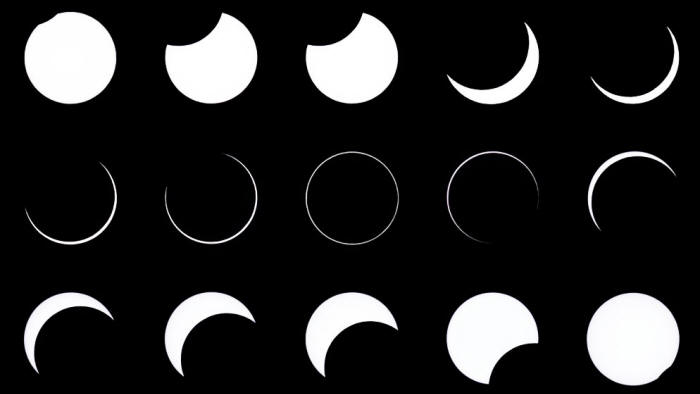
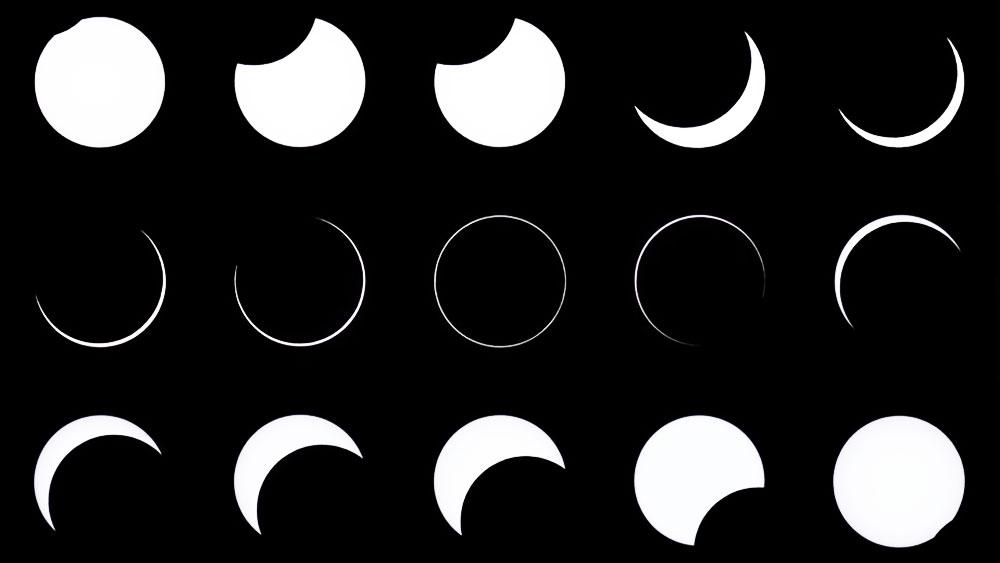
Phases of an
annular eclipse
captured over
Argentina in 2017.
Image credit:
ALEJANDRO PAGNI/AFP
via Getty Images
A magnificent annular solar eclipse just swept over Antarctica,
putting on an impressive display of orbital mechanics as the moon
passed in front of the sun at the perfect distance from Earth to
create a fiery halo in a darkened sky - at least for the few souls
lucky enough to be in a position to see it.
Feb. 17's annular solar eclipse occurred as the lunar disk slipped
between the sun and Earth during its new moon phase.
The alignment
occurred as the moon travelled through a distant point in its
elliptical orbit, making it appear smaller than usual in Earth's
sky.
Today's eclipse got underway at 4:56 a.m. EST (0956 GMT), as the
moon took an ever greater bite out of the solar disk, transforming
its burning orb into a glowing crescent, before finally diving
entirely within its fiery expanse.
The moon - appearing fractionally
smaller than usual - was unable to cover the entirety of the sun's
disk, leaving a thin sliver of its outer edge visible to surround
Earth's natural satellite to create a ring in the skies over
Antarctica.
So many unusual things are happening in the heavens this year.
Next month there will be a spectacular blood moon eclipse, and the
month after that an
absolutely enormous comet may be visible to the
naked eye during the daytime as it travels very close to the Sun.
We live in such interesting times, and I have a feeling that they
will become even more interesting during the months ahead.
|