|

by
Jamey Keaten
April 01, 2025
from
APNews Website
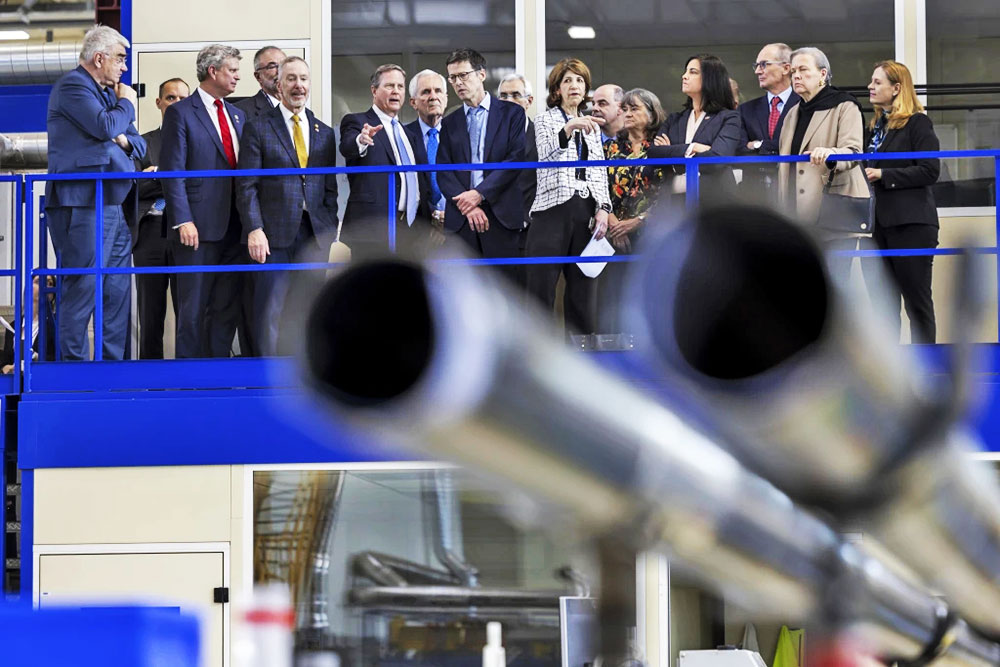
Mike Lamont, director for
accelerators and technology, center left,
and Fabiola
Gianotti, center right,
director
general of the European Organization for Nuclear Research (CERN),
speak with
members of the U.S. House of Representatives
in the Large
Magnet Facility during a visit to CERN facilities
in Meyrin, near
Geneva, Switzerland, Friday, March 21, 2025.
(Salvatore Di
Nolfi/Keystone via AP)
GENEVA (AP)
Top minds at the world's largest atom smasher
have released a blueprint for a
much bigger successor that could
vastly improve research into the remaining enigmas of physics.
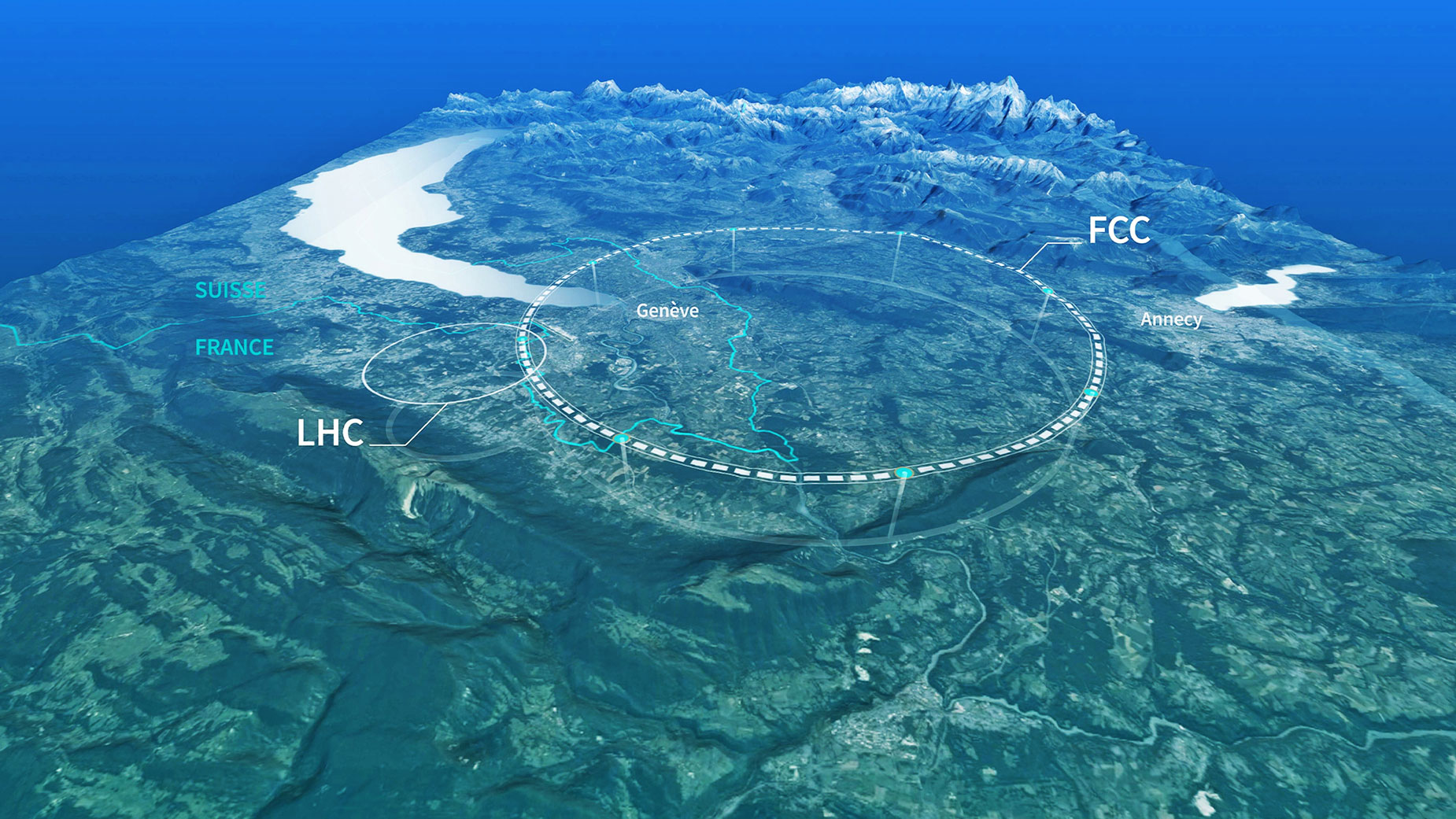
The plans for the Future Circular Collider - a nearly
91-kilometer (56.5-mile) loop along the French-Swiss border and
below Lake Geneva - published late Monday put the finishing details
on a project roughly a decade in the making at
CERN, the
European Organization for Nuclear Research.
The FCC would carry out high-precision experiments in the mid-2040s
to study "known physics" in greater detail, then enter a second
phase - planned for 2070 - that would conduct high-energy collisions
of protons and heavy ions that would,
"open the door to the unknown," said
Giorgio Chiarelli, a
research director at Italy's National Institute of Nuclear
Physics.
Europe plans
Next-generation Collider
Scientists at CERN, the European Organization for Nuclear
Research, have unveiled plans to build a super-sized atom
smasher called the Future Circular Collider to succeed
the Large Hadron Collider and further probe the mysteries of
physics.
A schematic
map showing a possible location
for the Future
Circular Collider.
(Image credit: CERN)
Source
"History of physics tells that when there is
more data, the human ingenuity is able to extract more
information than originally expected," Chiarelli, who was not
involved in the plans, said in an e-mail.
For roughly a decade, top minds at CERN have been
making plans for a successor to the
Large Hadron Collider, a network of
magnets that accelerate particles through a 27-kilometer (17-mile)
underground tunnel and slam them together at velocities approaching
the speed of light.
The blueprint lays out the proposed path, environmental impact,
scientific ambitions and project cost.
Independent experts will take a look before
CERN's two dozen member countries - all European except for Israel -
decide in 2028 whether to go forward, starting in the mid-2040s at a
cost of some 14 billion Swiss francs (about $16 billion).
CERN officials tout the promise of scientific discoveries that could
drive innovation in fields like cryogenics, superconducting magnets
and vacuum technologies that could benefit humankind.
Outside experts point to the promise of learning more about the
Higgs Boson, the
elusive particle that has been
controversially dubbed "the God particle," which helped explain how
matter formed after
the Big Bang.
Work at the Large Hadron Collider confirmed
in 2013 the existence of the Higgs boson,
the central piece in a puzzle known as the standard model that helps
explains some fundamental forces in the universe.
CERN Director-General
Fabiola Gianotti said the
future collider,
"could become the most extraordinary
instrument ever built by humanity to study the constituents and
the laws of nature at the most fundamental levels in two ways,"
by improving study of the Higgs boson and paving the way to
"explore the energy frontier",
...and by looking for new physics that explain
the structure and evolution of the universe.
One unknown is whether the
Trump administration, which has
been
cutting foreign aid and
spending in academia and research,
will continue to support CERN a year after the
Biden administration pledged
U.S. support for the study and collaboration on the FCC's
construction and "physics exploitation" if it's approved.
The United States is home to 2,000 users of
CERN, making them the single largest national contingent among
the 17,000 people working there, including outside experts
abroad and staff on site, Gianotti said.
While an observer state and not a member, the
U.S. doesn't pay into the CERN regular budget but has contributed to
specific projects. Most of the CERN regular budget comes from
Europe.
Costas Fountas, the CERN
Council president, said he had spoken with some U.S. National
Science Foundation and Department of Energy staff who relayed the
message that so far,
"they're 'under the radar of the cuts of the
Trump administration'. That's their words."
CERN scientists, engineers and partners behind
the plans considered at least 100 scenarios for the new collider
before coming up with the proposed 91-kilometer circumference at an
average depth of 200 meters (656 feet).
The tunnel would be about 5 meters (16 feet) in
diameter, CERN said.
|