|
Article also
HERE
For decades, the greatest threats to global stability were often imagined as distant possibilities - events reserved for history books, military simulations or the darkest years of the Cold War.
Today, that assumption is becoming increasingly difficult to defend.
International defense spending has reached levels not seen in decades, armed conflicts continue to reshape regional security architectures, and governments across Europe, North America and Asia are investing heavily in civil defense, cybersecurity and the protection of critical infrastructure.
These are not preparations made in anticipation
of ordinary times, but responses to a world that has become
measurably more volatile than it was only a few years ago.
More often, they are changed by a sequence of crises that appear unrelated until they begin reinforcing one another - geopolitical confrontation, economic instability, infrastructure failures and the gradual erosion of public confidence.
Whether viewed through the lens of preparedness, national security or historical precedent, one conclusion remains remarkably consistent:
Top Three
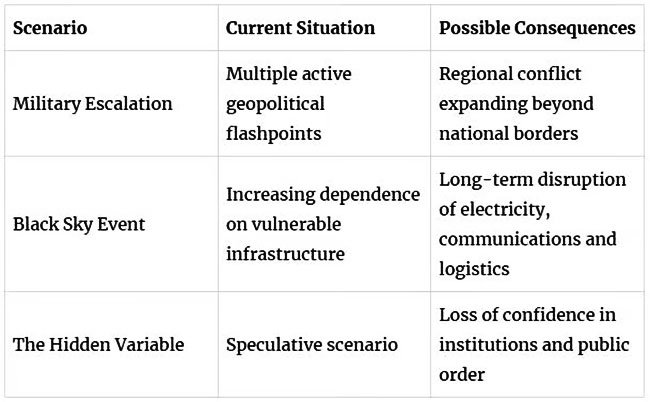
Unstoppable SHTF Scenarios
One of the biggest misconceptions about large-scale disasters is that they begin with a single dramatic event.
Movies have trained us to expect sirens, mushroom clouds and emergency broadcasts interrupting television programming. Reality has been far less theatrical.
Most crises begin quietly, almost anonymously,
disguised as temporary inconveniences that appear manageable until
they suddenly aren't.
Looking back now, it's easy to say the warning signs were obvious.
At the time, they blended into the constant flow of headlines competing for attention every single day. That pattern has repeated itself throughout history.
Major disruptions rarely arrive without warning;
they arrive surrounded by so much background noise that almost
nobody recognizes them until hindsight turns scattered events into
an obvious timeline.
None of those developments automatically lead to
global conflict, but together they create an environment where a
single mistake could carry consequences well beyond the region where
it begins.
History contains numerous examples of conflicts
that expanded not because every participant wanted war, but because
every participant believed the other side had already decided that
war was unavoidable.
2. The Black
Sky Event
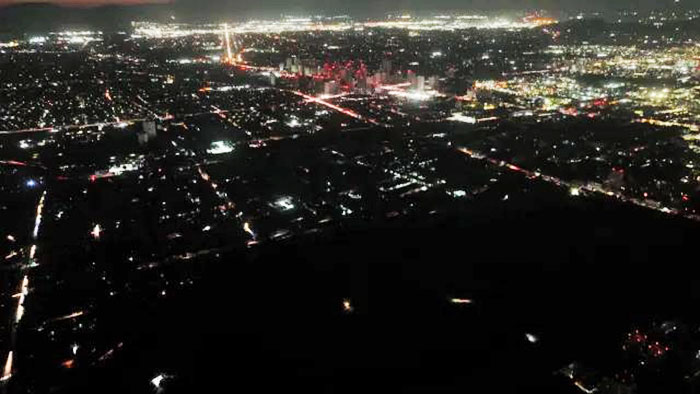
Few people spend much time thinking about the electrical grid.
It is one of those systems that exists almost entirely in the background, quietly supporting modern life without demanding much attention from the people who depend upon it every single day.
The greatest achievement of modern infrastructure may not be its scale, but its ability to disappear into everyday life.
Only when one part of the system stops working
does the extraordinary complexity behind ordinary routines become
impossible to ignore.
The motivation is not difficult to understand.
Modern economies rely upon systems that exchange enormous amounts of information every second, balancing electricity demand, coordinating transportation schedules and synchronizing financial transactions with remarkable precision. A disruption affecting one network rarely remains confined to a single location.
Even relatively localized failures can create
unexpected consequences elsewhere, not because the systems are
fragile by design, but because they have become deeply
interconnected through decades of technological progress.
Instead, it unfolds gradually, almost quietly, in a manner that resembles the opening stages of previous crises.
None of these developments appears catastrophic on its own.
Each can be explained individually. Together, however, they begin creating a pattern that attracts far more attention than any isolated incident would have received only days earlier.
What makes the situation increasingly difficult to interpret is the speed at which uncertainty travels.
Modern societies produce an extraordinary volume of information every hour, yet during periods of disruption the demand for answers almost always exceeds the supply of verified facts.
News organizations rely upon official briefings that evolve as new information becomes available. Independent analysts compare satellite imagery, transportation data and publicly available infrastructure reports, frequently arriving at different conclusions.
Social media platforms amplify eyewitness
accounts from thousands of locations simultaneously, mixing accurate
observations with misunderstandings, speculation and deliberate
misinformation until distinguishing one from another becomes a
challenge in itself.
Under ordinary circumstances, these arrangements represent one of the greatest strengths of the global economy.
During periods of sustained disruption, however,
even modest delays can begin affecting sectors that appear unrelated
at first glance.
Engineers focus on restoring damaged infrastructure, while government agencies attempt to coordinate information across multiple jurisdictions.
Businesses activate continuity plans that had existed largely on paper until circumstances required their implementation. Some organizations transition smoothly to backup systems, while others discover that contingency measures designed years earlier no longer reflect the complexity of present-day operations.
Every hour brings incremental progress in some
areas and unexpected setbacks in others, creating an environment
where optimism and concern coexist in equal measure.
These individual decisions seem reasonable when
viewed independently, yet together they begin reshaping daily life
in subtle but unmistakable ways.
The real question is no longer whether power will eventually return, but how a society built upon continuous connectivity adapts when continuity can no longer be taken for granted.
That question, more than any technical
explanation or engineering report, becomes the defining theme of the
weeks that follow.
3. The Hidden
Variable
These events dominate headlines because they can be measured, mapped and documented.
They leave behind damaged infrastructure,
economic losses and political consequences that analysts can examine
long after the immediate emergency has passed.
History suggests that societies rarely unravel because of a single catastrophe.
More often, they are tested by uncertainty itself.
The modern information environment has transformed that process in unprecedented ways.
This democratization of information has created
extraordinary opportunities for transparency, but it has also made
distinguishing reliable reporting from incomplete or manipulated
content considerably more difficult.
Accurate reporting becomes increasingly valuable precisely because it is competing against an overwhelming volume of conflicting claims.
This gradual erosion of certainty produces consequences that extend well beyond politics.
None of these individual decisions appears
dramatic in isolation. Collectively, however, they can reshape
economic activity far more effectively than a single headline ever
could.
Once confidence begins deteriorating, restoring it often proves considerably more difficult than repairing damaged infrastructure or rebuilding physical assets.
One of the defining characteristics of the digital age is that every major event now unfolds simultaneously across multiple realities.
The physical event occurs first. Within minutes it is interpreted by journalists, government agencies, financial analysts, independent researchers and millions of ordinary citizens, each bringing different assumptions and priorities.
By the end of the day, the public conversation
may no longer revolve around the original event itself, but around
competing explanations of what it means and what should happen next.
The speed of communication has increased exponentially, while the speed of verification has not.
Reliable conclusions almost always arrive more
slowly than speculation, creating an unavoidable gap between public
demand for immediate answers and the time required to produce them
responsibly.
Restoring electricity, reopening transportation corridors or stabilizing financial systems remains essential, but maintaining public confidence increasingly depends upon something equally important:
Without it, even temporary disruptions can appear
far larger than they actually are, while isolated incidents may be
interpreted as evidence of broader systemic failures.
In reality, modern societies have become so interconnected that developments in one domain inevitably influence the others.
Whether future crises resemble past events or take entirely new forms, one principle remains remarkably consistent.
The resilience of a society depends not only upon the strength of its military, the sophistication of its technology or the size of its economy, but also upon its ability to adapt when certainty becomes scarce.
Throughout history, civilizations have demonstrated an extraordinary capacity to recover from disasters that once appeared overwhelming.
The greatest advantage has rarely been perfect
preparation or flawless prediction. More often, it has been the
willingness to remain adaptable, cooperate across institutions and
communities, and make informed decisions despite incomplete
information.
The headlines that define an era usually arrive only after months, and sometimes years, of developments that seemed disconnected while they were unfolding.
The same pattern can be found across countless
historical events, where the decisive turning point often becomes
obvious only after enough individual pieces have fallen into place.
Although military conflict, infrastructure disruption and institutional uncertainty appear to belong to different worlds, they are ultimately linked by the same underlying reality:
Each development interacts with countless others,
creating consequences that are often impossible to predict from any
single event alone.
Human beings naturally interpret new developments through the lens of previous experience.
Most of the time, those assumptions prove correct.
Societies recover, institutions adapt and
ordinary life gradually resumes. It is precisely because this
pattern has repeated so often that genuinely transformative moments
are frequently underestimated during their earliest stages.
At its core, preparedness has always reflected something far broader:
History consistently rewards flexibility over certainty.
One lesson emerges repeatedly from past crises.
During periods of uncertainty, headlines compete for attention, opinions multiply and speculation often spreads faster than verified facts.
The challenge is not simply finding more information, but learning how to evaluate it carefully, recognizing the difference between immediate reactions and longer-term trends.
Decisions made under pressure rarely benefit from
panic, yet they also suffer when obvious warning signs are ignored.
Maintaining that balance has always been one of the defining
characteristics of resilient societies.
Advances in technology, communication and global trade have delivered extraordinary prosperity and unprecedented convenience, while simultaneously creating new forms of dependency that earlier generations never experienced.
That duality is likely to define many of the challenges ahead.
Every innovation that strengthens society also
introduces new questions about resilience, complexity and the
unintended consequences of living in a world where events on one
side of the planet can influence daily life on the other within
hours.
History has repeatedly demonstrated that resilience is rarely built in the middle of a crisis.
No one can predict precisely what the next defining global crisis will look like. It may resemble challenges experienced before, or it may emerge from directions that currently receive little attention.
What history suggests with remarkable consistency is that the first signs are seldom recognized for what they are.
Only later, when enough connections become
visible, does the larger picture begin to emerge.
More often, they begin quietly, almost unnoticed,
hidden within the ordinary rhythm of everyday life until the moment
that rhythm changes - and the world realizes it has already
entered a new chapter...!
|