|
from SavageMinds Website Information sent by MJGdeA
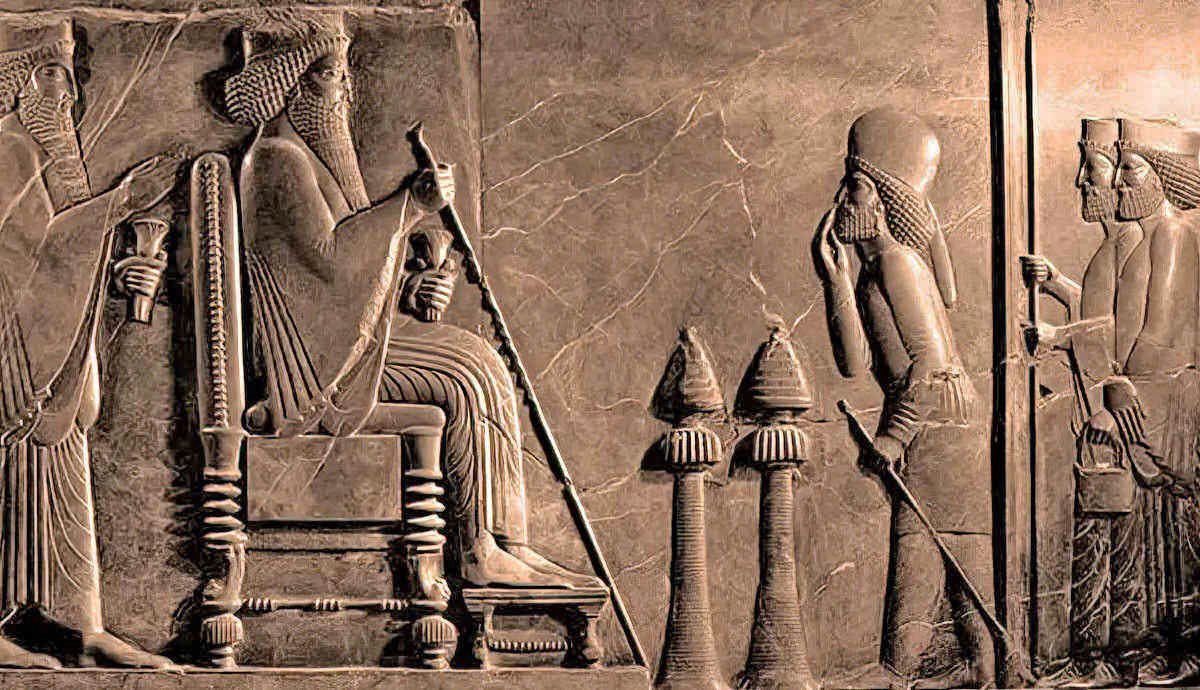
depicts an Achaemenid king enthroned (generally identified as Darius I) with his son and successor, Xerxes I, standing behind him. This 5th-century BC stone carving, originally from the Apadana staircase, symbolizes the continuity, legitimacy, and hereditary power of the Persian royal line. Photo credit: Boris Dubensky
Yet history occasionally offers a more unsettling lesson:
The early seventh-century war between
Byzantium and
Sasanian Persia - echoed in the
Quranic Surah Ar-Rum - offers precisely such a lesson, one that
resonates uncomfortably in today's geopolitical landscape,
particularly in understanding Iran's strategic culture and
resilience.
The Byzantine Empire, once the eastern pillar of
Rome, looked terminal. Contemporary observers saw not merely defeat,
but civilisational unraveling.
Emperor Heraclius, presiding over what seemed a dying state, reorganized, mobilized resources - including melting ecclesiastical wealth - and launched a counteroffensive that culminated in the decisive Battle of Nineveh in 627.
Persia, overstretched and internally brittle,
imploded soon after. The remarkable precision of this reversal -
occurring within a narrow window of years - has often been treated
as theological validation.
That anatomy bears a striking resemblance to the
modern Islamic Republic of Iran.
Yet such readings overlook the deeper historical grammar that shapes Iranian statecraft - one forged not in uninterrupted dominance but in cycles of invasion, recovery, and adaptation.
Like the Sasanian, Safavid, and Qajar experiences,
The Byzantine-Sasanian war underscores a critical miscalculation that contemporary policymakers risk repeating:
Persia's early victories were overwhelming, but they produced overextension.
Administering vast conquered territories - from
Syria to Egypt - strained logistics, diluted military focus, and
created governance vacuums.
Persia's rapid overextension was not a failure of
power but of gravity - its victories expanded faster than its
capacity to hold them, turning conquest into quiet collapse.
Iran, by contrast, has invested in asymmetric
endurance - cultivating proxy networks, embedding influence within
fractured states, and leveraging ideological cohesion as a force
multiplier.
Economic warfare provides another parallel.
The Persian capture of Egypt effectively imposed a grain blockade on Constantinople, triggering famine and desperation.
Today, sanctions regimes operate as a modern
analogue of what some scholars describe as "contemporary siege
warfare," inflicting systemic pressure without direct military
confrontation. Iran has lived under such conditions for decades.
But it does challenge a persistent assumption in Western policy circles:
History suggests otherwise.
Equally instructive is the role of narrative...
In the early Muslim community, the prophecy of Byzantine recovery functioned as a psychological counterweight to despair.
Iran's political discourse similarly situates
present struggles within an expansive historical arc - one that
stretches from ancient empires through colonial encroachments to
contemporary resistance.
There is something profoundly disorienting about
engaging an actor whose strategic memory stretches well beyond the
Westphalian frame - back through revolution and empire, through
invasion and restoration, through cycles where fall quietly precedes
resurgence.
The prevailing diplomatic instinct - to compress
outcomes into electoral timelines, to measure success in quarterly
shifts of compliance - collides with a strategic culture that
metabolizes hardship slowly, almost deliberately.
Iran, like other historically burdened states, does not simply react to pressure:
And in a
multipolar order where time
horizons are fragmenting, that asymmetry becomes power.
The lesson is not confined to Tehran. It extends to any polity shaped by civilisational depth:
Since 1979, Iran has refined a strategic identity
built not on isolation but on adaptive resistance, transforming
revolutionary shock into a durable geopolitical method.
Engagement can no longer be episodic or purely transactional; it must be layered, historically literate, and attuned to the emotional architecture of states that carry memory as strategy.
There is an almost paradoxical truth at play:
In that sense, the future of global order
may not be decided solely by those who project force most
effectively, but by those who have learned - through centuries of
defeat and renewal - how to wait, how to endure, and ultimately, how
to reshape the meaning of victory itself.
Today's Middle East is similarly fluid, with shifting partnerships in evolving Gulf-Iran dialogues - reshaping the strategic map.
The Gulf-Iran rapprochement is not reconciliation in the Western sense but a quiet recalibration of fear, where rivals choose managed coexistence over mutual exhaustion, recognizing that endless conflict only invites external dominance.
In nuclear diplomacy, this temporal
asymmetry turns every deadline into an illusion, as Iran negotiates
not to concede the present but to outlast it.
The Byzantine-Sasanian conflict, described as the last great war of antiquity, ended not with a stable balance but with mutual exhaustion.
In contemporary terms, this raises uncomfortable questions about great-power competition today.
In a prolonged contest between major powers,
Iran's trajectory suggests that resilience, not dominance, may be the more decisive currency in such an environment.
It is a lesson drawn not from triumphalism, but from survival against the odds. And it is a reminder that in international relations, the seeds of tomorrow's order are often sown in the soil of today's apparent defeat.
For those crafting policy in an era of uncertainty, the message is clear, if disquieting:
|