|
by A Midwestern Doctor the most challenging moment of our Lives...
Prior to the COVID-19 vaccines being released, many concerns were raised about these experimental gene therapies, including their potential for causing infertility, autoimmune diseases, and cancer (e.g., many of the theoretical autoimmune issues were summarized by Stefanie Seneff shortly after the vaccines hit the market).
So, when Pfizer's regulatory submission to Europe's FDA (the EMA) was leaked on December 9, 2020, I read through it in detail and discovered that Pfizer simply had been allowed to exempt itself from testing the vaccine for the above three key issues (despite that testing being required for gene therapies).
Pfizer concluded their best option was to simply claim plausible deniability by insisting they "didn't know" their vaccines would do all of that (because they'd "never" tested for them).
Regrettably, due to the 'religious' fervor surrounding the vaccine (e.g., that it would rescue us from the lockdowns and return everything to normal), my arguments to wait on the vaccine largely fell on deaf ears with my colleagues and instead, excuse after excuse was made to dismiss the highly unusual and severe complications our patients kept developing immediately after vaccination (e.g., "there's no evidence for this").
Before long, people I knew around the country began contacting me with severe complications following the vaccination (e.g., dying suddenly or an elderly relative rapidly progressing into dementia) to ask if it could be linked to the vaccine.
Hating that there was nothing at all I could do to stop this (I felt like an ant in front of a tsunami), I then decided I needed to document all of them so that I'd at least have some type of "evidence" I could show my skeptical colleagues (as I knew the medical journals would never allow vaccine injury datasets to be published).
In the process of doing that, I came across numerous cases of cancers rapidly developing (or dormant ones that had been in remission for years coming back) immediately following COVID vaccination, including numerous unusual cases that strongly argued the two were linked.
Before long, more and more people noticed similar things, and the notion of COVID-19 "turbo cancers" entered the cultural lexicon.
Since that time, the medical orthodoxy has denied that this is an issue, but more and more datasets are emerging showing it is.
Scott Adams
When Trump ran for office in 2016, initially very few people believed Trump could win (e.g., this was shown in the political betting markets).
However, Dilbert's author Scott Adams did, and rapidly built a large online following by highlighting how his training as a hypnotist allowed him to recognize that Trump was the most politically persuasive candidate and hence, Scott hypothesized, was favored to win.
As such, once Trump won, Scott pivoted to using that same lens (how persuasion shapes political events) to become a pundit on a variety of other current issues.
During that process, Scott Adams made the controversial decision early on to endorse the COVID vaccine to his followers and to vaccinate.
I know of multiple other instances where individuals who were long considered "experts in propaganda" made the decision to get the COVID vaccine - something which I view as a testament to just how effectively the vaccine was marketed.
Later, in January 2023, to his great credit, Scott posted a video essentially admitting he was wrong and the anti-vaxxers ended up being entirely correct.
Then, on May 19, 2025, Scott Adams disclosed to his audience that,
Scott eventually tried a variety of cutting-edge conventional therapies recommended by top oncologists and, among other things, had the Trump administration directly intervene on his behalf with Kaiser when his access was abruptly cut off (highlighting the challenges patients without connections routinely face in the medical system).
Nonetheless, nothing worked, and he gradually became weaker and weaker until he said his final goodbyes to his followers and passed away at home on January 13, 2026.
Changing Relations with Death
People are so afraid to die that they never begin to live. Henry Van Dyke
In 1976, Ivan Illich published Medical Nemesis, which critiqued the medical system and predicted many of the issues which emerged in the decades that followed.
One key theme was that through the medical profession's marketing, our cultural conception of death evolved from an intimate, lifelong companion we had no separation from to a feared, medicalized entity to be conquered by doctors with death being defined by the cessation of brain waves.
Note:
as I show
here, the modern criterion for death is quite dubious, existing
to support organ donations and eliminate the long-term costs of
treating vegetative patients.
He also argued that this Western death image had been exported globally, supplanting traditional dying practices and contributing to societal dysfunction by alienating people from their own mortality.
Medicalized Death
Presently, one of the most common settings for death in America is within the hospital...
This however is controversial as:
For example, to quote a 2016 article in Time:
Note: another 2016 study found 27.9% of physicians vs. 32% of the general population chose to die in hospitals, and during the last six months of life physicians were less likely to have surgery (25.1% vs. 27.4%) and less likely to be admitted to the ICU (25.8% vs. 27.6%).
Likewise, a viral 2011 essay highlighted that doctors preferred to die at home with less invasive therapies.
Note: many patients do not know that the overall survival rate with hospital resuscitation is around 23-25%, making it typically futile (while outside the hospital CPR hovers closer to 10%).
Our society has essentially put doctors into the role priests once occupied, but without the training that role typically requires.
Doctors hence are frequently sought out for consultations on life and death despite not being spiritually prepared for that responsibility - which inevitably leads to issues arising.
In turn, I and colleagues strongly feel:
Furthermore, in many cases, hospital care is "futile" because incorrect therapies are being utilized, and modern financial incentives are set so that doctors are not sufficiently trained or supported in bringing sick patients back to health (discussed here).
a major reason I am working so hard to build a robust case for and interest in forgotten therapies like ultraviolet blood irradiation and DMSO is that these therapies can radically improve hospital outcomes (e.g., UVBI frequently cures life threatening infections that do not respond to conventional treatments, while DMSO cures severe neurological injuries like strokes and traumatic brain injuries medicine has struggled with for decades - to the point dozens of readers have now shared DMSO with me saved them from a stroke and the life of "inevitable" disability that would have followed).
Fortunately, there has been some progress in this area, and the percentage of American deaths in hospitals has gradually decreased while hospice care has become more widely available.
Unfortunately, this has dovetailed with medically assisted in dying (MAID) being made more and more available (e.g., in 2024, 5.1% of deaths in Canada were from MAID) and gradually being pushed upon patients with chronic physical or psychiatric illnesses that socialized medical systems do not wish to address.
one of the most amazing stories I discovered about MAID was that some providers only allow you to receive MAID if you have been vaccinated against COVID.
Patient Values
Because of the immense power doctors are entrusted with and the ability to harm others (particularly psychologically and spiritually), medical ethics training is vital, but has been largely neglected in modern medical education.
In medical ethics, one of the foundational premises everyone is taught is that patient autonomy and values must be respected - but as shown by events like COVID vaccine mandates, medical ethics are discarded when it's not convenient and interferes with making money...!
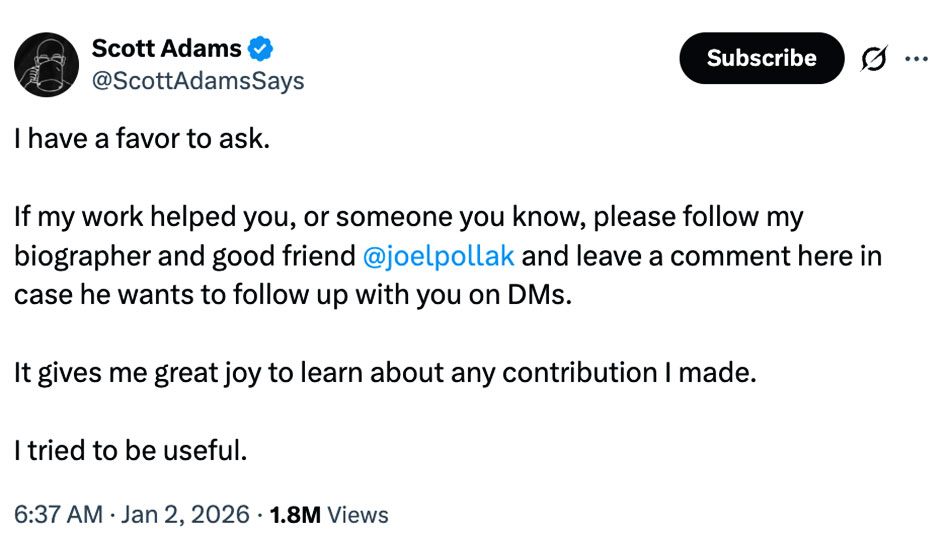
For example, when Scott realized his condition was terminal, he decided that he wanted to spend his remaining time engaging with his followers through his political podcast as much as possible, even when he was on the verge of death.
Had I been in Scott's position, the last thing I would be doing in my last days would be being online.
However, those were Scott's values, so when I saw a post where Scott said he expected to pass in the near future, I wanted to honor them and asked a mutual friend to relay this message to him:
Note: out of respect for Scott's autonomy, I deliberately worded my message so as not to ask for anything or project any emotional needs onto him.
A few hours after receiving that message, Scott then posted this on his page, in turn corroborating that this touched upon the core values he'd adopted at the end of life:
Likewise, once he passed a detailed note was posted from his account stating:
Note: all things considered, I feel Scott handled his dying process quite well (particularly given how much more challenging it is when a large number of people are involved in what would otherwise be a very private process) and provided many vital lessons on the healthy ways to navigate death.
What Really Matters?
Society always revolves around competing parties trying to hijack your attention and resources to gain wealth and power.
Many people carry belief systems implanted in them that lead them to pursue things that do not bring joy or happiness. It is frequently only at the end of life that these unhealthy filters break, and people realize what actually mattered to them.
Typically, that is some combination of:
This powerfully reinforces why the medicalization of death is so problematic:
Meanwhile, the clear-eyed perspectives of those nearing death offer something invaluable - a rare, unfiltered counterweight to society's pressure to chase superficial pursuits that so many later regret.
Note: it is also often important for the dying person's associates to resolve what they have with them before the individual passes. People normally benefit immensely from some form of resolution before death (e.g., grief will affect them for a much shorter period).
Consciousness and Death
One of the major tensions within our culture has been materialistic science (which effectively became our society's dominant religion), rejecting the spiritual aspect of our existence.
While this mechanistic model can explain many phenomena, it falls short on aspects of the human experience interwoven with spirit.
For example,
I've hence tried to touch upon the evidence science has collected that undermines its materialistic paradigm, particularly in an article on organ transplantation that discussed two of the greatest mysteries in medicine, where I provided evidence that:
These points challenge a central dogma of science's materialistic paradigm:
This is particularly poignant for the dying process, since many who witness deaths report profound occurrences suggesting consciousness transforms and travels at death rather than vanishing into thin air once the brain "turns off."
Likewise, this recognition of spirit persisting beyond the physical body was foundational to how every tradition which has stood the test of time navigated the death process.
Note: numerous spiritually attuned doctors and nurses I've met over the years shared that this drew them into hospice care - the most fulfilling part of their careers because of how much they helped patients and the profound experiences they had (some mirroring the literature on "Shared Death Experiences").
Conclusion
Death is a core facet of the human experience, and like many, I deeply believe accepting it rather than denying and fearing it is critical for allowing one of the most critical moments in our life to proceed in the healthiest way possible.
Likewise, as I've tried to show here,
With the dying process, one of the most important things is recognizing,
My hope is that this article will give you critical insights for drafting your own living will and advanced care directive so your autonomy is preserved when you're least able to advocate for yourself.
I sincerely thank you for opening...
Author's note: This is an abridged version of a longer article which goes into greater details on the points mentioned here, particularly the spiritual facets of dying and navigating the death transition. That article, along with the approaches we've learned are critical for improving the dying process can be read here...
|