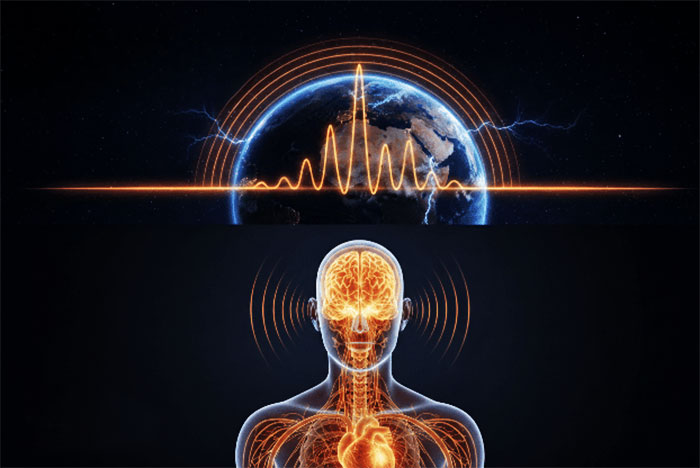
Stress Reduction and Relaxation
Some research suggests that exposure to
Earth's natural electromagnetic frequencies, including Schumann
Resonance, may help reduce stress and promote relaxation.
A 2025 double-blind randomized controlled trial by Park et al.,
published in Advances in Integrative Medicine, studied 60
adults who used grounded mats for 31 days.
The grounded-mat group, which was exposed to
Earth's electromagnetic field, including Schumann frequencies,
showed statistically significant reductions in stress levels as
measured by the Brief Psychosocial Stress score, along with
improved sleep quality.
However, this study did not isolate Schumann
Resonance specifically, so the effect could be due to other
grounding mechanisms.
Supporting this, a
2018 observational study by Alabdulgader et al. in
Scientific Reports found that increases in Schumann
resonance activity correlated with increased heart rate
variability and parasympathetic nervous system activation in 16
volunteers monitored over 72 hours.
While these preliminary findings suggest
potential stress-reducing effects, the evidence is not yet
conclusive.
The research is correlational rather than
definitively causal, and more rigorous, large-scale clinical
trials are needed before Schumann Resonance can be recommended
as a proven stress management approach.
Blood Pressure and Cardiovascular Function
Emerging research suggests that
Schumann Resonance may influence cardiovascular
function, with laboratory and observational studies showing
potential protective effects.
Laboratory research provides insight into
possible mechanisms.
A 2019 study
by Elhalel et al. in Scientific Reports exposed rat
heart cells to oxidative stress conditions-mimicking what
happens during heart attacks or hypoxia.
When a weak 7.8 Hz magnetic field (matching
Schumann Resonance) was applied, it prevented approximately 50%
of the cellular damage that would normally occur.
The SR-frequency field helped cells maintain
more normal contraction rates and stabilized calcium signaling,
which is critical for heart function.
Notably, only frequencies around 7.6-8 Hz
produced this protective effect; slightly different frequencies
did not have the same results.
Population-level observations support
potential cardiovascular effects.
A 2023
five-year study by Qammar et al. in Atmosphere
tracked local geomagnetic and Schumann resonance conditions
alongside acute myocardial infarction (heart attack) rates.
The researchers found significant
associations between certain SR frequency variations and changes
in heart attack incidence, suggesting the electromagnetic
environment may influence cardiovascular events.
Earlier research by Mitsutake et al. in 2005, published in
Biomedicine & Pharmacotherapy, monitored 56 adults in
Japan wearing ambulatory blood pressure monitors for seven
consecutive days.
Comparing measurements on days with normal
versus enhanced natural Schumann resonance activity, researchers
found that 32% of participants had significantly lower systolic
blood pressure on days with higher SR activity, while only 4%
showed higher blood pressure.
However, these findings come with important
limitations.
The laboratory study was conducted on
isolated cells, not living organisms, so we cannot assume the
same protective effects occur in humans.
The population studies are observational and
show correlation, not causation - other environmental factors
that vary with SR activity could contribute to the observed
cardiovascular changes.
These converging results suggest Schumann
Resonance may genuinely influence heart health, but controlled
human trials are needed to confirm therapeutic benefits and
establish safe, effective applications.
Wound Healing and Tissue Repair
Laboratory research suggests that
electromagnetic frequencies in the Schumann Resonance range may
influence cellular processes involved in wound healing, though
human clinical trials are lacking.
The most specific evidence comes from a
2023 study by Sugiwaki et al. in the Journal of Cosmetic
Dermatology, which exposed normal human skin cells (keratinocytes)
to a 7.83 Hz pulsed electromagnetic field for just 10 minutes.
Over the following 48-72 hours, researchers
observed a 2.8-fold increase in cell proliferation compared to
unexposed cells.
The 7.83 Hz stimulation also significantly
enhanced cell migration in a simulated wound, with cells moving
faster to close the gap.
At the molecular level, the Schumann
Resonance exposure upregulated SIRT1 gene expression nearly
five-fold - a gene involved in tissue regeneration and repair -
along with antimicrobial peptides that could help prevent
infection.
Supporting this,
a 2014 study by Seeliger et al. used a device emitting
pulsed electromagnetic fields (including 7.8 Hz and 33 Hz
components) on human tendon fibroblast cultures with scratch
wounds.
The treated cells closed wounds approximately
33% faster than controls (3.35 days versus 5.05 days, p<0.001),
with more than double the DNA synthesis rate, indicating
accelerated cell growth without toxicity.
A
comprehensive 2021 review by Gualdi et al. in
International Journal of Molecular Sciences examined the
broader effects of extremely low-frequency electromagnetic
fields on wound repair.
The review concluded that ELF-EMF exposure
can modulate inflammation, promote angiogenesis (new blood
vessel formation), regulate matrix metalloproteinases that
remodel tissue, and stimulate both keratinocyte and fibroblast
activity.
These effects appear dependent on specific
parameters including waveform, frequency, amplitude, and
exposure duration.
However, critical limitations must be noted:
all of this evidence comes from laboratory studies on isolated
cells, not from clinical trials in actual patients with wounds.
Promotes Relaxation and Better Sleep
The strongest evidence for Schumann Resonance
health effects comes from sleep research.
A 2022 double-blind randomized controlled trial by Huang et al.
in Nature and Science of Sleep tested 40 adults with
chronic insomnia using either an active 7.83 Hz device or
placebo for four weeks.
The SR device group showed significant
improvements: they fell asleep faster and slept longer as
measured by polysomnography, with subjective sleep quality and
satisfaction also improving (p<0.05).
The placebo group reported some subjective
improvements but no objective sleep gains.
A 2025 study by Park et al. in Advances in Integrative
Medicine found similar results using grounded mats that
expose users to Earth's natural electromagnetic field including
Schumann frequencies.
Sixty adults with poor sleep quality used
either grounded or ungrounded mats for 31 days.
The grounded group showed significantly
improved sleep quality scores and reduced stress levels, with
effects persisting one week after stopping.
Limitations include small sample sizes (40
and 60 participants), short durations (4 weeks and 31 days), and
in the Huang study, one author holds a patent on the SR device.
These findings require replication in larger,
longer-term trials before Schumann Resonance can be recommended
as an established sleep treatment.
Spiritual and Cultural
Perspectives on Schumann Resonance
Within spiritual and wellness communities,
various beliefs exist about the Schumann Resonance frequency of
7.83 Hz.
Some spiritual practitioners and wellness
advocates hold beliefs that this frequency may connect with
human consciousness or promote spiritual awareness.
Common spiritual perspectives include viewing
the 7.83 Hz frequency as Earth's "heartbeat" that symbolizes
interconnectedness, incorporating it into meditation practices,
and believing it may enhance relaxation or mindfulness states.
While individuals may find personal meaning
and value in these concepts, they should not be confused with
established 'science' or 'medical' evidence.
How to get Exposure to Schumann
Resonance
Schumann Resonance occurs naturally in
Earth's atmosphere.
Spending time outdoors, particularly in
natural settings like forests, parks, or areas away from urban
electromagnetic interference, provides natural exposure to these
background frequencies.
Various commercial devices and audio
recordings claim to emit or simulate the 7.83 Hz frequency for
use during meditation or relaxation.
However, it's important to note that the
effectiveness of these devices has not been established through
rigorous clinical research, and they are not regulated as
medical devices.
Safety Considerations and
Contraindications
Consult a healthcare professional before
using Schumann Resonance devices if you have:
-
Pacemakers or implanted electronic
devices – May interfere with device function, causing
malfunction or incorrect readings
-
Pregnancy – Effects on fetal
development are unknown; avoid as a precaution
-
Epilepsy or seizure disorders –
May potentially trigger seizures in susceptible individuals
-
Active cancer or recent cancer
treatment – Could theoretically affect cell
proliferation; requires oncologist approval
-
Recent surgery or acute injuries –
May affect healing processes in unpredictable ways
-
Metal implants in treatment area –
Metal may heat up or concentrate electromagnetic fields
-
Implanted medication pumps – May
malfunction and deliver incorrect medication doses
-
Bleeding disorders or blood thinners
– May affect blood flow and coagulation
Potential side effects include headaches,
agitation, electromagnetic sensitivity reactions, and
overstimulation from prolonged exposure - individual responses
vary significantly.
Regulatory Status:
These devices are marketed as general
wellness products, not medical devices.
They have not been evaluated or approved
by
the FDA for the diagnosis, treatment, cure, or prevention
of any disease.
As wellness products, they are not
subject to the same rigorous testing and safety standards
required for medical device