|
by Chip Gibbons
Spanish version we are obligated to acknowledge the millions of lives he cut short, like those of Iraqi women and children who were bound and killed execution-style in 2005.
(David Hume
Kennerly / Getty Images) censoring a report on CIA domestic surveillance to running cover for the Contra War to helping launch the war on terror, Dick Cheney dedicated his life to making sure the US national security state could kill, spy, and torture with few checks.
After over a decade of brutal sanctions and continuous bombing, in spring 2003, the US had launched a full-scale invasion of the oil-rich Middle Eastern nation. The invasion was a flagrant violation of international law.
After toppling Iraq's Ba'athist government, a former on-again, off-again ally of Washington, the United States and its allies began a protracted military occupation of Iraq.
The
neocolonial affair was particularly
brutal. Such is the nature of seeking to impose your presence by
military force on a people who do not wish it and are willing to use
force to oppose it.
Allegedly they were looking for an individual believed to be responsible for the deaths of two US soldiers and a facilitator for al-Qaeda recruitment in Iraq. In the version told by US troops, someone from the house fired on the approaching soldiers, prompting a twenty-five-minute confrontation.
Eventually the soldiers entered the house,
killing all of the residents.
An autopsy performed on the deceased,
After slaughtering the family execution style, US soldiers called in an air strike, destroying the house.
The presumed reason for the bombardment was to cover up evidence of the extrajudicial killings.
"When it comes to the architects of the war on terror, one name looms larger than the rest: Dick Cheney."
This includes not just Iraq but also Afghanistan, Syria, Yemen, and Pakistan. It is impossible to reduce the "war on terror" and its colossal human toll to one person.
But when it comes to the architects of the war on terror, one name looms larger than the rest:
On Monday, November 3, Cheney died at age 84 due to complications from pneumonia and cardiac and vascular disease.
I do not wish death on any human, nor do I have any desire to see any living being suffer. But when reflecting on Cheney's legacy, we are obligated to acknowledge the millions of lives he cut short, like those of Iraqi women and children who were bound and killed execution-style in 2005.
They are part of Cheney's legacy, a legacy that includes a lifetime of defending the worst crimes of the US national security state.
While this is certainly true, Cheney's ultimate
fidelity was to the national security bureaucracy that had
metastasized within the executive branch. Cheney's interventions
were on behalf of the executive branch's power to launch wars abroad
and conduct surveillance at home.
Revelations that Richard Nixon had set up
a secret spy unit called the White House Plumbers to first
target whistleblower
Daniel Ellsberg and then
burglarize the Democratic National Committee's office at the
Watergate Hotel forced Nixon out of office in disgrace. It also
resulted in a temporary setback for the national security state.
The Watergate scandal broke alongside scandals about the FBI's and CIA's surveillance of the antiwar and civil rights movements. Millions of Americans participated in both movements, only to find out that their government considered their conduct worthy of snooping on.
This greatly diminished trust in the national
security leviathan.
While the national security state lived on, the fallout from Watergate and Vietnam places its power at its nadir - at least temporarily.
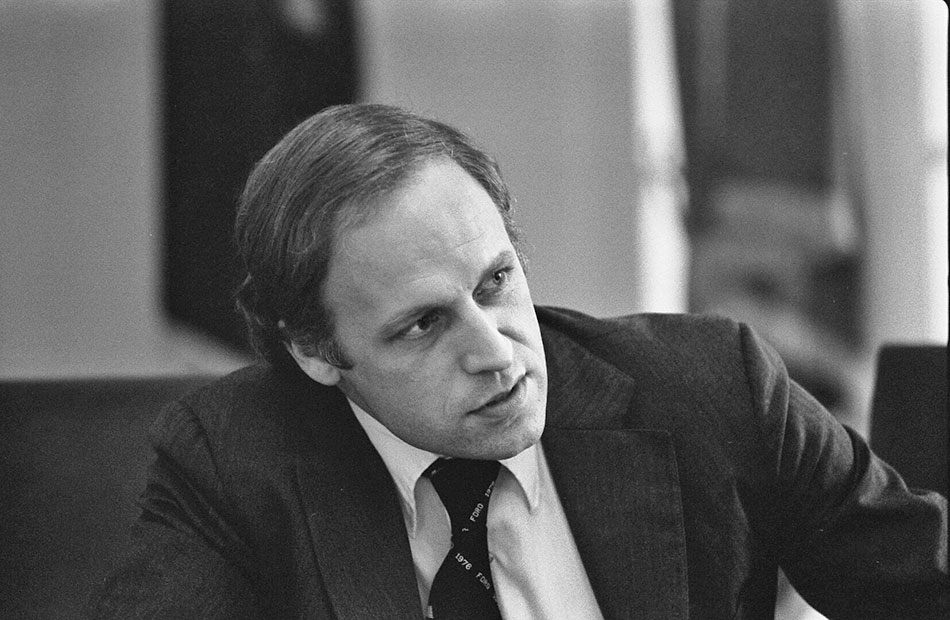
when he was serving as Gerald Ford's chief of staff. (David Hume Kennerly Gerald R. Ford Presidential Library)
As White House chief of staff for President Gerald Ford, Cheney made handwritten changes to a report on CIA activities. Chief among Cheney's edits was changing the description of domestic CIA surveillance as "illegal" to being "improper."
While Cheney failed to stave off the checks put
on the national security state, he refused to give up his fight.
In Congress, Cheney voted against both sanctioning apartheid South Africa and a nonbinding resolution calling for Nelson Mandela to be freed. Such votes led the Nation's John Nichols to dub Cheney "Apartheid's Congressman."
During the 2000 election, Cheney's votes on Mandela became a point of controversy.
Far from admitting error, Cheney defended his vote, explaining the African National Congress were viewed at the time as "terrorists."
In Congress, Cheney was the Republican ranking member on a House inquiry into the Iran-Contra scandal.
In the early 1980s, the Reagan administration was
caught mining the harbors of Nicaragua. This clear act of war was
carried out by the CIA, whom Ronald Reagan had promised to "unleash"
while running for president.
They deliberately targeted civilian infrastructure like literacy centers and health clinics to undermine the Sandinistas efforts to improve the lives of ordinary Nicaraguans.
Wary that Reagan's secret war could become another Vietnam, Congress passed a series of funding riders referred to as the Boland Amendment. It blocked lethal aid from being sent to the Contras for the purposes of regime change in Nicaragua.
A number of efforts were made to keep arms
flowing to the Contra terror, including the use of private funding
networks, as well as to (at the very least) turning a blind eye to
Contra
drug trafficking.
In Cheney's
minority report, the lawless party
were not those who armed Contra's terror campaign but Congress for
trying to limit the Reagan administration's secret war.
In that role, Cheney would oversee the US invasion of Panama. The completely lawless invasion violated both the international law and the US Constitution. And it killed 3,500 Panamanians.
The official pretext was the United States had indicted Panama's leader, Manuel Noriega, for drug trafficking and invaded the country to kidnap and render him to a Miami courtroom. Noriega was a former CIA asset.
And he was not the only former US ally Cheney would have to do battle with as secretary of defense.
The Iraq War Throughout the 1980s, the United States had armed Iraqi dictator Saddam Hussein against Iran, even as Hussein used chemical weapons.
In 1990, Hussein again went to war with one of his neighbors, this time Kuwait. There is evidence to suggest the Iraqi leader erroneously but earnestly believed the US would turn a blind eye to the aggression.
But Kuwait, unlike Iran, was a US ally. And the
United States, going through the United Nations Security Council,
launched
a war against Iraq.
The United Nations described the bombing as "near apocalyptic."
With Iraq left unable to purify water, process sewage, or irrigate crops, the UN found the bombing had reduced the country to a "pre-industrial age." During the war, the United States dropped two two-thousand-pound "precision" bombs on the Amiriyah shelter.
This attack on a civilian air raid shelter with no military use resulted in the deaths of 408 civilians who had sought a refugee from the apocalyptic bombing of their country. And when Iraqi soldiers retreated from Kuwait, the US bombed them in what became known as the "Highway of Death."
The images of charred humans became some of the most shocking of the war.
As secretary of defense, Cheney bears
responsibility for these crimes.
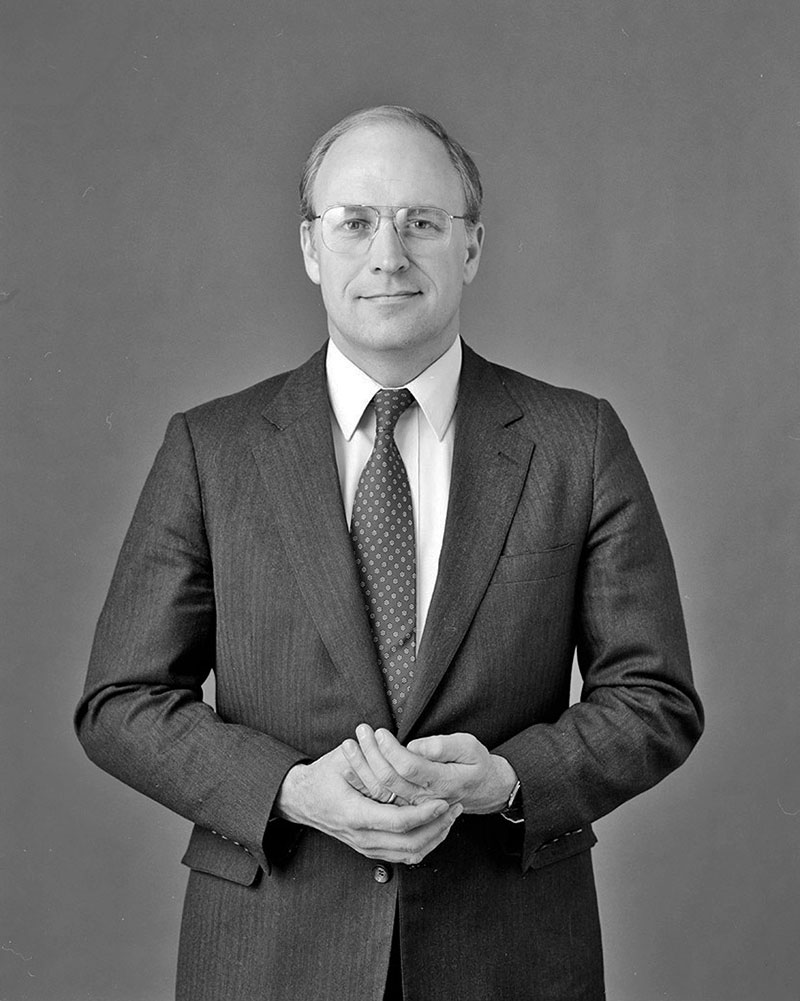
A 1984 photo of Dick Cheney, when he was a congressional representative for Montana. (Ronald Reagan Presidential Library & Museum)
But it is worth mentioning one final moment during his tenure as secretary of defense that is too often omitted. The United States had long stood accused of training Latin American militaries and death squads in torture and other human rights violations. These allegations prompted an official investigation.
A classified report, given the remarkably
bureaucratic title
Improper Material in Spanish-Language
Intelligence Training Manuals, confirmed that the US
training materials instructed clear violations of law.
It would not be the last torture scandal he would play a part in.
But two aspects of his career during this time would be foreboding. He became the CEO of Halliburton, an oil services company who would later receive a number of contracts related to the Iraq War when Cheney was vice president.
Cheney would also be one of the founding supporters of Project for a New American Century.
The neoconservative think tank pushed for the aggressive promotion of American hegemony and the buildup of American military might.
In a particularly deranged document, the Project lamented that many of its goals would take a long time to achieve,
While the Project for a New American Century
advocated an aggressive and hawkish vision of US foreign policy writ
large, it focused its attention on one country in particular: Iraq.
This escalation of the United States' longest air
war since Vietnam occurred two full years before the official start
of the Iraq War and seven months before the horrific 9/11 attacks.
The 9/11
And Cheney would play an important role. Cheney had been tapped by Bush to help him select a running mate. In typical Cheney fashion, he ended up becoming the vice presidential nominee.
After an election that was almost certainly stolen, Bush and Cheney arrived in the White House rejected by the majority of Americans at the ballot box.
the most powerful vice president in history."
After a second plane struck the World Trade Center, Bush was whisked away in Air Force One. With the actual commander in chief flying around US airspace,
By the time the order was given, the passengers had already revolted, attempting to take the plane from the hijackers intent on using it as a weapon.
As a result of this heroism, the plane crashed,
killing all on board, before it could be used to strike another
target.
But in the aftermath of the attacks, Cheney would become the most powerful vice president in history.
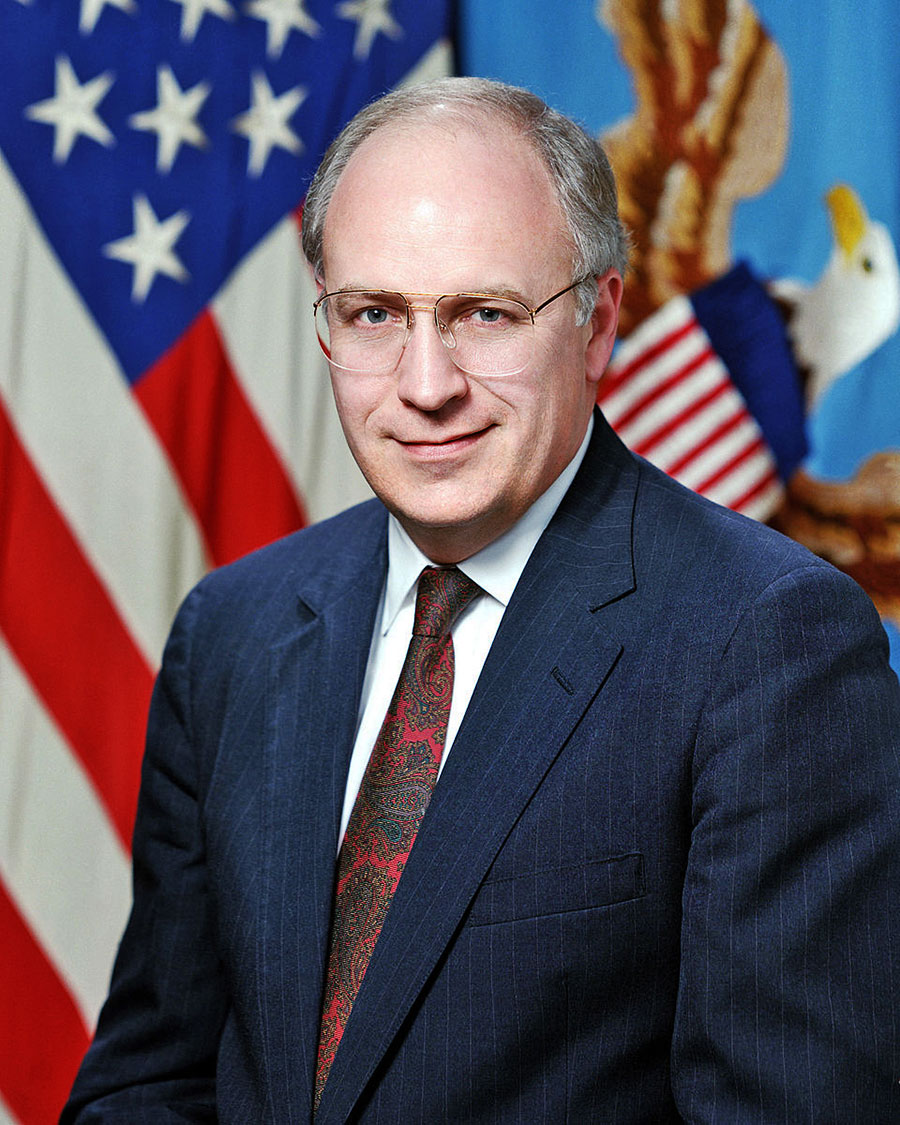
Official portrait of
Dick Cheney
This war was premised on two major lies, both of which Cheney promoted: First, that Iraq possessed weapons of mass destruction. Second, that Iraq was involved in the 9/11 attacks. The second lie was particularly preposterous.
The secular nationalist Ba'athist government of
Hussein, while brutal, had nothing in common with the Salafist
jihadist al-Qaeda responsible for the murderous attacks. If any
government had aided al-Qaeda, it was
Saudi Arabia.
At the same time it was manufacturing evidence
about Iraq, the Bush administration was blocking any inquiry into
the possible Saudi role.
The Expansion of Executive Power
But Iraq was not Cheney's only crime after 9/11.
And after 9/11, he exploited the tragedy to try to enact the theories he had long argued for.
Cheney was instrumental in pushing claims that as
commander in chief, the US president could detain anyone, including
US citizens, without any judicial review. He supported a CIA program
of forced disappearances and torture reminiscent of the state terror
of fascistic or military dictatorships.
In the aftermath of Watergate and revelations about spying on Martin Luther King and other activists, there was a serious attempt to limit domestic national security surveillance.
To accomplish this end, Congress passed the Foreign Intelligence Surveillance Act (FISA). The law was hardly civil libertarian; it allowed a secret court to authorize electronic eavesdropping on Americans.
But to Cheney and other hard-line national security hawks, it was an intolerable affront to place any limit on the president's authority to conduct national security wiretaps.
has allowed some to sickeningly seek to rehabilitate him as a champion of democracy. Nothing could be further from the truth."
FISA, it should be noted, was not a mere suggestion; it created criminal prohibitions on warrantless wiretapping.
This criminal surveillance regime was dubbed the
President's Surveillance Program, but it might as well have been the
Vice President's Surveillance Program.
Although the program was infamous for allowing the NSA to warrantlessly intercept Americans overseas communications, as designed by Addington, it originally allowed for the interception of purely domestic calls.
Even the arch surveillance hawk Hayden thought
this was too far and refused to implement that part of it. It was
dropped from later reauthorizations.
That FISA criminalized them did not matter - the
real law breaking was FISA's attempt to rein in the president. It
mirrored the logic Cheney put forward during Iran-Contra as a
congressman.
This move mirrored Israel's own program of
assassinations, which were euphemistically referred to as "targeted
killings" in part to get around international prohibitions on
extrajudicial killing.
There was one dissenter...
Cheney publicly broke with the administration's stated line, endorsing the Israeli killing. And during the war on terror, the Bush administration, aided by Israeli technical knowledge and legal arguments, formally adopted targeted killings.
Whether by Special Forces or by mechanized
drones, assassinations would become the hallmark of the US war on
terror.
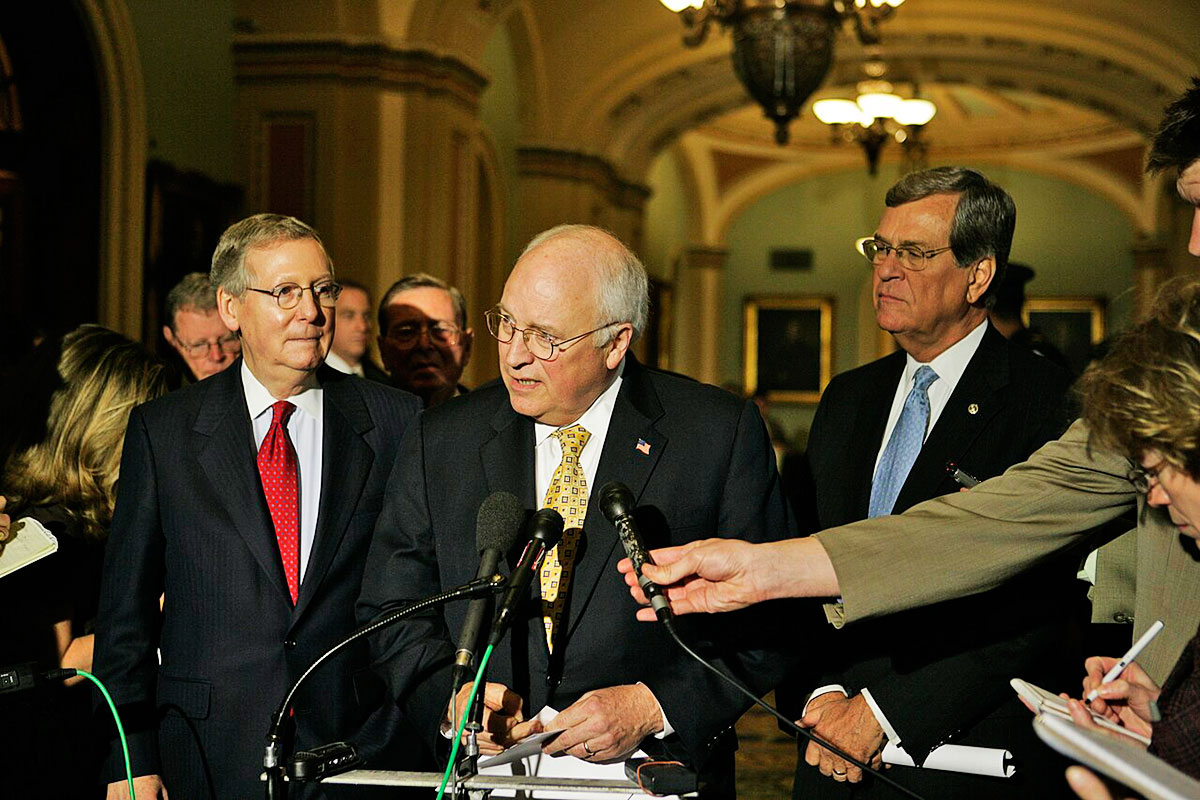
Then vice president Dick Cheney addresses the press with then Senate minority leader Mitch McConnell and Senator Trent Lott at the US Capitol Building on April 24, 2007. (Vice Presidential Records of the Photography Office,
George W. Bush
Administration)
Living in
Cheney's World
The archconservative, lifelong Republican emerged supposedly as an opponent of Donald Trump.
Cheney went so far as to endorse Kamala Harris's failed presidential bid. In one of the most tone-deaf moves of any campaign in history, Harris's campaign openly touted Cheney's endorsement as well as those of other Republican war hawks.
As the Harris campaign struggled with key voters over its refusal to break with Joe Biden's criminal support for Israel's genocide, they sought to somehow outhawk Trump.
Nothing could be further from the truth...
Cheney rose to vice president as the result of a stolen election. Once in power, his attacks on democracy only worsened.
Exploiting the 9/11 tragedy, he broke nearly every democratic norm to enact a regime of authoritarian, murderous policies.
He not only was perhaps the single most destructive figure for American democracy in the twenty-first century:
"Can anyone seriously argue Trump's actions are not the logical extensions of Cheney's war on terror?"
Trump's first campaign was marked by calls for surveillance of mosques, support for torture, escalating air wars in the Middle East, and retaliatory killing of "terrorists'" families.
Can anyone seriously argue these are not the
logical extensions of Cheney's war on terror?
These are the policies Cheney spent his life
advocating for. Trump even achieved Cheney's long-term dream
of
bombing Iran.
According to Cheney, the US government could not only wiretap a US citizen without a warrant but detain them without any recourse to the courts or possible intervention from Congress.
Like Cheney, Trump almost certainly salivates at
the thought of carrying out such policies.
Yet in spite of riding this popular outrage to
the White House, Obama
cemented and expanded many of these
policies, including warrantless NSA surveillance and global
assassinations.
|