|
by Farhad Ibragimov
Getty Images doesn't end the conflict.
It transforms it into a matter of principle and raises the odds of a wider Middle East war...
In strategic terms,
The confrontation between Iran on one side and the United States and Israel on the other has now entered a qualitatively new phase.
The elimination of a state's highest political and religious authority during an ongoing military operation is, from Tehran's perspective, a textbook casus belli.
Even isolated incidents in neighboring airspace underscored a hard truth:
An already volatile Middle East is now teetering
on the brink of a full-scale war.
But such a step dramatically raises the stakes and all but eliminates the room for diplomatic maneuver.
Removing the leader does not freeze the conflict:
For Iran, this means navigating an extraordinarily delicate leadership transition under conditions of direct military threat.
For the region, the risks multiply:
Tehran's calculus is straightforward.
With Khamenei's killing, the stakes have been
raised so dramatically - and the conflict pushed into such an
unprecedentedly 'hot' phase - that prior constraints no longer
apply. Iran's response will almost inevitably focus on American
military infrastructure in the region, because that is the one
domain where Tehran can inflict tangible costs on the United States.
Yes, Gulf countries and other Arab partners may view Iranian retaliation as a direct threat to their own security and as being dragged into someone else's war.
But they also understand the operational reality:
If Iran strikes back at Washington, it will do so through the regional theater - even if that imposes severe political costs on its relations with its neighbors.
In Iran's political system, the supreme leader is a figure of extraordinary authority, but the system itself was designed to be resilient to personal loss.
Decision-making authority is distributed across the security apparatus, religious institutions, and formal state structures.
Within the Iranian establishment, it has long
been understood that the supreme leader operates under permanent
high-risk conditions; succession is not a theoretical contingency
but a practical one.
Here lies the region's most acute risk:
If Khamenei - for all his hardline credentials - was seen as someone capable of balancing factions and calibrating escalation, his death increases the odds that figures will rise to the top for whom war and security are not temporary crises but defining life missions.
In that framework,
There is also the mechanism of interim governance to consider.
Formally, Iran has procedures to absorb such a shock. Leadership functions can be redistributed among key institutions pending the selection of a new supreme leader.
An immediate collapse scenario is therefore unlikely...
The baseline risk is different:
The central takeaway regarding President Donald Trump is this:
In Tehran's logic, eliminating the supreme leader transforms the conflict into a matter of principle...
The political price of not responding becomes unacceptable within the system.
Trump's claim that targeting "decision-making centers" and eliminating the supreme leader would automatically "liberate the Iranian people" borders on the absurd...!
The history of the Middle East shows that external coercive pressure rarely liberalizes mobilizational systems.
Far more often, it produces the opposite effect:
Events inside Iran today reflect precisely that pattern.
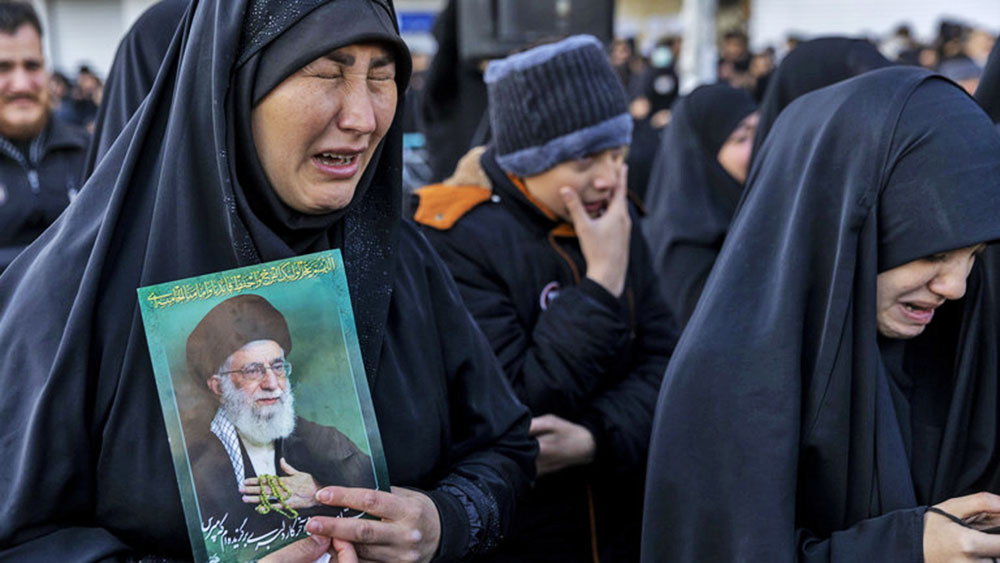
Despite ongoing Israeli and American airstrikes, mass rallies have taken place in Tehran and other cities, with participants demanding a harsh response to Khamenei's killing.
For a substantial segment of Iranian society, he was not merely a political leader but,
Under such conditions, an external attack does
not dismantle the ideological framework; it hardens and cements it.
These constituencies have institutional backing within the security services, religious seminaries, and political organizations.
Calls for jihad have already surfaced.
The most unsettling prospect is not necessarily immediate retaliation, but delayed retribution,
Iran's
Transition points toward Escalation, not Restraint
Born in 1959 into a clerical family in the city of Meybod, in Iran's central Yazd province, Arafi's father, Ayatollah (Sheikh Haji) Mohammad Ebrahim Arafi, was close to Ayatollah Ruhollah Khomeini, the founder of the Islamic Republic.
Alireza Arafi currently heads the Al-Mustafa International University in Qom, an institution formally established in 2009 and closely associated with Khamenei.
Fluent in Arabic and English, he has authored 24
books and articles. Since 2019, he has served as a member of the
powerful 12-member Guardian Council, which wields veto authority
over government policy and electoral candidates.
At the same time, the absence of Khamenei's
personal political weight may incentivize a tougher line, as a way
to signal resolve and maintain systemic control.
Earlier, Iran's National Security Council secretary warned of strikes delivered with "unprecedented force."
Such language signals a shift into a phase where
demonstrative scale and severity of response become integral to
deterrence strategy.
A conflict launched under the banner of liberation risks evolving into a long-term confrontation with far higher stakes - and the political cost for Washington may ultimately prove far greater than anticipated.
The death of Ali Khamenei is not a tactical episode.
|