|

by Leo Sands
June 21, 2026
from
NewYorkTimes Website
Article also
HERE
Italian version
|
Leo Sands
is a
correspondent for the Breaking News Hub of The New York
Times based in London. |
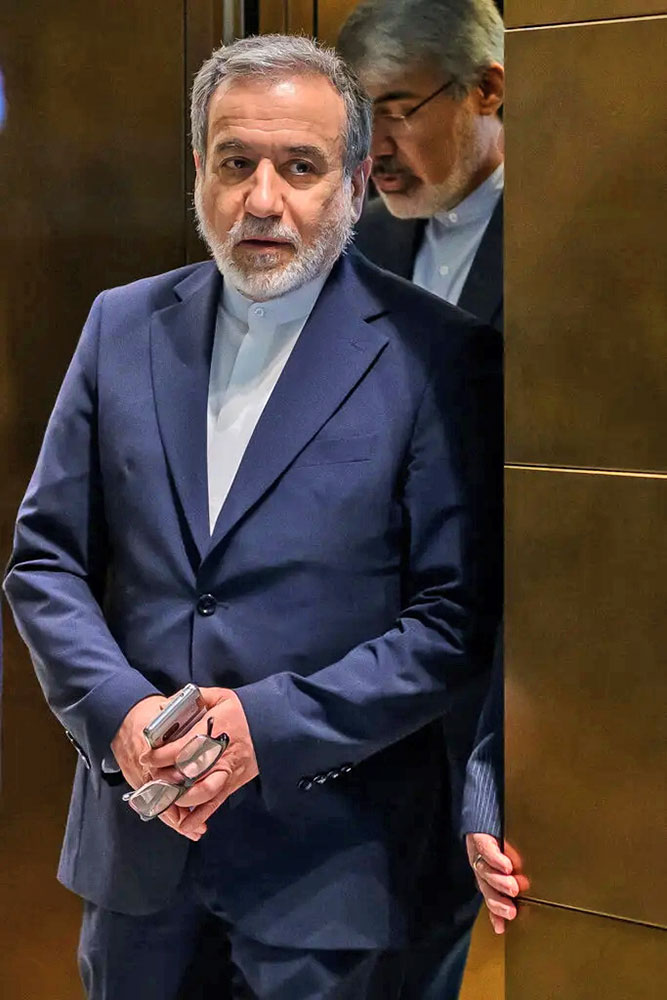
Iran's foreign
minister, Abbas Araghchi,
on Sunday at the
Bürgenstock resort in Switzerland.
Credit: Pool photo by
Fabrice Coffrini
Tehran insists that its nuclear program
is for
peaceful purposes.
The Trump
administration
is
demanding assurances that
Iran
cannot secretly develop a weapon.
The next round of U.S.-Iran negotiations will seek to resolve
perhaps the thorniest issue between the two sides:
What should happen to Iran's nuclear program?
President
Trump has repeatedly said that
the primary motivation for starting war with Iran was to prevent it
from obtaining a nuclear weapon.
For years,
Iran has been amassing
near-bomb-grade uranium, which the United States and Israel fear
could be developed into a weapon.
The site where most of that material is believed
to be stored was believed to be heavily damaged in U.S.-Israeli
attacks last year.
But without independent access to the area,
the fate of the stockpile remains unclear...
For
more than 50 years, Tehran has
insisted that its nuclear program is for peaceful purposes only. But
the United States is demanding assurances that Iran cannot secretly
develop a weapon.
Here are four key areas the talks are likely to focus on...
1 - Uranium Enrichment
The process of enriching uranium transforms it from fuel that can be
used for civilian purposes, like energy production, into a crucial
component of a nuclear weapon.
To prevent that from happening, the United States is demanding that
Iran suspend all uranium enrichment for at least 20 years. The
Iranians have countered with offers of a 10-year halt.
In a phone call with The New York Times
on June 14, Mr. Trump hinted that he might settle for a
15-year suspension, but that said he didn't want to negotiate via
the news media.
In the same call, he also suggested that Iran be
limited to enriching at low levels "forever."
Looming over the new talks is
the deal struck by President
Barack Obama in 2015 that
negotiated
a 15-year halt.
Mr. Trump tore up that deal in his first
term.
Vice President JD Vance, who is leading
the American negotiation, stated on Thursday that the U.S. was
seeking a complete a moratorium on all uranium enrichment by Iran
over the suspension period.
"The Obama deal allowed the Iranians to
enrich uranium. This deal will not," Mr. Vance told reporters.
Mr. Obama's deal limited enrichment to 3.67
percent,
enough for research and medicine.
Nuclear weapons typically require about 90
percent enrichment.
2 - Current Stockpile
After Mr. Trump withdrew from the nuclear deal in 2018, Iran
steadily increased
its stockpile of near-bomb-grade material
until it had enough to build at least 10 bombs.
As of June 2025, the U.N. nuclear watchdog, the
International Atomic Energy Agency (IAEA),
believed that Iran had about 970 pounds of uranium enriched to 60
percent, in addition to roughly
11 tons of uranium enriched to
other levels.
The United States
struck three key Iranian nuclear sites
last year, including a complex outside Isfahan, where the U.N.
agency said most of the near-bomb-grade material was stored.
But with international inspectors barred from
the site, the status of the enriched uranium is uncertain...
U.S. officials are insisting that Iran disposes of its
stockpiles completely.
According to two American officials,
the United States is offering to work with the U.N. watchdog to
dilute, or "downblend," it to safe levels.
Another option would be for Iran to transfer
the stockpile to another country, as it did with 98 percent of
the cache under the 2015 deal.
Iran has not said publicly whether it would be
willing to give up its entire stockpile.
3 - Nuclear Sites
The United States has insisted that Iran dismantle its two
enrichment plants at Natanz and Fordo,
as well as its uranium storage tunnels at Isfahan.
It's possible that Iran also has additional
nuclear sites that the world doesn't know about.
Tehran has balked, insisting that that would
amount to surrendering its "right to enrich."
It has argued that at least one site should
remain, though that might prove difficult for U.S. negotiators
to stomach.
Under the Obama deal, Iran was permitted
to keep facilities, as long as they were repurposed for civilian
use.
Critics of that deal say it meant that Iran was
able to quietly revive nuclear enrichment after the 2015 deal
collapsed.
4 - Access for Inspectors
International inspectors haven't had any visibility into Iranian
nuclear sites since the U.S.-Israeli attacks last year prompted
Tehran to block the U.N. agency's access.
The Trump administration wants international inspectors to be
able to conduct "snap" visits at any time and at any site in Iran.
Rafael M. Grossi, the head of
the U.N. watchdog, said on Thursday that both Iran and the United
States wanted his agency to have a role in verifying their
agreement.
Prospects for an Agreement
Resolving all of these questions within the 60-day negotiating
timeline set out by the initial U.S.-Iran deal will be a tall order,
said
Darya Dolzikova, an expert in
nuclear weaponry at the Royal United Services Institute, a
London-based research group.
The 60-day window is extendable by mutual
consent, and Mr. Trump said this past week that it was not a "hard"
deadline.
For one thing, she said, the two sides would need to establish the
current status of Iran's nuclear program and stockpile, an extensive
exercise.
"If you're going to start negotiating away
parts of Iran's program and potentially even accepting certain
elements of it," Ms. Dolzikova said, "then we need to have a
sense of what they have now."
"I don't want to say it's not possible," she said, "but these
are very complex issues, and 60 days is not a lot of time."
|