|

by Fyodor Lukyanov
May 07, 2026
from
RT Website
|
Fyodor Lukyanov
the editor-in-chief
of Russia in Global Affairs, chairman of the Presidium
of the Council on Foreign and Defense Policy, and
research director of the
Valdai International Discussion
Club. |
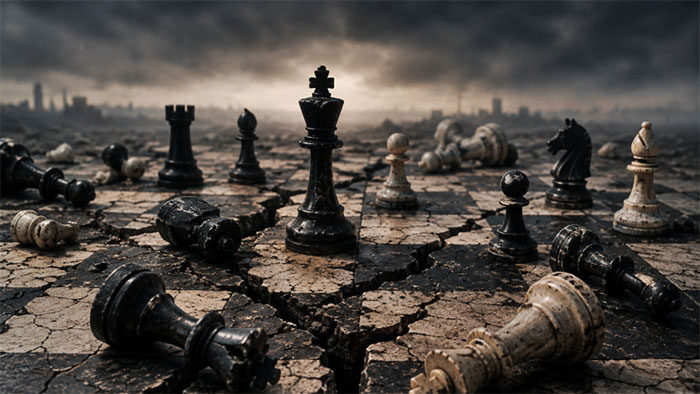
"A New World Order must be built
to ensure
economic justice and equal
political
security for all nations.
An end to the
arms race
is an essential
prerequisite
for the
establishment of such an order."
Forty years after the Delhi Declaration,
the world
is again searching for a new order,
but this
time without shared rules
or a
usable blueprint...
This year marks the 40th anniversary of those words from
the Soviet-Indian Delhi Declaration, signed in 1986 during
Mikhail Gorbachev's visit to India and his talks with Prime
Minister Rajiv Gandhi.
It was one of the first major documents of
the late Cold War era to openly speak of the need for a 'New
World Order'.
At the time, the Soviet leadership believed this
order would emerge through what it called 'new political thinking'.
The idea was that former adversaries would
abandon confrontation and combine the best elements of their
respective systems to create a more stable and equitable
international framework.
It was an ambitious vision:
A joint effort to rebuild global politics
from the ruins of ideological rivalry.
But history, however, had other plans...
The Soviet Union soon disappeared into a vortex of internal crises
before vanishing altogether from the world stage.
The phrase 'New World Order' survived, but it was
quickly
repurposed by the administration of
President
George H.W. Bush.
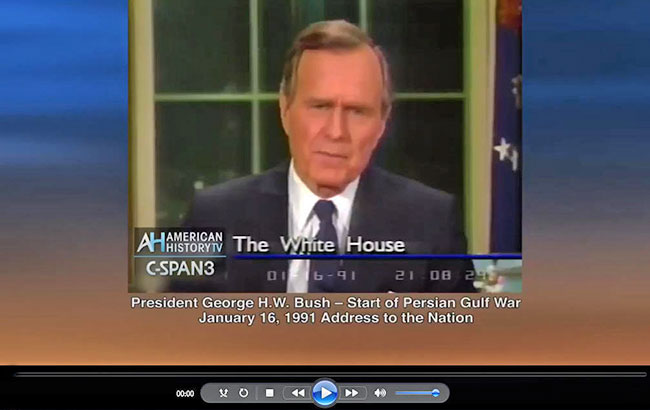
For VIDEO click above
image
In Washington's interpretation,
the concept no longer meant a shared
international architecture.
It came to mean a liberal order dominated
politically and militarily by the US and its allies.
In reality, this wasn't an entirely new order at
all.
It was an extension of the post-1945
system, only now without the counterweight of the Soviet
Union...
For a time, many believed this arrangement
represented the natural endpoint of history.
Yet contrary to those expectations, once the Cold
War confrontation disappeared, global stability didn't deepen.
Instead, tensions gradually intensified and by the beginning of the
2010s, the foundations of the system were already beginning to
crack.
Since then, the pace of disintegration has accelerated
dramatically...
As humanity moves deeper into the second quarter of the 21st
century, it is becoming increasingly difficult to deny that the
previous world order has effectively ceased to exist.
Whatever doubts may have lingered vanished
during the opening months of 2026...
What matters isn't simply that the strongest
states increasingly ignore laws and conventions that once appeared
firmly established, more significant is the style in which politics
is now conducted.
Decisions are
impulsive and often openly
contradictory as governments act first and improvise later.
Statements made today may directly contradict
those made yesterday, yet this no longer seems to matter.
This atmosphere shouldn't necessarily be mistaken
for collective irrationality...
Rather, many political actors appear convinced
that the old restraints have collapsed and that the current moment
represents a historic opportunity.
The instinct is simple:
Seize as much advantage as possible before
the landscape hardens again.
The redistribution of the world has already
begun.
Political influence, transport corridors,
resources, financial flows, technological ecosystems, and even
cultural and religious spheres are all being contested
simultaneously.
Every major power is now defining its ambitions
and testing the methods by which those ambitions might be achieved.
Of course,
mistakes will be expensive, but
that, at least, is nothing new in international politics...
The real uncertainty lies elsewhere because the
previous era left behind an assumption that periods of chaos are
eventually followed by the emergence of a new equilibrium.
After disorder comes 'structure' and after
confrontation comes a 'new framework'...
But there's no guarantee this time.
The international system today isn't an empty construction site
waiting for a new design. After major world wars, old structures are
often swept away on a vast scale, creating space for something new
to emerge, and that's not the case now.
Instead, the world remains cluttered with institutions and habits
inherited from previous eras.
Many are discredited or dysfunctional,
but they still exist. And even those states that attack these
institutions most aggressively continue to use them whenever
convenient.
The
United Nations system remains an
example.
Its authority has diminished, yet governments
still appeal to it selectively when doing so serves their
interests.
Likewise, the structures created during the
period of liberal globalization have proven more resilient than many
expected.
Despite trade wars, sanctions, geopolitical fragmentation, and
increasingly open rivalry among major powers, the global economic
network continues to resist complete disintegration.
Supply chains bend but do not fully break.
Markets remain interconnected.
Even countries engaged in fierce political
confrontation continue trading with one another indirectly.
This resilience appears to frustrate some
of the very powers trying to reshape the system.
The creation of a genuinely new international framework will
therefore be an exceptionally painful process. The available raw
material consists of fragments from different historical periods,
ideological systems, and institutional models.
Somehow these incompatible components must be
assembled into something functional.
Some states are attempting this carefully, selecting elements that
might fit together into a relatively coherent structure. Others are
behaving more crudely, trying to hammer incompatible pieces into
place through pressure or intimidation.
The danger is obvious:
Excessive force may not produce stability at
all, but only further fragmentation...!
Yet perhaps the defining feature of the present
moment is that,
nobody possesses a real blueprint for what comes
next...
During earlier periods of transition, however
flawed the visions may have been, leaders at least believed they
understood the destination.
However, today there is no such clarity and the latest struggle to
construct a New World Order comes without universal principles or
even a broadly accepted idea of what success would look like.
The old rules are fading, but no agreed
replacements have emerged.
For now, the message confronting every major
power is brutally simple:
do it yourself, and then try to live with
the consequences...!
|
