|
by Evgeny Norin September 08, 2026 from RT Website
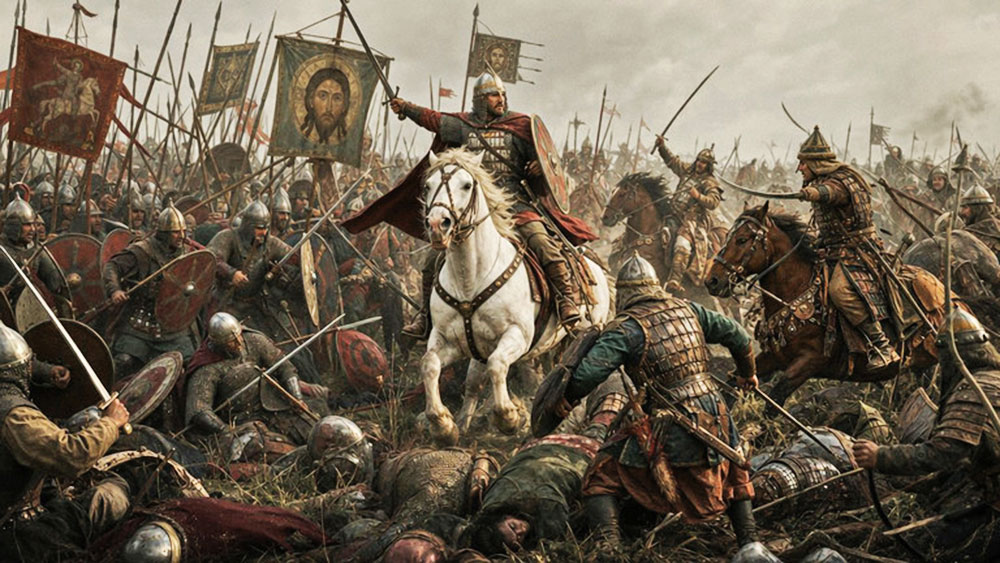
This image was generated
using AI technology.
the Golden Horde at Kulikovo. Now the warrior prince has returned as a symbol for another age of conflict...
Russian President Vladimir Putin stood by an open white stone sarcophagus, made the Sign of the Cross, and bowed his head.
The Russian president called the uncovering of
the relics a "miraculous discovery."
Beneath the burial cloth lay the remains of
Prince Dmitry Donskoy, a warrior prince canonized by the
Orthodox Church and venerated in Russia as the holy savior of Rus'.
Particles of the relics were placed in reliquaries for veneration by the faithful; one of them may be delivered to Russian troops at the front.
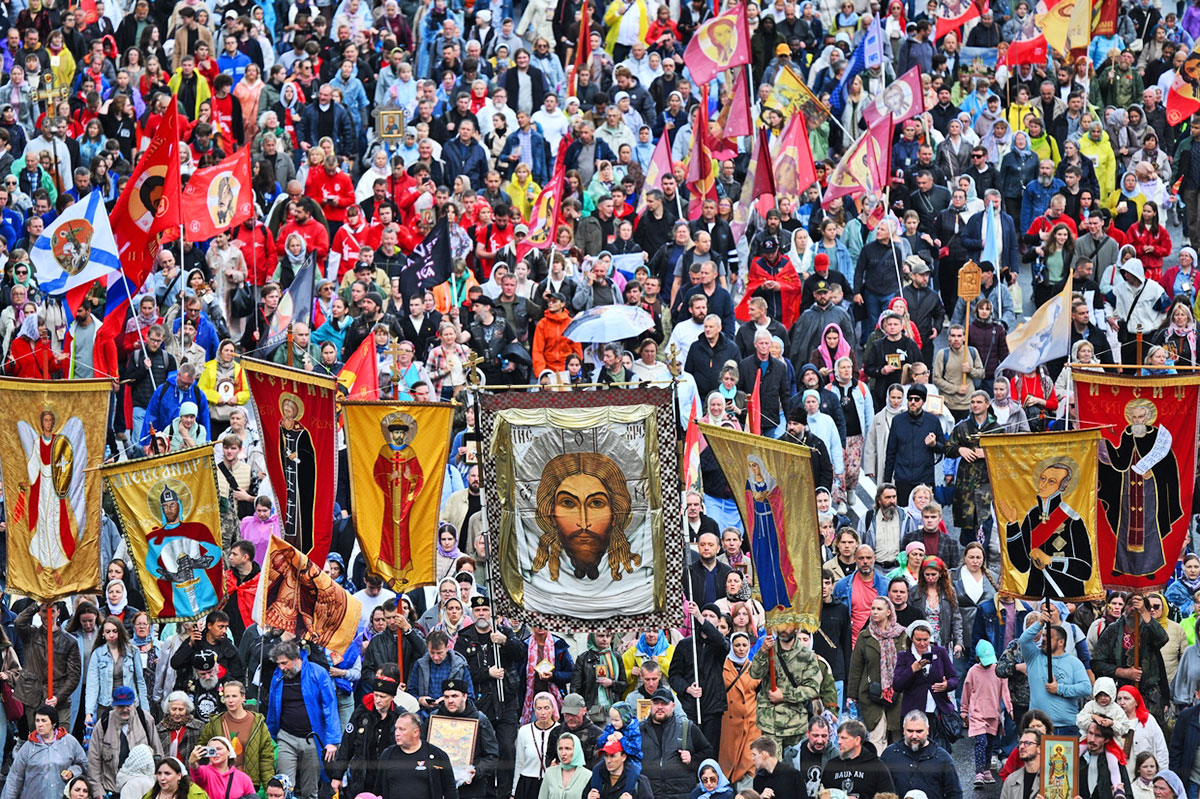
On September 6, one of those reliquaries was carried at the head of a major religious procession through Moscow.
Led by Patriarch Kirill, the procession drew around 100,000 people and followed a 6.5-kilometer route from the Cathedral of Christ the Savior to Novodevichy Convent.
Grand Prince Dmitry Ivanovich of Moscow, better known as Dmitry Donskoy, is a fairly common example of a historical figure remembered by virtually all his compatriots, but known only to specialists outside his country.
This 14th-century prince played a huge role in the history of Russia, which was then still known as Rus'.
His contributions to the fate of Russia as a
warrior and statesman were recognized during his lifetime, but after
his death, Dmitry gradually became a symbolic figure of the struggle
for independence.
Believers take part in a citywide religious procession marking the feast of the Synaxis of the Saints of Moscow on September 6, 2026 in Moscow, Russia. © Sputnik / Kirill Zykov
Modern Russia once again speaks the language of
sovereignty, unity, and resistance to an external adversary - the
same concepts which national memory associates Dmitry Donskoy.
The list of Russia's historical adversaries isn't topped by Poland, Germany, or Türkiye, as one might expect from a brief look at Russian history.
The most formidable enemy, one that called into question the very existence of the Russian people, was a state that no longer exists on the world map:
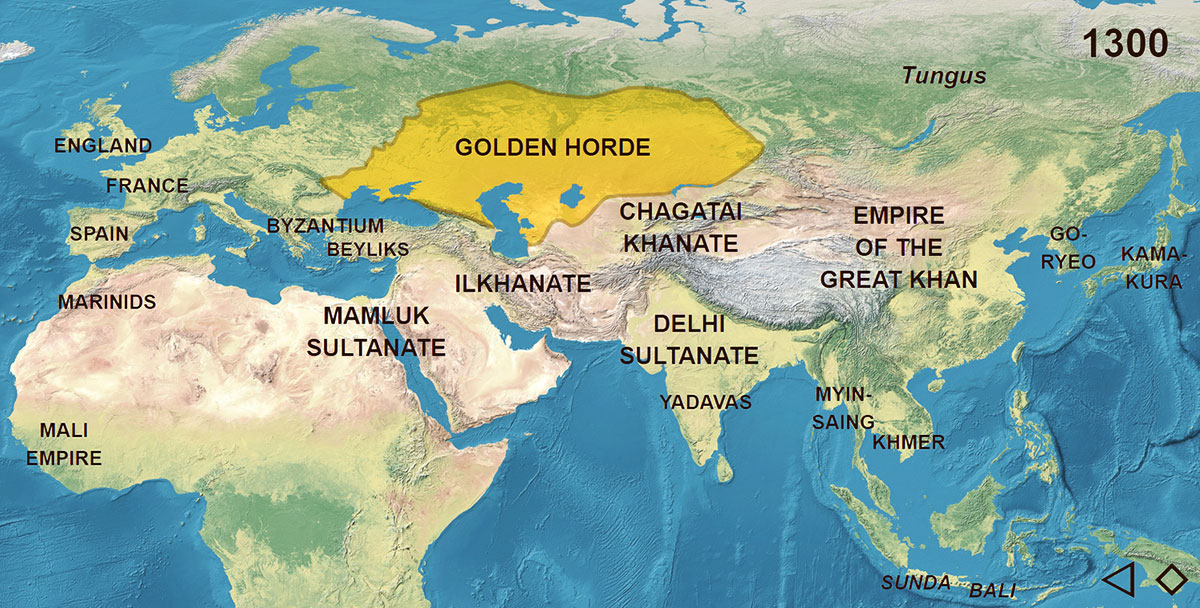
Rus' was one of the countries that fell prey to the Mongols. From this moment on, an epic struggle began, encompassing several dozen wars, not to mention isolated raids and minor border conflicts.
Until the second half of the 15th
century, Rus' remained a vassal state to the steppe kingdom.
As is usually the case, the baskaks abused their
power and engaged in extortion. Whenever they overstepped the
boundaries, another rebellion would break out, followed by a new
punitive campaign.
There was no single leader in Rus' at the time, so the princes traveled to the khan's headquarters to intrigue against each other, turning to the Mongols as arbiters.
The winners of this vile contest received a 'yarlyk' or charter to rule, along with the obligation to pay tribute and support the Mongols against those attempting to shake off their rule.
This period in Russia is still called "the yoke,"
calling to mind the yoke meant for draft animals. It aptly describes
the severity and humiliation of the situation in which Rus' found
itself for many years.
The nomadic empire was weakening.
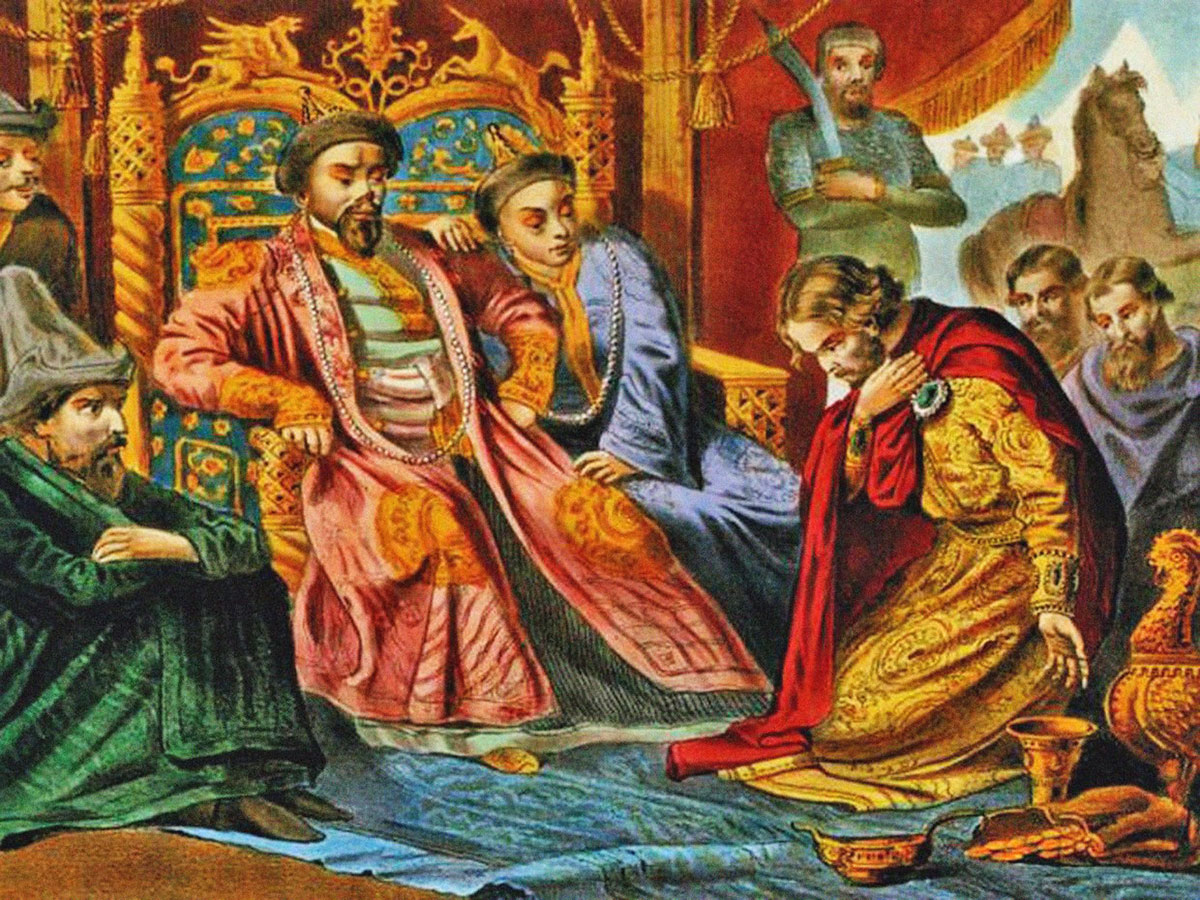
begging Batu Khan for mercy for Russia, End of 19th century. © Fine Art Images / Heritage Images / Getty Images
Lithuania's time as a great Eastern European power was short but brilliant. The western principalities of Rus' gravitated toward the Grand Duchy of Lithuania; this is how the future country of Belarus began to take shape.
In the eastern part of Rus', however, the control
of the Horde was more strict, and events took a different course.
'Kalita' is a nickname meaning 'money bag' as he
was indeed a sort of bagman, an unscrupulous schemer who based his
power on the flow of money. He managed to 'sell' himself to the
Horde as the most loyal of the princes and, most importantly,
persuaded the khans to entrust him with collecting tribute from all
of Rus'.
Ivan Kalita's position as a go-between was disreputable but highly lucrative.
He profited from the cash flow but managed to strike a fine balance, avoiding further rebellions within Rus' while satisfying the khan's demands.
His accounting tricks still allowed him to keep some of the money for himself. He also used his position to quietly undermine his rivals, particularly the powerful prince of Tver.
Now a smaller city northwest of the modern
capital, at the time Tver was a serious rival of Moscow.
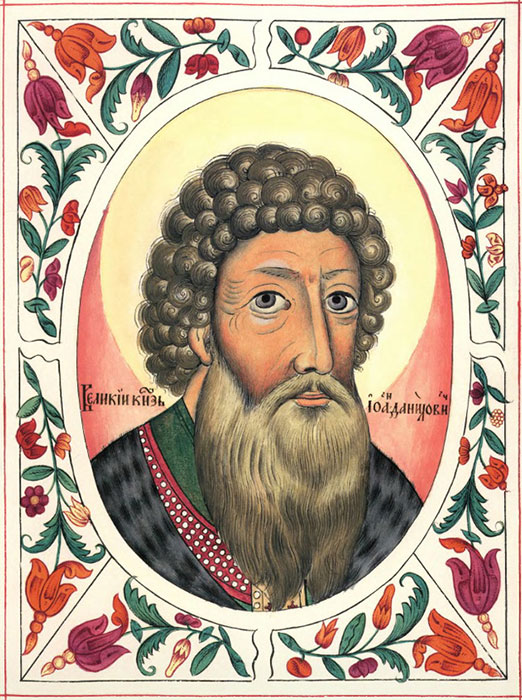
in the Tsarskiy titulyarnik (1672). © Wikimedia / Public Domain
The principality was supposed to be headed by Simeon's heirs, but both Simeon and his sons fell victim to the plague. The cause of death of his younger son Ivan is unknown, but he was 33 years old at the time and may have fallen victim to the same disease.
Be that as it may, in 1359 rule over the
principality was formally passed on to a nine-year-old boy named
Dmitry Ivanovich.
The Birth of a
Legend
Generations of chroniclers and writers have
described the prince as a chivalrous man and a patriot with deep
convictions. Such a person was of course supposed to be ideal, and
Dmitry was characterized as exceptionally virtuous and wise beyond
his years.
The second important factor was that, after his father's death, Dmitry was thrown headlong into the brutal maelstrom of politics.
He had to learn self-control and military skills literally from childhood.
In short,
Thus, from childhood, Dmitry was exposed to the harsh school of politics, intrigue, and war.
Young Dmitry had to endure short but intense wars with Lithuania. Moreover, Regent Alexei could not protect Dmitry forever, and the latter was forced to negotiate with the Horde and participate in campaigns against other princes.
Dmitry besieged Tver, which had long been a thorn
in Moscow's side, and forced Prince Mikhail of Tver to pledge his
loyalty to him.
Apparently, Dmitry earnestly hated the Horde and wanted to fight it.
Such an opportunity soon presented itself.
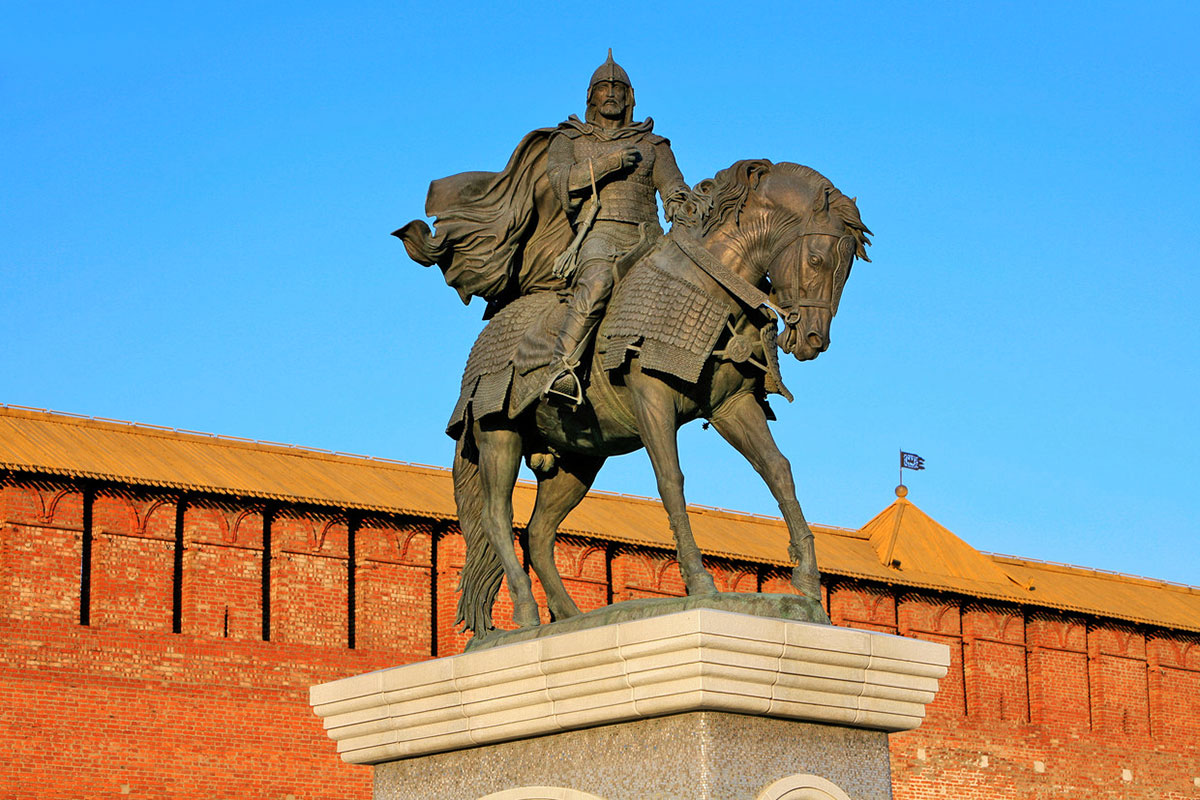
Grand Prince Saint Dmitry Donskoy (1350-1389) at the Kremlin in Kolomna, Russia © Legion-Media / Alamy / DE ROCKER
Its de facto ruler was the military commander Mamai. In Russian tradition, Mamai is often referred to as a khan, but this is incorrect. He was a 'beklarbek', i.e., one of the top-ranking officials.
However, this position afforded him powers almost equal to those of a khan.
Mamai ruled the Horde like an 'eminence grise', outliving a dozen khans while hiding behind the back of the nominal ruler Muhammad Bulak.
Mamai maintained his rule by means of poison, dagger, and intrigue.
In 1363, it was Mamai who granted the charter to
young Dmitry. However, in the 1370s, Dmitry, feeling powerful
enough, refused to pay tribute to the Horde.
At that time, the Horde seemed almost invincible to the Russians. Psychologically, someone had to finally stand up and say "No", and the most powerful prince of eastern Rus' did so.
Dmitry convened a congress of princes who
expressed their support for him.
Mamai faced a serious problem.
Rus', which was seemingly subjugated long ago, now rebelled. Moreover, Mamai was in serious trouble:
Mamai needed to act quickly and brutally.
It was late summer 1380...
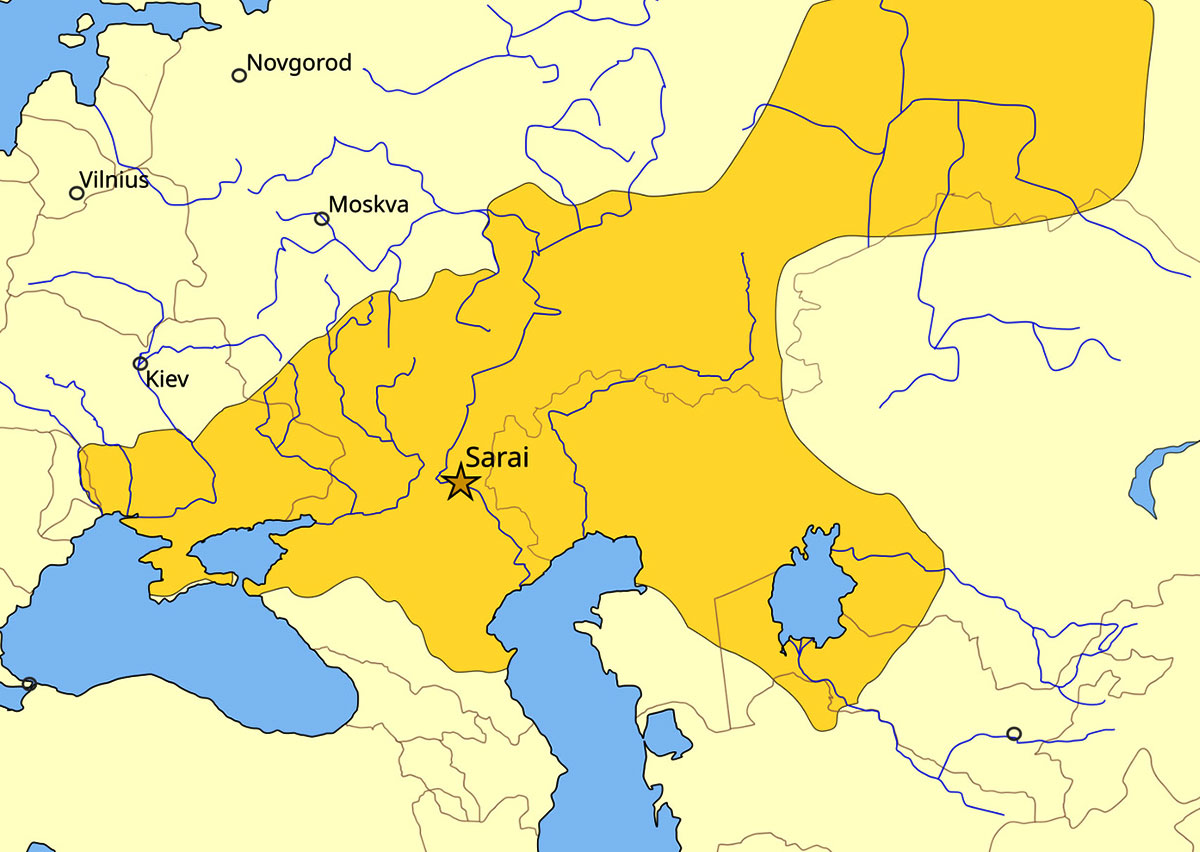
© Wikimedia / MapMaster / CC BY-SA 3.0
Prince Oleg, the leader of Ryazan, which bordered the Horde, took an ambiguous stance.
A century and a half earlier, in 1237, Ryazan had
fiercely resisted the invasion, but the city had been completely
devastated, and its inhabitants had almost entirely perished. Now,
the descendants of the few survivors did not want to get involved.
He did not have the full might of Rus' at his disposal, but commanded a considerably large force assembled from various principalities:
Moreover, individual detachments arrived from Ryazan, despite Prince Oleg's ambiguous stance, and there were also troops from the Rostov Principality, Nizhny Novgorod, Yaroslavl, Bryansk, and Starodub.
Small groups even came from the Lithuanian
Principality - these were the detachments of the exiled princes,
Jagiello's half-brothers.
The first detachment went into the steppe and disappeared; a second detachment had already been dispatched from Moscow to search for it when a scout from the first group emerged from the steppe.
This was Vasily Tupik, whose group managed to kidnap Mamai's confidant. The scouts forced him to provide information about the enemy's whereabouts and plans.
This information was so vital that the name of
the soldier who obtained it was written down in the chronicles, and
thus remained in history.
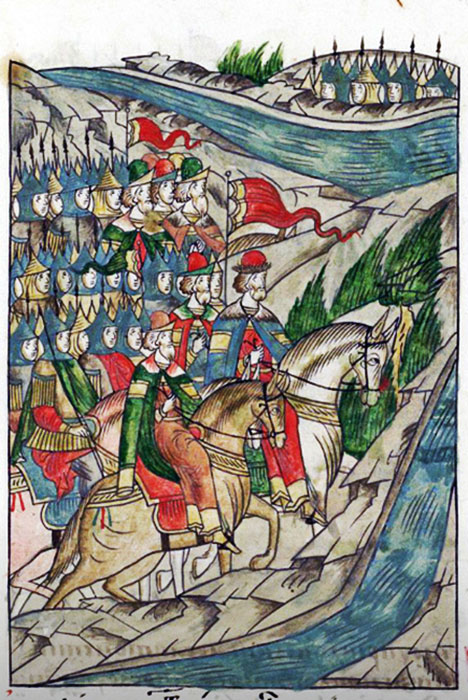
on the way to Kulikovo Field, miniature from the Illustrated Chronicle of Ivan the Terrible. © Wikimedia / Public Domain
Instead, he first made a surprise dash west. This was done to accomplish two goals.
Jagiello, unwilling to engage in a pitched battle with the strong Russian army, slowed his march.
So, by the time Dmitry turned back and embarked
on the campaign against Mamai, it was hard for the Lithuanian prince
to catch up. By the morning of September 8, Dmitry had crossed the
Don River which separated him from the army of the Horde.
Time wasn't on his side:
Dmitry employed a good deal of imagination in planning the battle.
Historically, the Mongols possessed highly maneuverable cavalry. Dmitry occupied a battlefield bordered by forests, rivers, and ravines on the flanks; this protected his army from encirclement.
But the Horde didn't yet know the biggest surprise.
The weakest link in the Russian position was the left flank, positioned next to a large oak forest. But it was precisely here that Dmitry had an ace up his sleeve:
Bobrok was an old, experienced warrior with
strong nerves, and his task was to carry out a surprise attack when
the situation became critical.
It was a cruel decision:
The battle began on the morning of September 8.
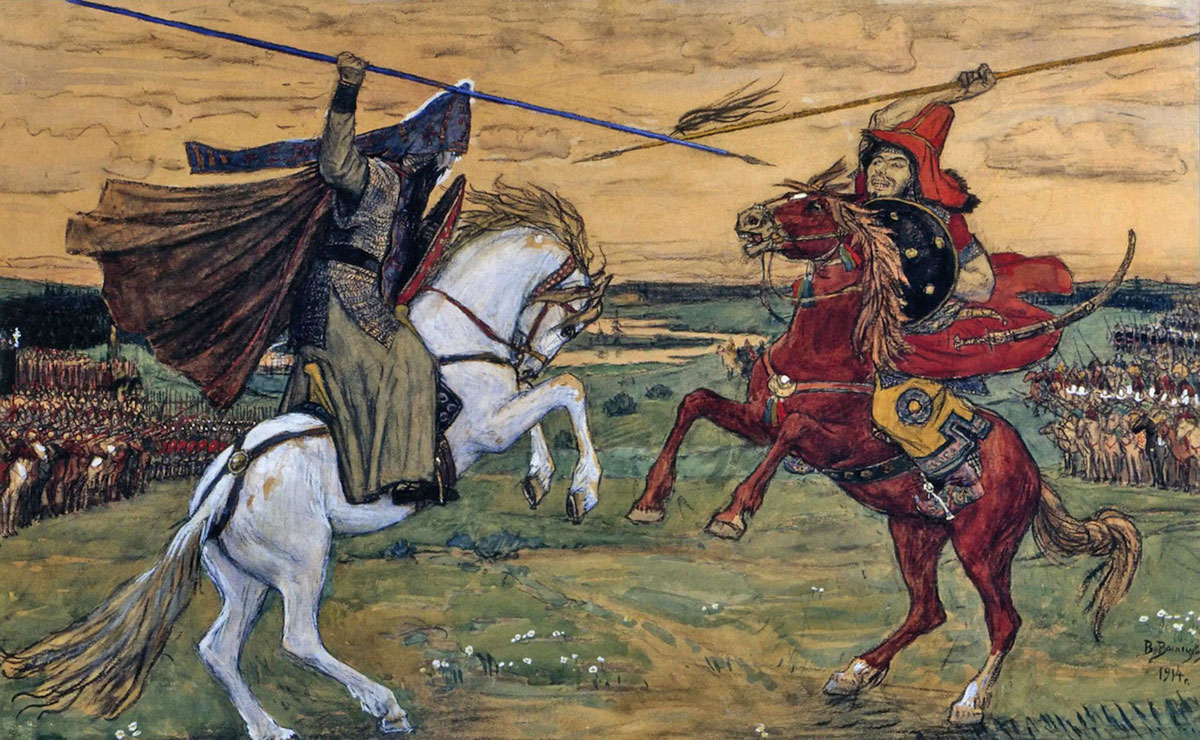
painting by Viktor Vasnetsov (1914). © Wikimedia / Public Domain
Apparently, the steppe army had a numerical advantage, as the Russians spent almost the entire battle on the defensive.
The biggest estimates place the number of participants at 100,000-150,000 men on each side. This is highly questionable. Firstly, such a number of men is dramatically at odds with the logistical capabilities of the time.
Considering that both armies consisted almost entirely of cavalry, 150,000 warriors would have required forage for at least 300,000 horses (main + spare horse for each warrior), which is absurd.
Not to mention that such numbers of men would require supply by rail.
Later, when Russian military bureaucracy allowed for more precise troop estimates, 100,000-man armies 'disappeared' from the accounts and were replaced by armies of standard European size, i.e., 10,000-20,000 fighters.
Considering that not all principalities of Rus'
took part in the Battle of Kulikovo, one must agree with
those researchers who limit the number of participants to
10,000-15,000 warriors on each side.
They persistently sought out weak points and fought in waves for several hours. Of course, we're not talking about hours of nonstop fighting. Cavalry armies fought on both sides and the battle resembled a series of skirmishes.
The detachments charged at each other, fought for
several minutes, then dispersed, making way for fresh reserves.
The battle raged past midday. Mikhail Brenk, who had exchanged armor with Dmitry, was killed in battle.
The prince himself not only commanded the battle,
but actively participated in it and was wounded. This had no effect
on morale; everyone knew Prince Dmitry was somewhere among the
fighting ranks, but his simple, unadorned armor made it difficult to
know his exact whereabouts.
A small reserve detachment came to its aid, but stabilized the situation only briefly. The Horde forded the narrow Smolka River and pushed the Russians further and further back.
The battle had reached its climax; both armies
suffered heavy losses and were terribly tired. However, the Horde
army had inflicted serious damage on the Russians' left flank and
was about to move into the rear of their center.
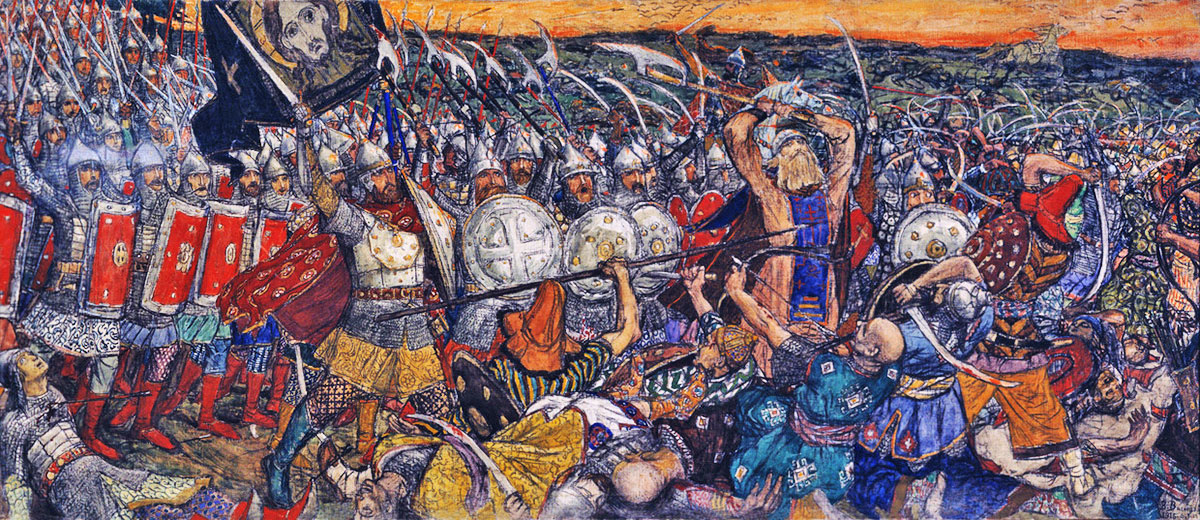
painting by Viktor Vasnetsov (1915). © Wikimedia / Public Domain
The balance of power didn't just shift:
Now, instead of the Russian left flank, the Horde's right flank began to crumble.
Some time after the attack by the Ambush
Regiment, the enemy wavered and began to scatter.
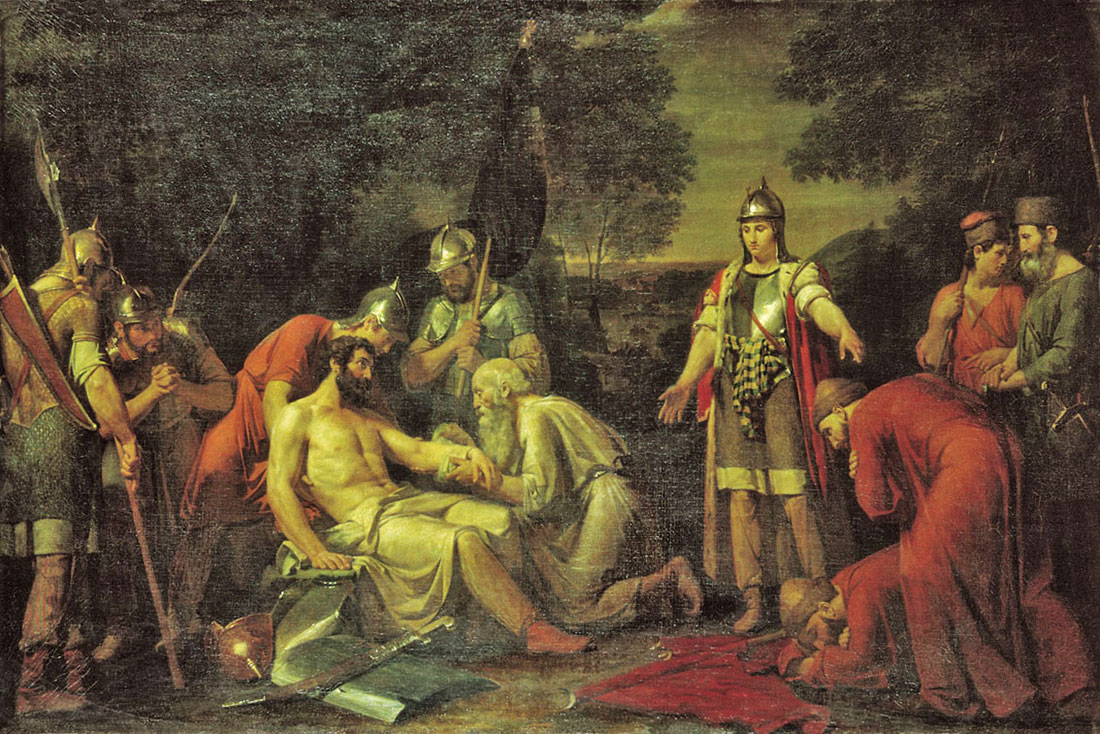
He fought the most important battle of his life at the forefront of his warriors, with a war club in hand, and nearly paid for the victory with his life.
Unfortunately, the chroniclers did not specify in what circumstances he was wounded, but the location where he was found speaks for itself:
From that moment on, Prince Dmitry of Moscow would be known by the name that would become part of history:
On September 14, the army turned back.
painting by Vasily Sazonov (1824). © Wikimedia / Public Domain
The Russian army routed the Horde in a proper pitched battle - it didn't hide behind fortified walls, and didn't just defeat a single detachment; it utterly destroyed the enemy's main field army.
This was not accomplished by any single
principality but by a broad alliance. Men who had seen the backs of
the fleeing Horde army with their own eyes returned to Nizhny
Novgorod, Pskov, Novgorod, and Yaroslavl.
Tokhtamysh set about restoring the Horde's former glory. In 1382, he launched a new campaign against Rus', and this time succeeded in taking Moscow while Dmitry was gathering a field army.
Dmitry, through gritted teeth, paid tribute for the previous two years (but not for the earlier years).
However, the Battle of Kulikovo marked a new style of relations between Rus' and the Horde. Tokhtamysh made no attempt to install anyone else as ruler of Moscow. The idea of independence and political unity took hold in Rus', and Moscow clearly headed this process.
The Russians were still paying tribute, but they
already saw that they could seize the opportunity to avoid it. The
gaps between payments grew wider and successful battles with the
Horde became more frequent.
The cause of his early death is unknown. However, he left behind a powerful legacy:
At the end of the 14th century, 'Zadonshchina'
- a literary monument about the Battle of Kulikovo - was published.
The great conflict thus ended, and all debts were settled...
|