|

by Ethan Siegel
19 October, 2026
from
Medium Website
Article also
HERE
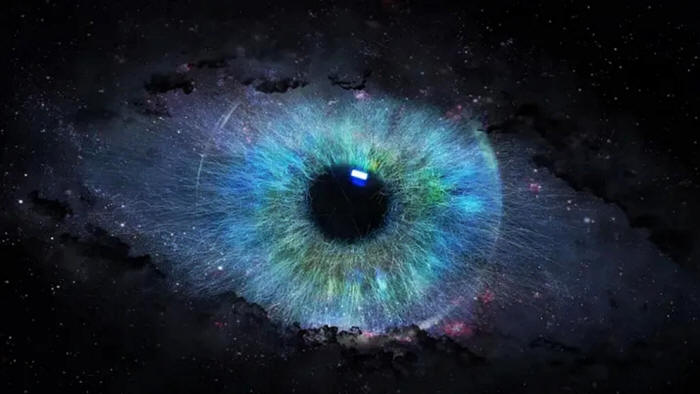
This
illustration blends a dusty, star-forming galaxy
with a
human-like eye and spooky, white tendrils.
Is the
Universe, somehow,
looking back at
us when we observe it?
Credit: adimas
/ Adobe Stock
Compared to the scale of the cosmos,
a single
human body
might seem
insignificant.
But
there's an entire Universe
within
each of us, too...
Quick take
-
Here
on planet Earth, we orbit the Sun within the Milky Way,
and yet the Milky Way itself is just a drop in the
cosmic ocean that is our vast, 13.8 billion year-old
observable Universe.
-
A
human being might seem particularly humble compared to
the scale of the cosmos, but within each of us, there's
an entire Universe of consisting of organs, cells,
molecules, atoms, and more.
-
These 7 comparisons between what's inside you and what's
within the observable Universe can help put both the
incredibly large and the incredibly small in
perspective.
Our observable Universe is enormous compared to a human:
over 1026 times as large.
|
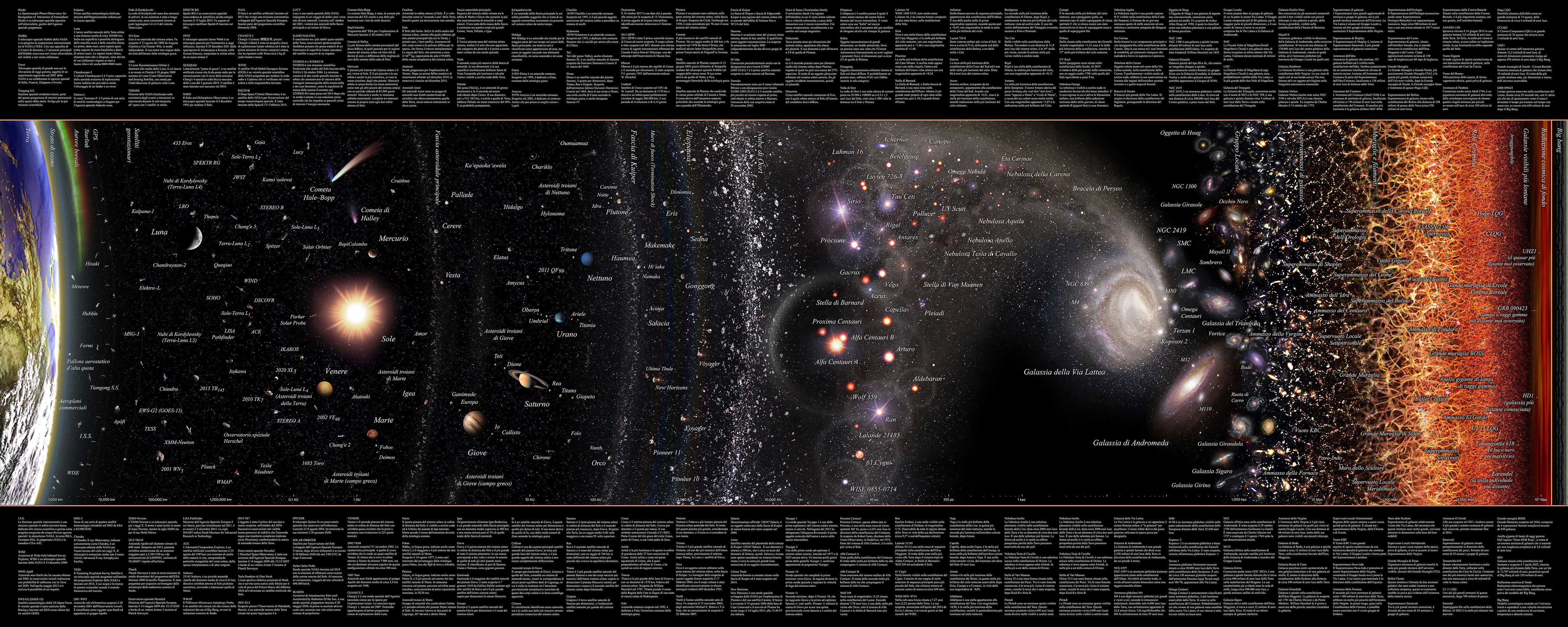
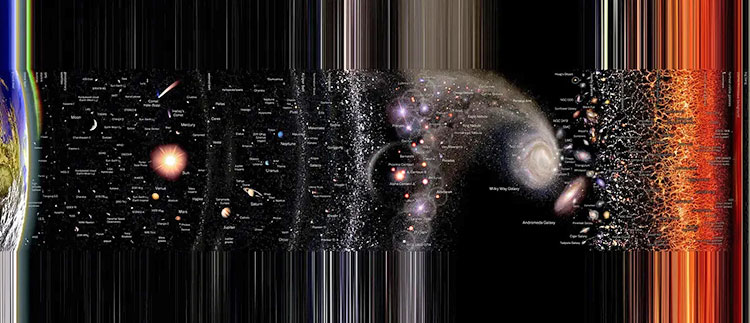
This horizontally-oriented
logarithmic map of the Universe shows how, from
left-to-right, we go from Earth-sized scales to the
largest cosmic distances of all.
As spectacular as this logarithmic
view is, it "only" spans about 20 orders of magnitude:
from the size of the Earth to the size of the
present-day cosmic horizon.
A human is a further factor of
7,000,000 smaller in scale, roughly, than planet Earth.
(Credit:
Pablo Carlos Budassi) |
These 7 comparisons give perspective to these vastly different
scales.
|
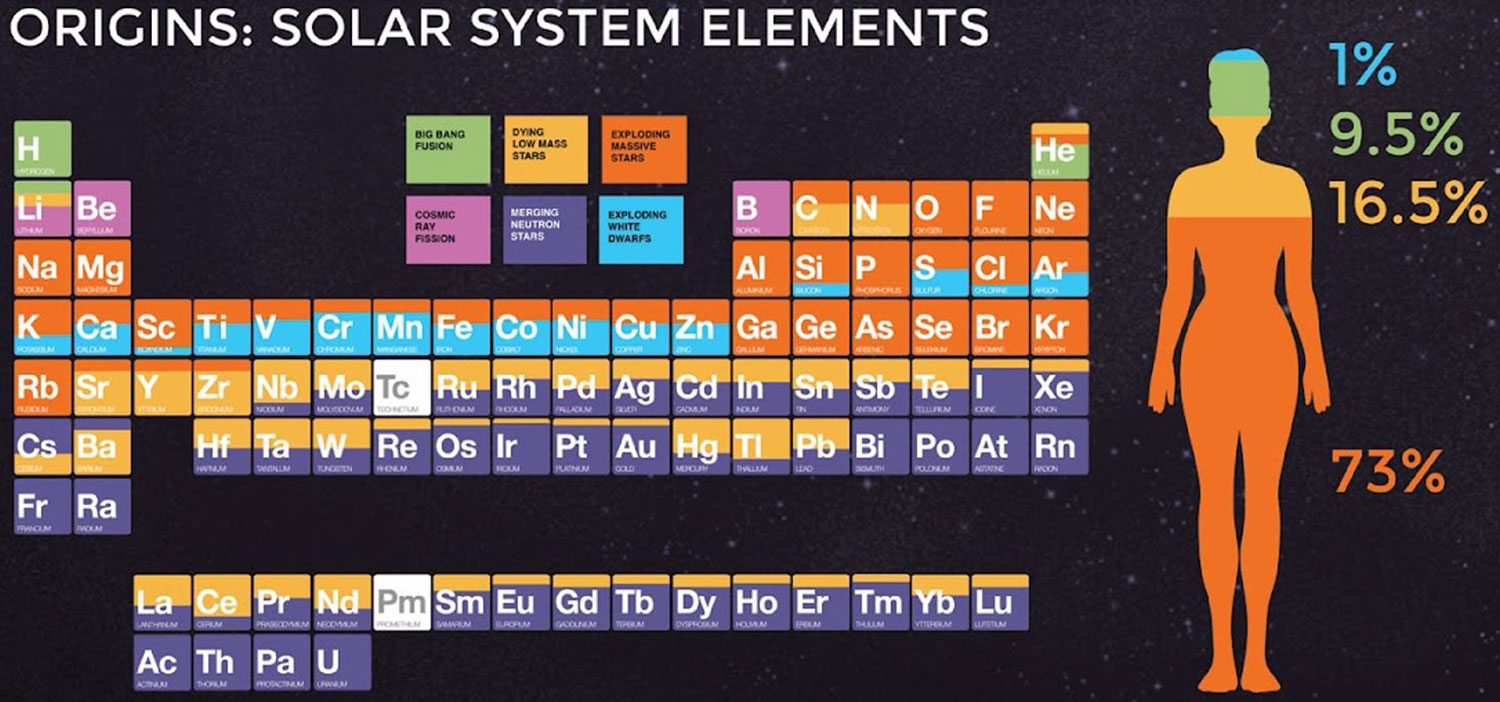
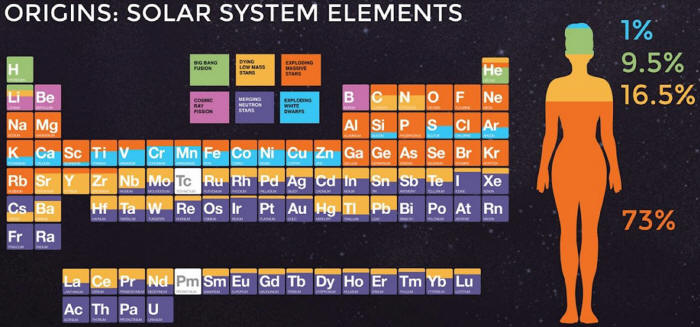
The elements of the periodic table,
and where they originate, are detailed in this image
above.
While most elements originate
primarily in supernovae or merging neutron stars, many
vitally important elements are created, in part or even
mostly, in planetary nebulae, which do not arise from
the first generation of stars.
Beryllium, boron, and some lithium
are primarily created through a process known as
spallation: when cosmic rays strike and split apart
heavier atomic nuclei.
The human body, although it contains
over 70 types of atoms, is primarily made up of only
four:
oxygen, carbon, hydrogen, and
nitrogen.
(Credit:
NASA/CXC/SAO/K. Divona) |
1.) Human cells equal galactic
planetary bodies
|
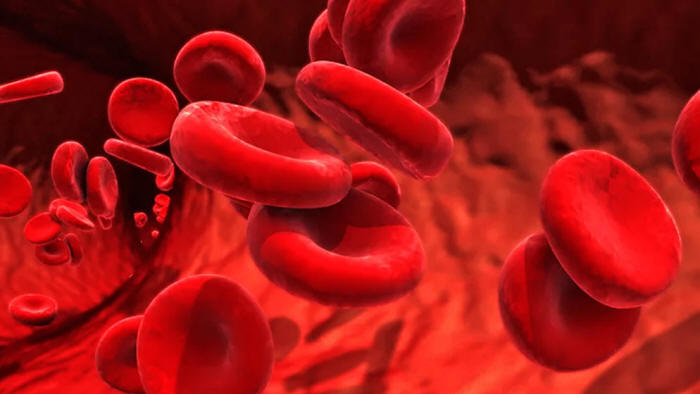
There are approximately 30–40
trillion red blood cells in the human body:
by far the most common type of
cell that is made by humans within the body, and
representing around 90% of all cells.
In addition, approximately an equal
number of non-native cells live within our microbiome,
mostly inside our digestive tract.
(Credit: Design
Cells / Adobe Stock) |
Each human body possesses 80 trillion cells,
half of which are human.
|
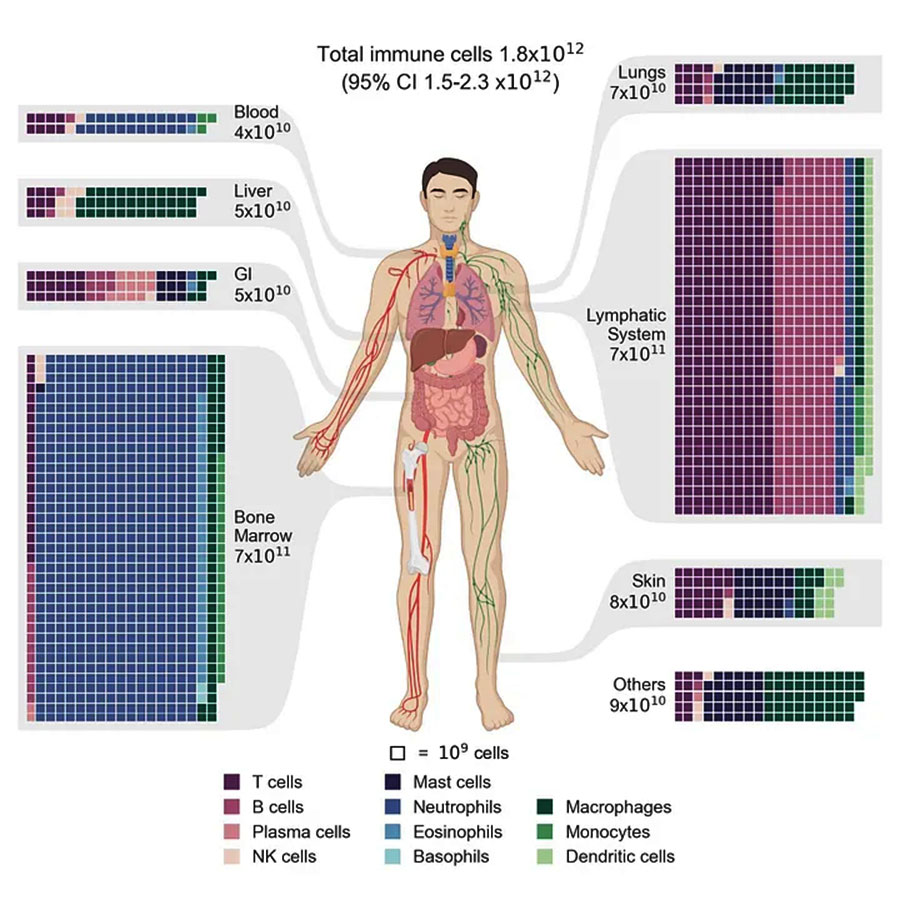
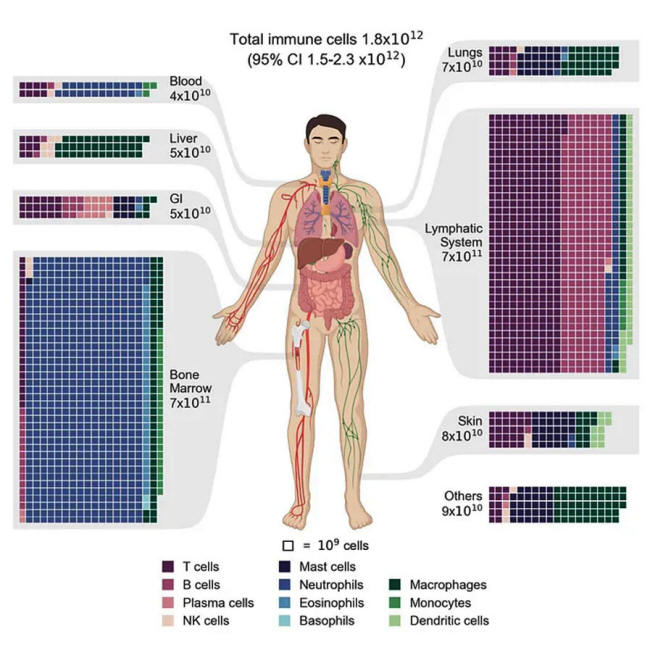
While cells in the digestive tract
and red blood cells make up the majority of cells in the
human body, the next most common cell type are the cells
of the immune system, making up approximately 1.8
trillion cells on their own.
Their estimated distribution and
location is shown here.
(Credit:
Ron Sender/BioRender.com) |
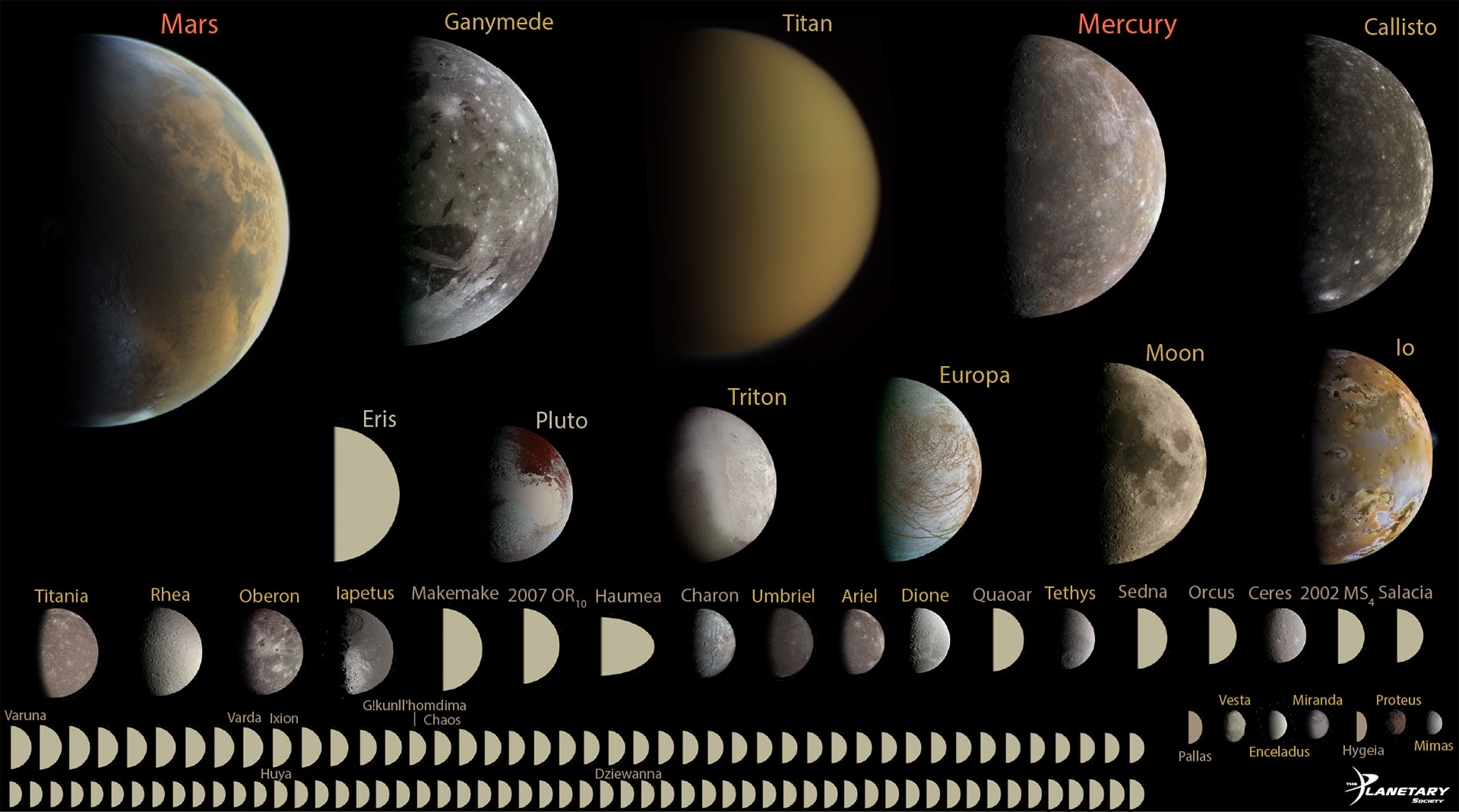
Our galaxy contains 400 billion stars, with
around
100 rounded objects per stellar system.
|
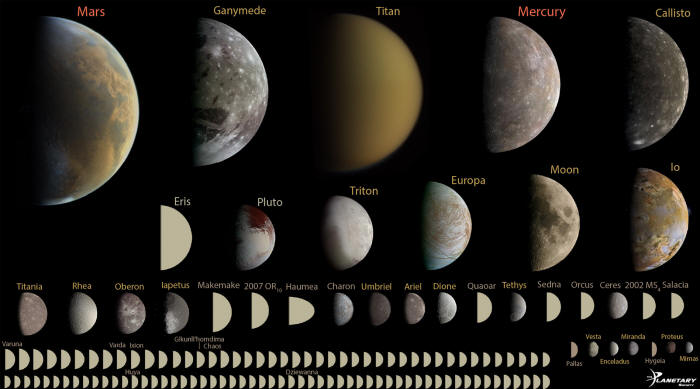
Although Earth and Venus are the two
largest rocky objects in the Solar System, Mars,
Mercury, as well as over 100 of the largest moons,
asteroids, and Kuiper belt objects have all achieved
hydrostatic equilibrium.
Ganymede and Titan are larger than
Mercury, but Callisto, at 99% of Mercury's size, has
just one-third of Mercury's mass.
All told, all known objects with
diameters greater than 800 km are in hydrostatic
equilibrium.
The number of rounded bodies is
expected to be similar among nearly all star systems.
(Credit:
Emily Lakdawalla. Data from NASA / JPL, JHUAPL/SwRI,
SSI, and UCLA / MPS / DLR / IDA, processed by Gordan
Ugarkovic, Ted Stryk, Bjorn Jonsson, Roman Tkachenko,
and Emily Lakdawalla) |
2.) More Cells than
overall Galaxies
|
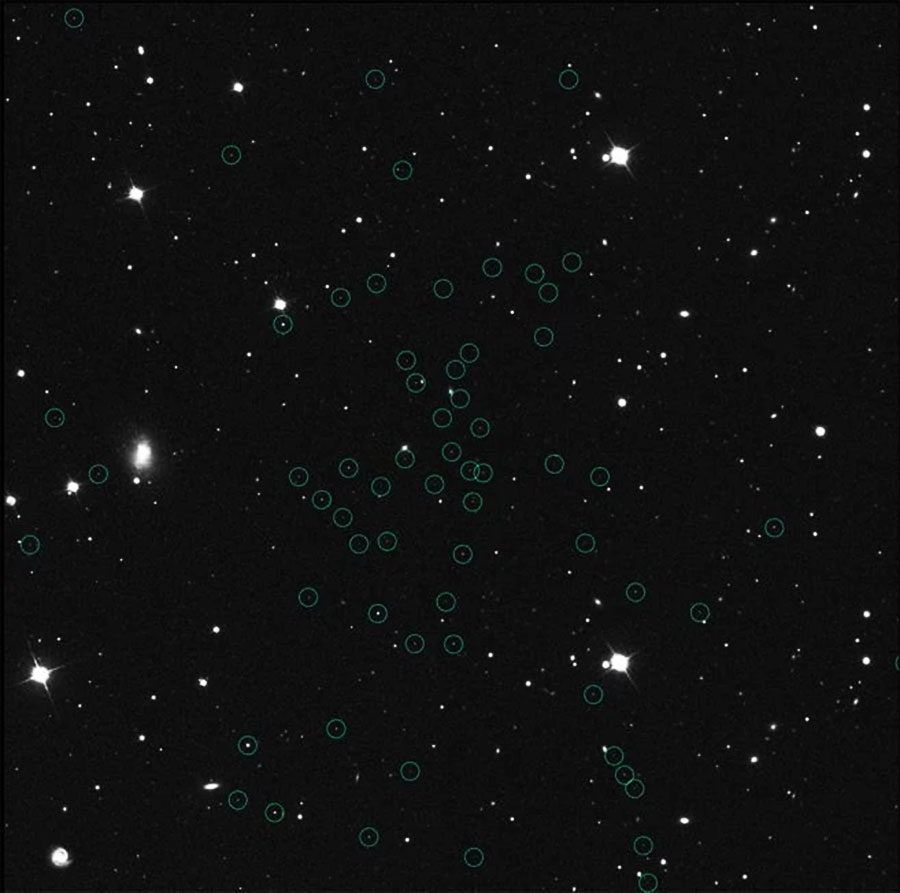
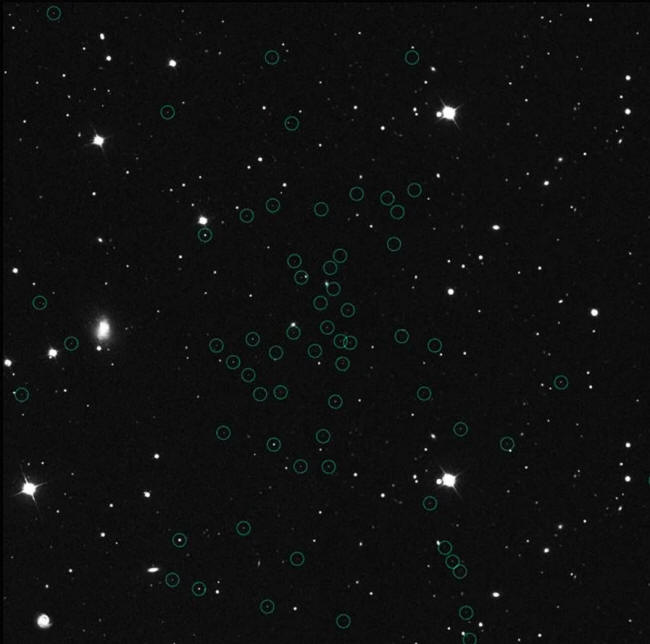
Only approximately 1000 stars,
totaling ~175 solar masses, are present in the entirety
of dwarf galaxies Segue 1 and Segue 3, the latter of
which has a gravitational mass of an impressive 600,000
Suns.
The stars making up the dwarf
satellite Segue 1 are circled here.
As we discover smaller, fainter
galaxies with fewer numbers of stars, we begin to
recognize just how common these small galaxies are as
well as how elevated their dark matter-to-normal matter
ratios can be; there may be as many as 100 for every
galaxy similar to the Milky Way, with dark matter
outmassing normal matter by factors of many hundreds or
even more.
(Credit:
Marla Geha/Keck Observatory) |
This outstrips the number of galaxies in the observable Universe:
estimated at 20 trillion.
|
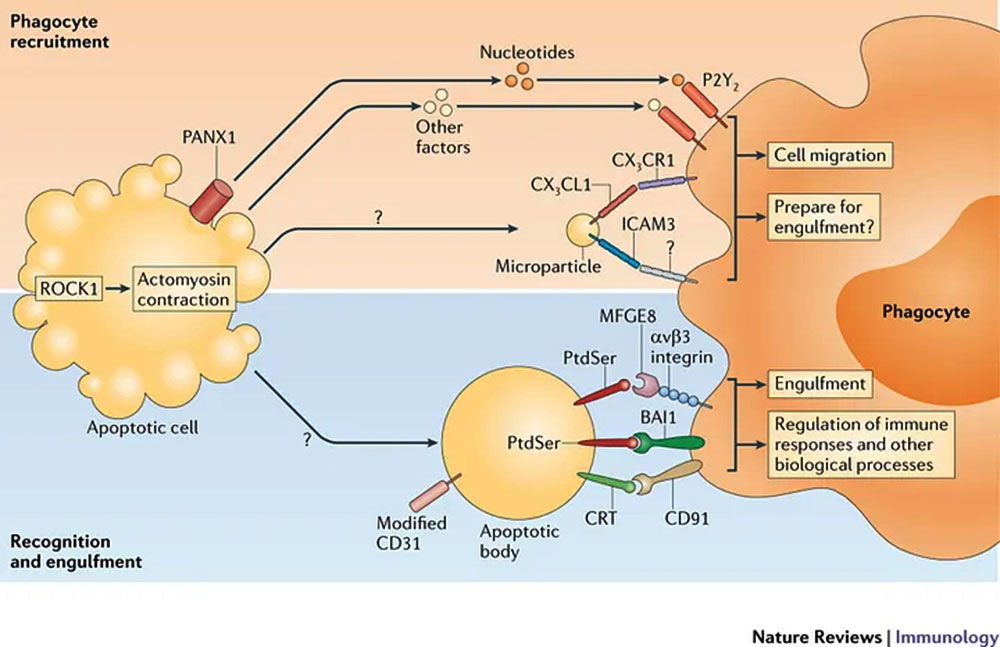
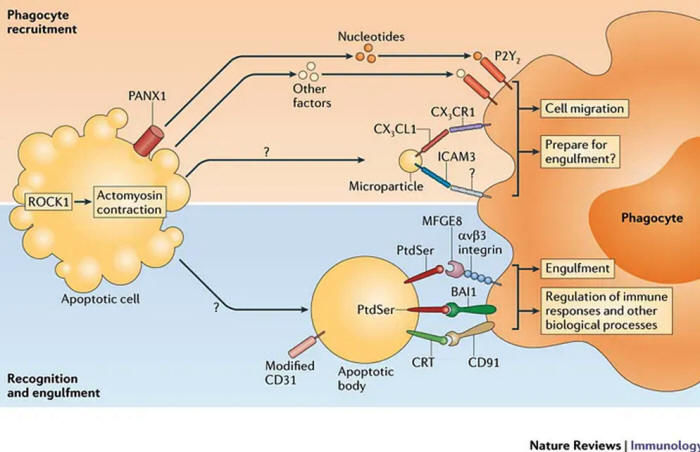
This diagram shows the phases of
apoptotic cell clearance.
Apoptosis is the process by which the
body regularly destroys older cells, paving the way for
newer, healthy, less damaged cells to take their place.
Every day, somewhere around 50-70
billion cells die inside your body.
(Credit:
I.K.H. Poon et al., Nature Reviews Immunology, 2014) |
3.) Daily Cell Death comprises a
whole Galaxy of Stars
|
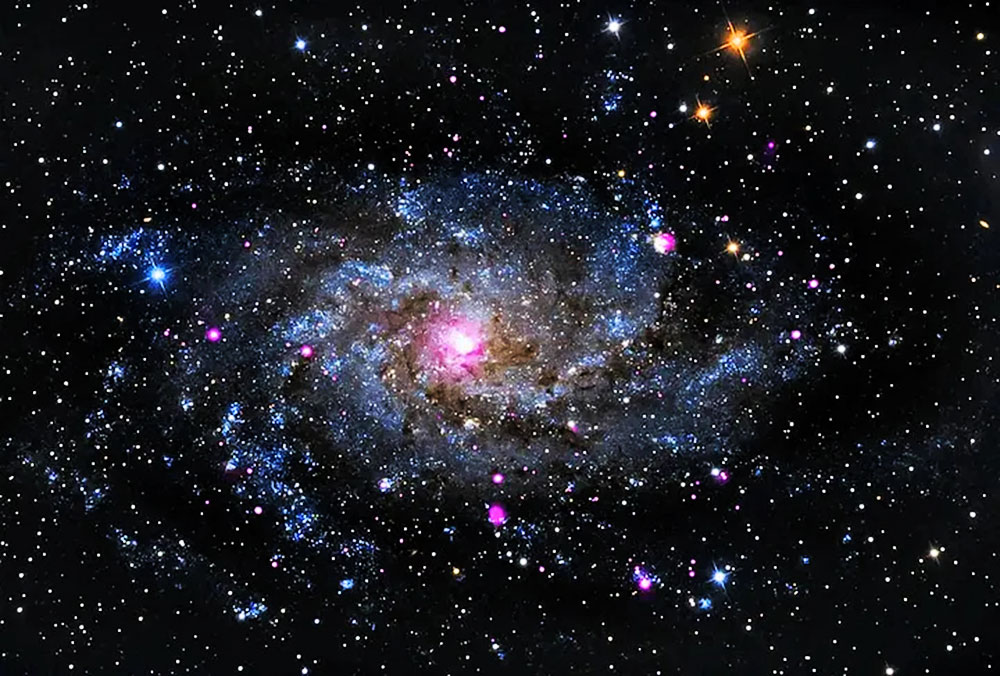
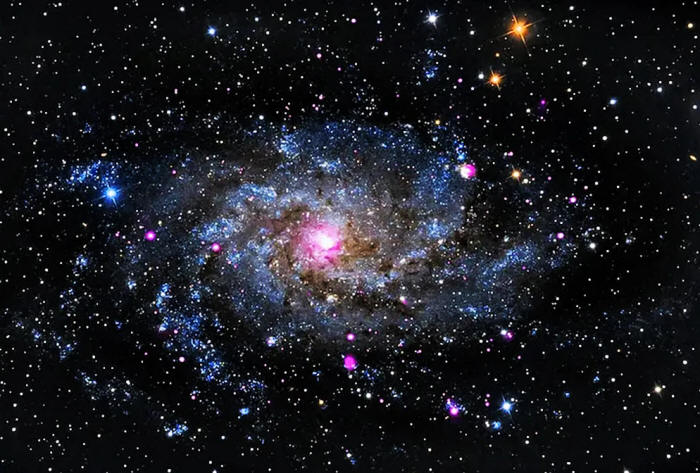
The spiral galaxy Messier 33, shown
as imaged by an amateur astronomer with X-ray data from
NASA's Chandra overlaid in pink, is also known as the
Triangulum galaxy: a faint galaxy visible in the
southern skies.
First recorded in 1654, it is the
faintest object visible by typical, unaided human eyes
at a distance of 2.878 million light-years: several
hundred million light-years more distant than Andromeda.
As the Local Group's third largest
galaxy, it contains an estimated 40–50 billion stars.
(Credit:
Optical: Warren Keller; X-ray: NASA/CXC/SAO/P. Plucinsky
et al.) |
Each day,
50-70 billion cells die: comparable
to
our total number of brain neurons.
|
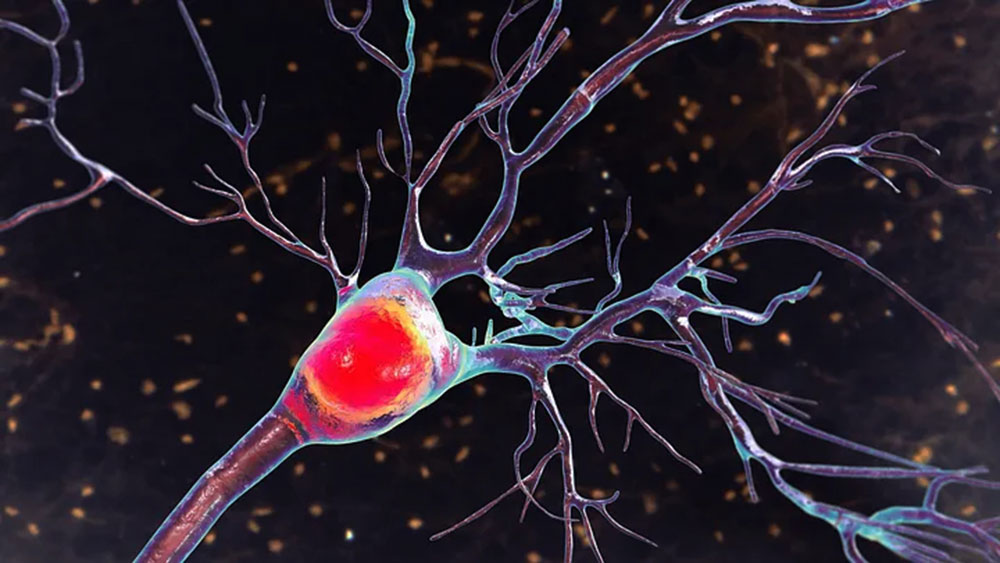
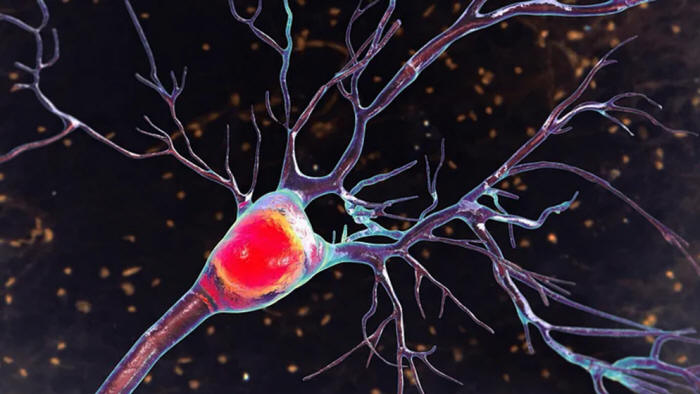
The brain is a network of neurons,
connected by synapses, embedded in a substrate of four
different types of glial cells.
There is both white and gray matter
in the brain, and a three-layer protective casing
surrounding it, all fed by blood vessels.
A typical human brain contains an
estimated 86 billion neurons. How this organ produces
consciousness remains highly mysterious.
(Credit: Dr_Microbe
/ Adobe Stock) |
4.) A Galaxy
Cluster's Galaxies are like Organs, Muscles, and Bones
|
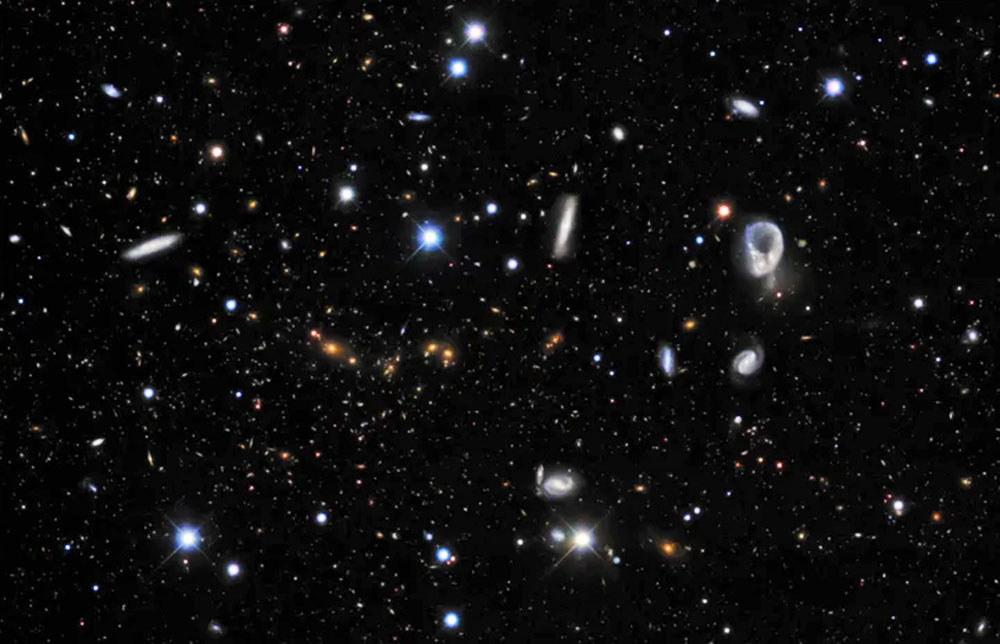
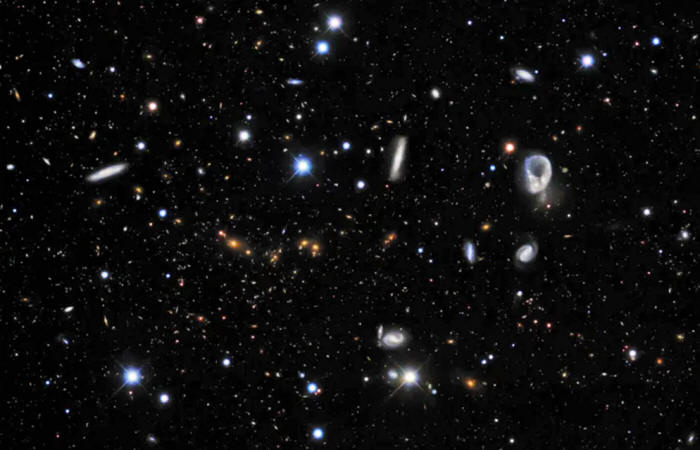
Most of the largest known galaxies in
the Universe are found at the hearts of massive galaxy
clusters, like the nearby galaxy cluster shown here.
While the largest and most massive
galaxy clusters possess several thousand galaxies, they
are rare.
More typically, galaxy clusters
contain a few hundred galaxies, with an "average" galaxy
cluster possessing right around 1000 significant
galactic members.
(Credit:
CTIO/NOIRLab/DOE/NSF/AURA; Image processing: Travis
Rector (University of Alaska, Anchorage/NSF's NOIRLab),
Jen Miller (Gemini Observatory/NSF's NOIRLab), Mahdi
Zamani & Davide de Martin (NSF's NOIRLab)) |
Most galaxy clusters have
around 1000 galaxies.
|
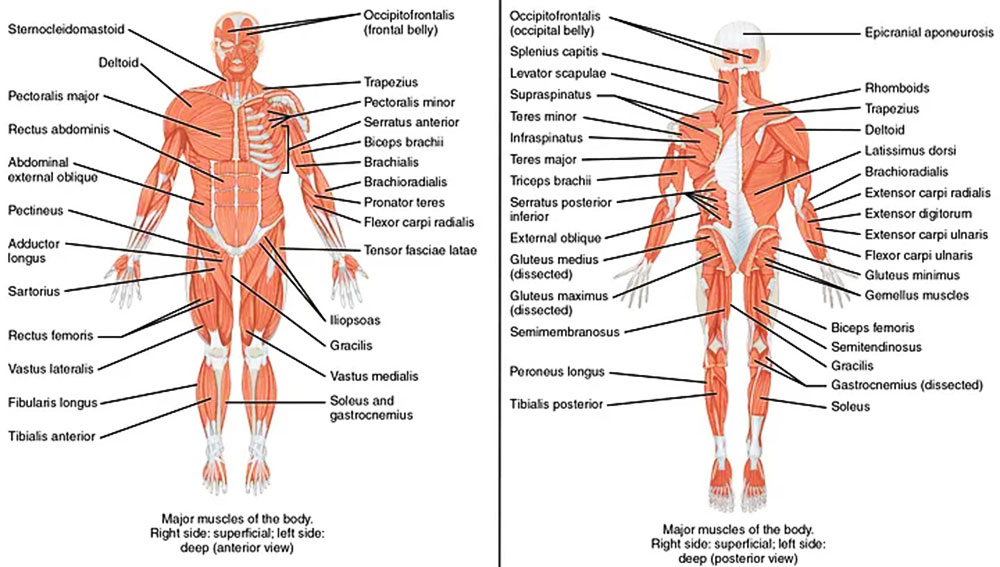
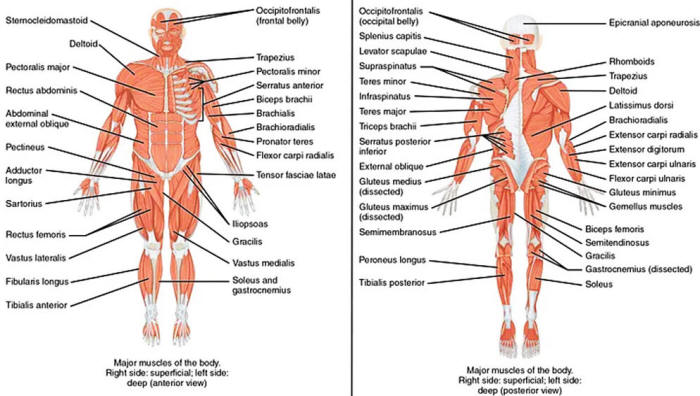
This view of the human body, both
shallow as well as posterior and anterior, shows the
major muscle groups found inside the human body.
Along with 79 organs and 206 bones,
there are over 600 and closer to 700 identified skeletal
muscles within the human body.
These three systems, combined make up
the majority of a human body's mass.
(Credit:
OpenStax Anatomy and Physiology/Wikimedia Commons) |
Meanwhile, humans have 79 organs, 206 bones, and
700 skeletal muscles.
|
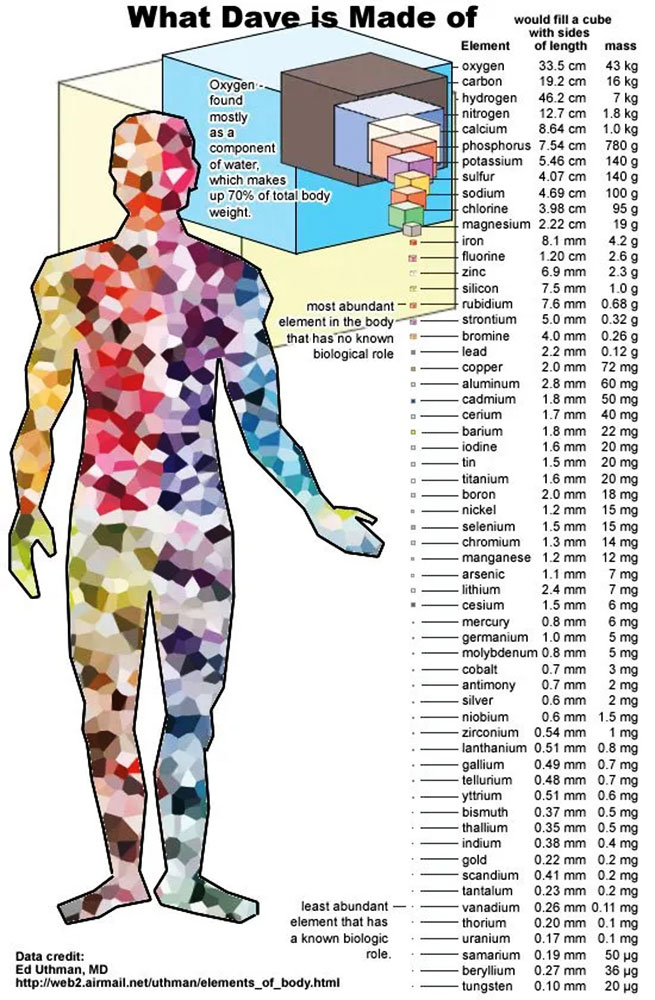
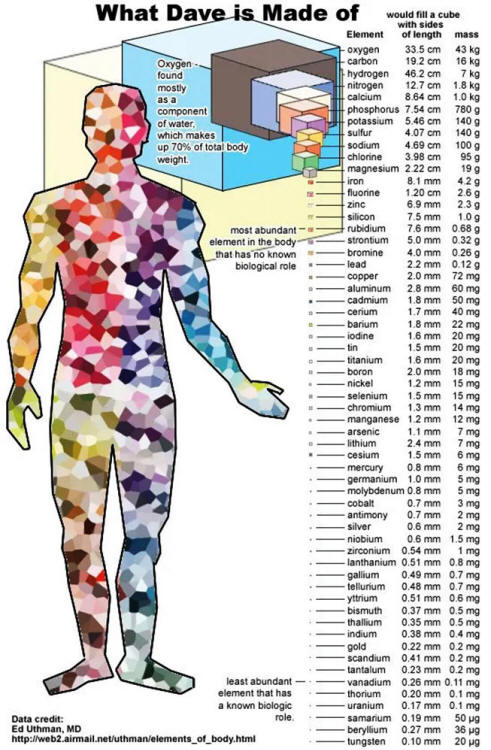
Although human beings are made of
cells, at a more fundamental level, we're made of atoms.
All told, there are close to ~1028
atoms in a human body, mostly hydrogen by number but
mostly oxygen (due to water) and carbon (due to the
musculoskeletal system and our organs) by mass.
(Credit:
Dave Collins/Dave's Brain) |
5.) Water is the
body's "Dark Matter"

|
Human bodies gradually evolve in
terms of their water-weight content over the course of
their lifetime.
A zygote's mass is nearly 100% water,
a developing fetus is around 90%, a newborn baby's water
content is 75–80%, which decreases to around 70% in
childhood, 55–65% in adulthood and down to about 50% in
the elderly.
(Credit: Kati
Finell / Adobe Stock) |
Humans are
mostly (50–80%) water, while
dark matter dominates (80–85%) the
cosmos's mass.
|
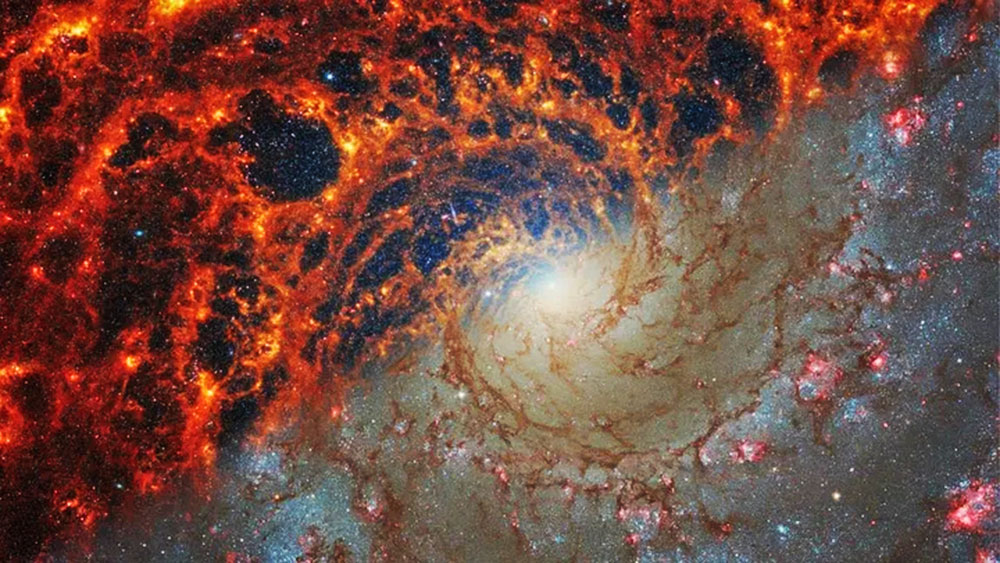
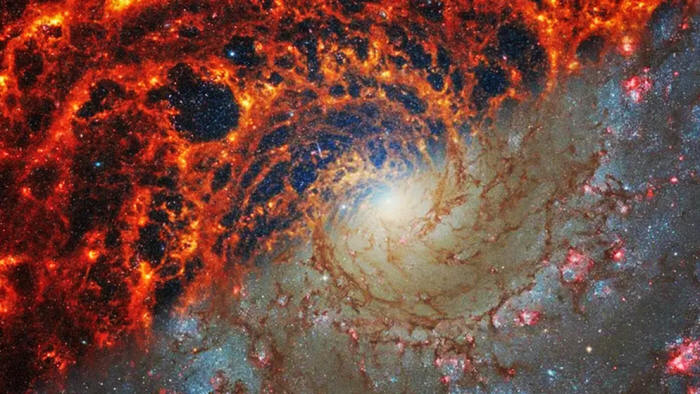
This composite JWST (above left) and
Hubble (lower right) image of nearby spiral galaxy NGC
628, located 32 million light-years away, showcases the
gas and dust network that traces out the spiral arms and
the current star-forming regions within them.
For large, high-mass spiral galaxies,
it's very common to find a dark matter to normal matter
ratio consistent with the cosmic average: 5-to-1.
However, in extreme environments and
for low mass galaxies, the ratios can be extreme, both
in terms of producing galaxies overabundant and
deficient in dark matter.
(Credit:
NASA, ESA, CSA, STScI, Janice Lee (STScI), Thomas
Williams (Oxford), PHANGS Team) |
6.) Our Circulatory
System's length is like a Galaxy compared to our home

|
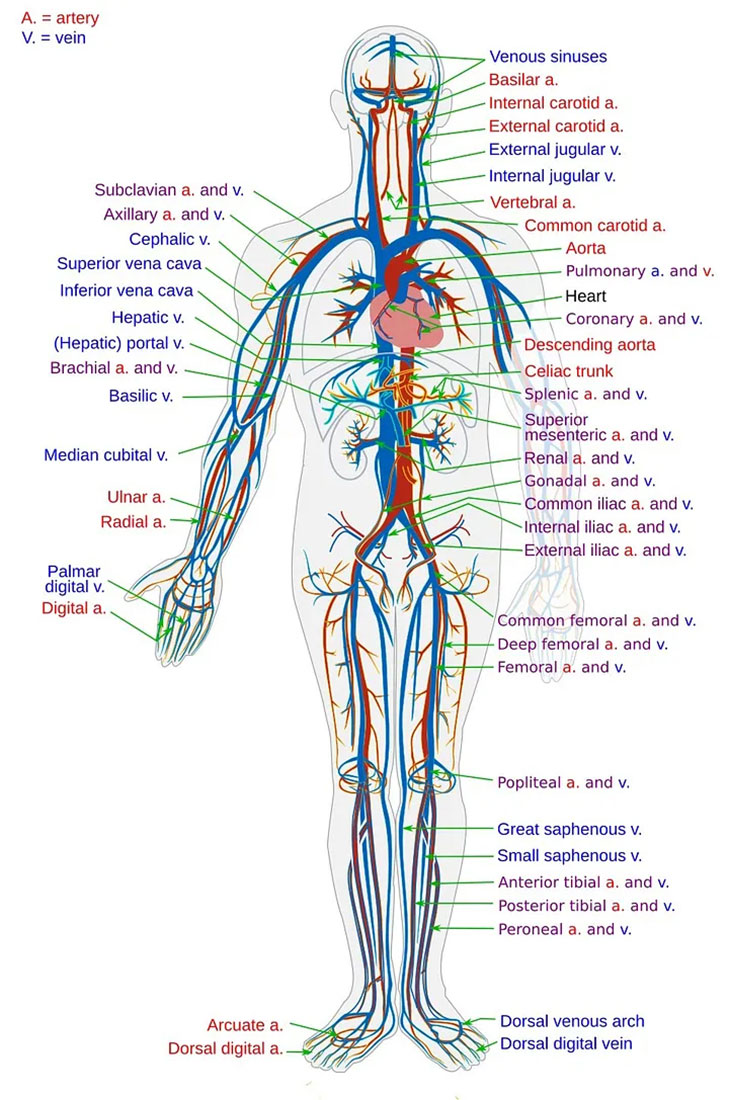
This simplified diagram shows the
large, major pathways for both arterial and venous blood
flow within the human body.
Although these are the
largest-diameter pathways for blood flow, the majority
of the length of the human circulatory system is
composed of the smallest vessels: capillaries.
(Credit:
public domain, LadyofHats/Wikimedia Commons) |
The ratio of
our circulatory system's length to
our height is 60,000,000.
|
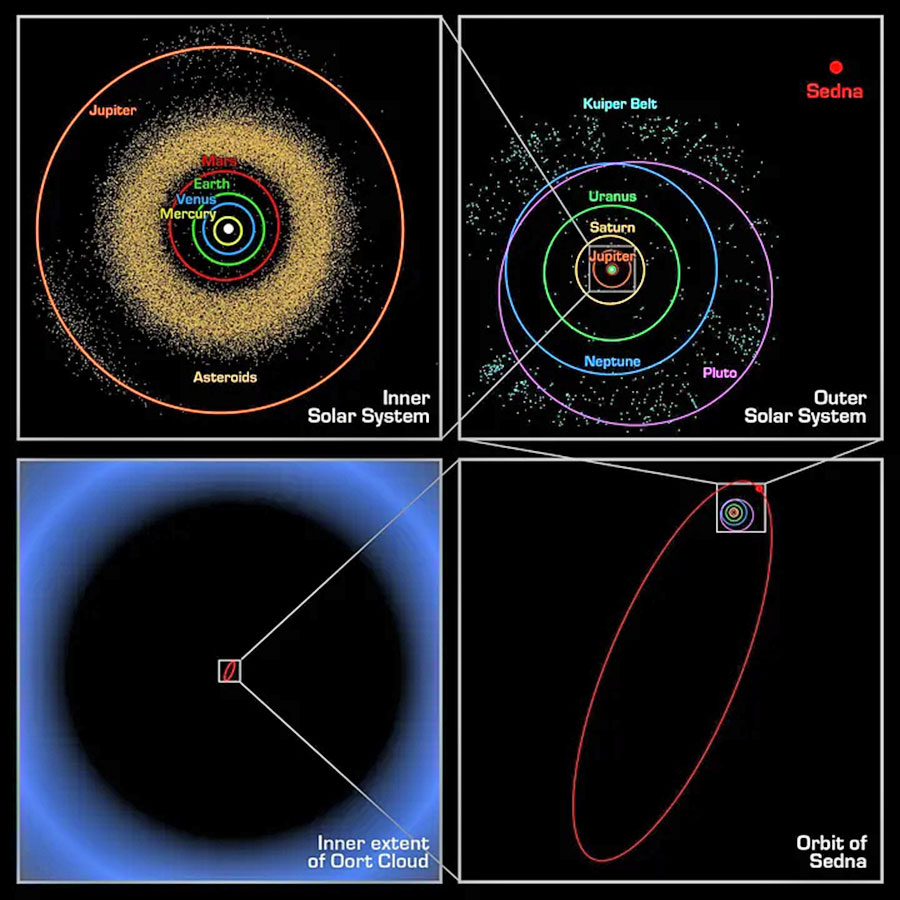
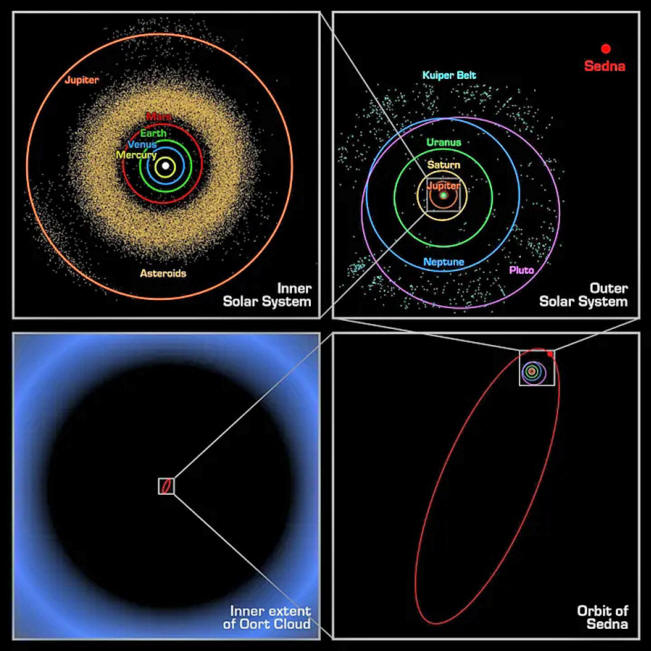
The inner Solar System, including the
planets, asteroids, gas giants, Kuiper belt, and more,
is minuscule in scale when compared to the extent of the
Oort Cloud.
Sedna, the only large object with a
very distant aphelion, may be part of the innermost
portion of the inner Oort Cloud, but even that is
disputed.
The diameter of the Kuiper belt is a
little bit over 100 AU in size, before giving way to the
Kuiper cliff, where its population abruptly plummets.
(Credit:
NASA/JPL-Caltech/R. Hurt) |
This equals
our Kuiper belt's to the Milky
Way's diameter ratio.
|
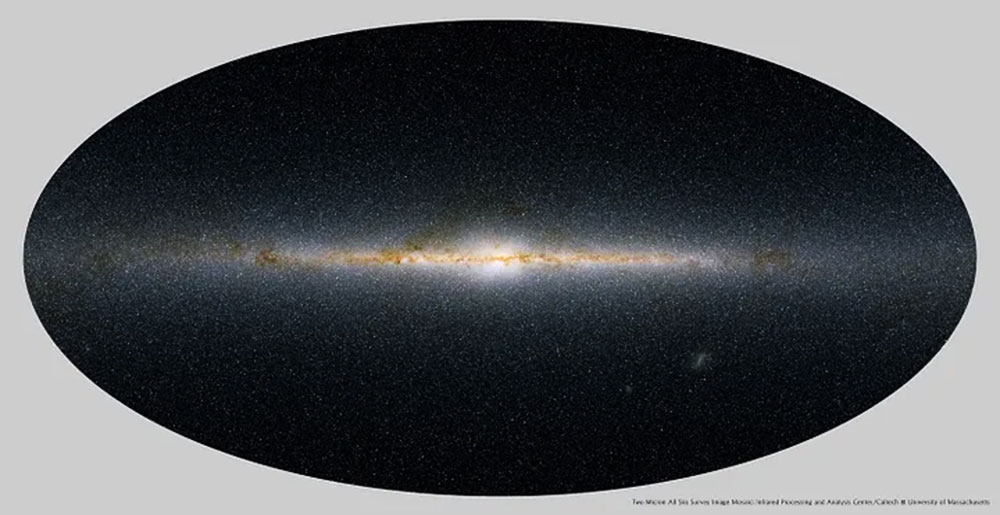
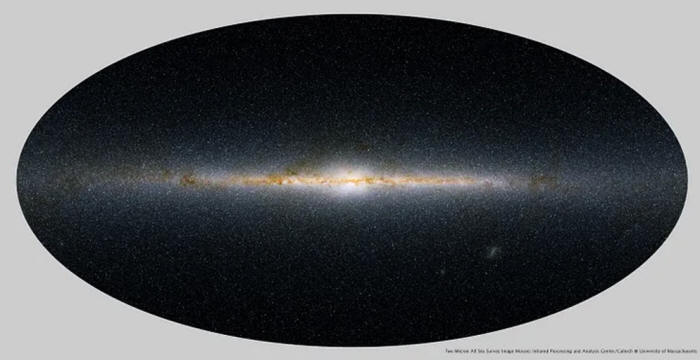
By viewing the Milky Way in infrared
wavelengths of light, we can see through large amounts
of the galactic dust and view the distribution of stars
and star-forming regions behind them.
As revealed by the 2 micron all-sky
survey (2MASS), the densest collections of galactic dust
can be seen tracing out our spiral arms, but the center
of the plane of the Milky Way is where the dust is
densest.
The Milky Way's diameter is estimated
to be just over 100,000 light-years.
(Credit:
2MASS/IPAC/Caltech & UMass) |
7.) Millions of Human
Atoms for every Star
|
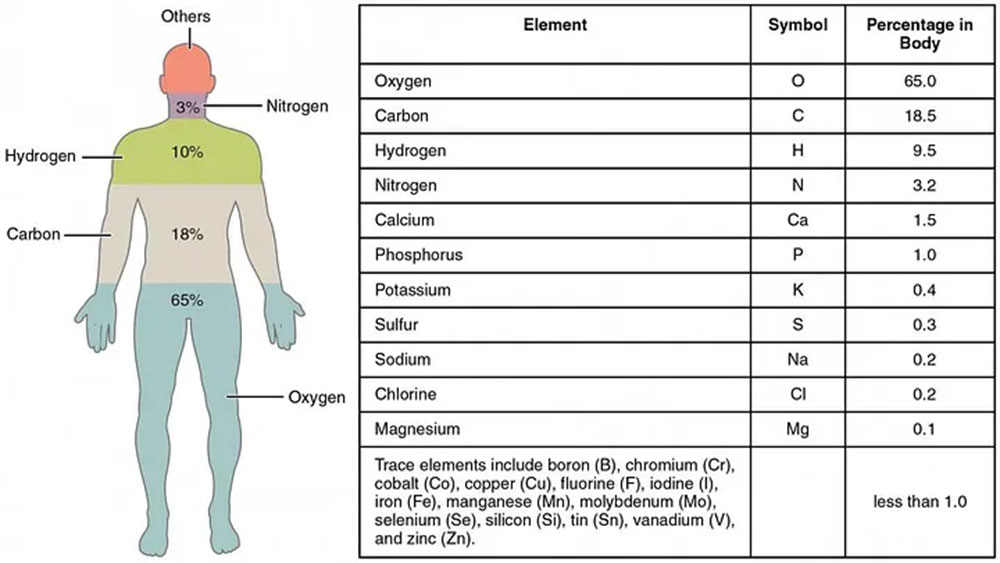
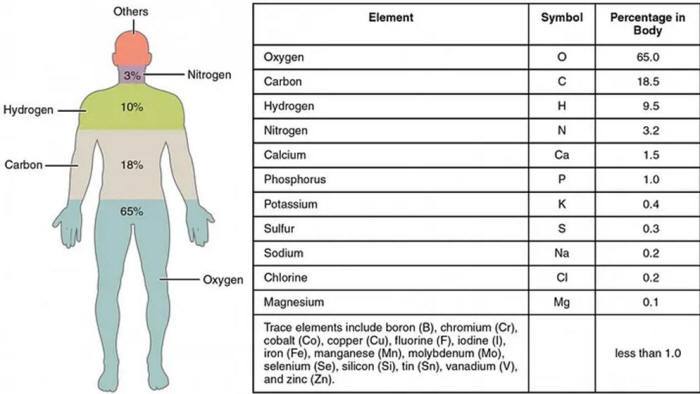
This diagram and table show the main
elements that compose the human body as a function of
percentage of mass.
The fraction by number of atoms is
vastly different and dominated by hydrogen, due to the
enormous variation in atomic weights of the various
elements.
Oxygen contributes the most mass
(with carbon second and hydrogen third), while hydrogen
is the most abundant element by number (with oxygen
second and carbon third).
(Credit:
OpenStax College, Anatomy & Physiology, Connexions Web
site, 2013) |
There are
1028 atoms within a human,
dwarfing
the Universe's 2×10²¹ stars.
|
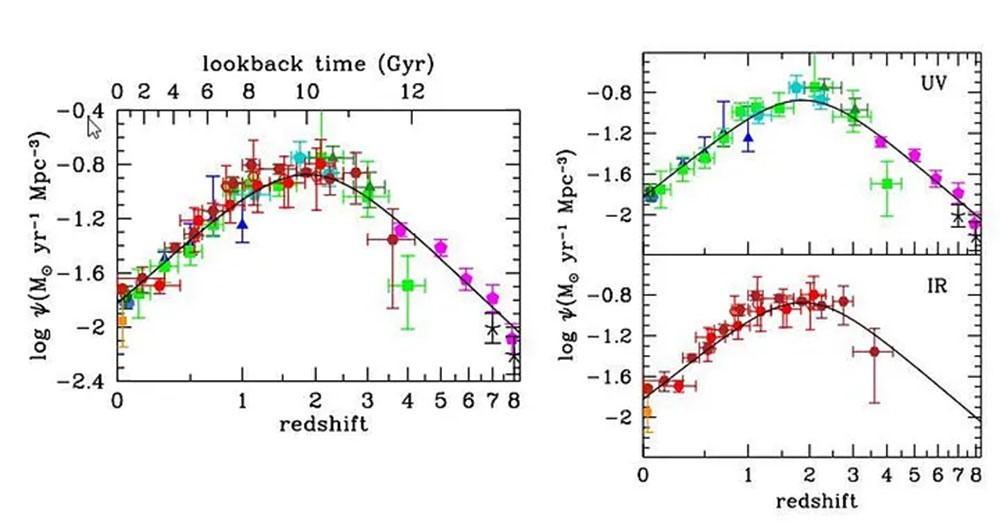
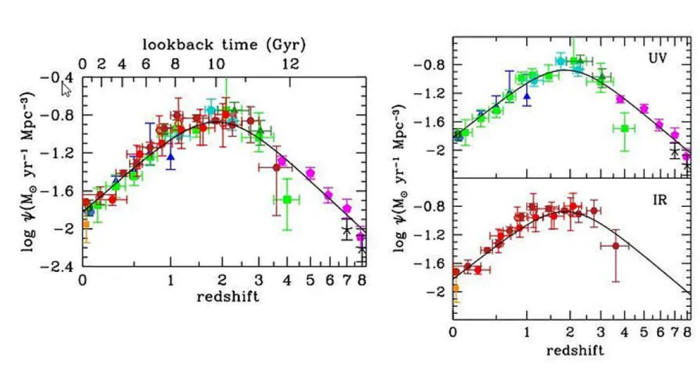
The star-formation rate in the
Universe is a function of redshift, which is itself a
function of cosmic time.
The overall rate, (left) is derived
from both ultraviolet and infrared observations, and is
remarkably consistent across time and space.
Note that star formation, today, is
only a few percent of what it was at its peak (between
3–5%), and that the majority of stars were formed in the
first ~5 billion years of our cosmic history.
Only about ~15% of all stars, at
maximum, have formed over the past 4.6 billion years,
with a total of just over 2 sextillion stars formed,
total, within our observable Universe.
(Credit:
P. Madau & M. Dickinson, 2014, ARAA) |
|