|
by Graham Shields
by Chris Butler/Science Photo Library.
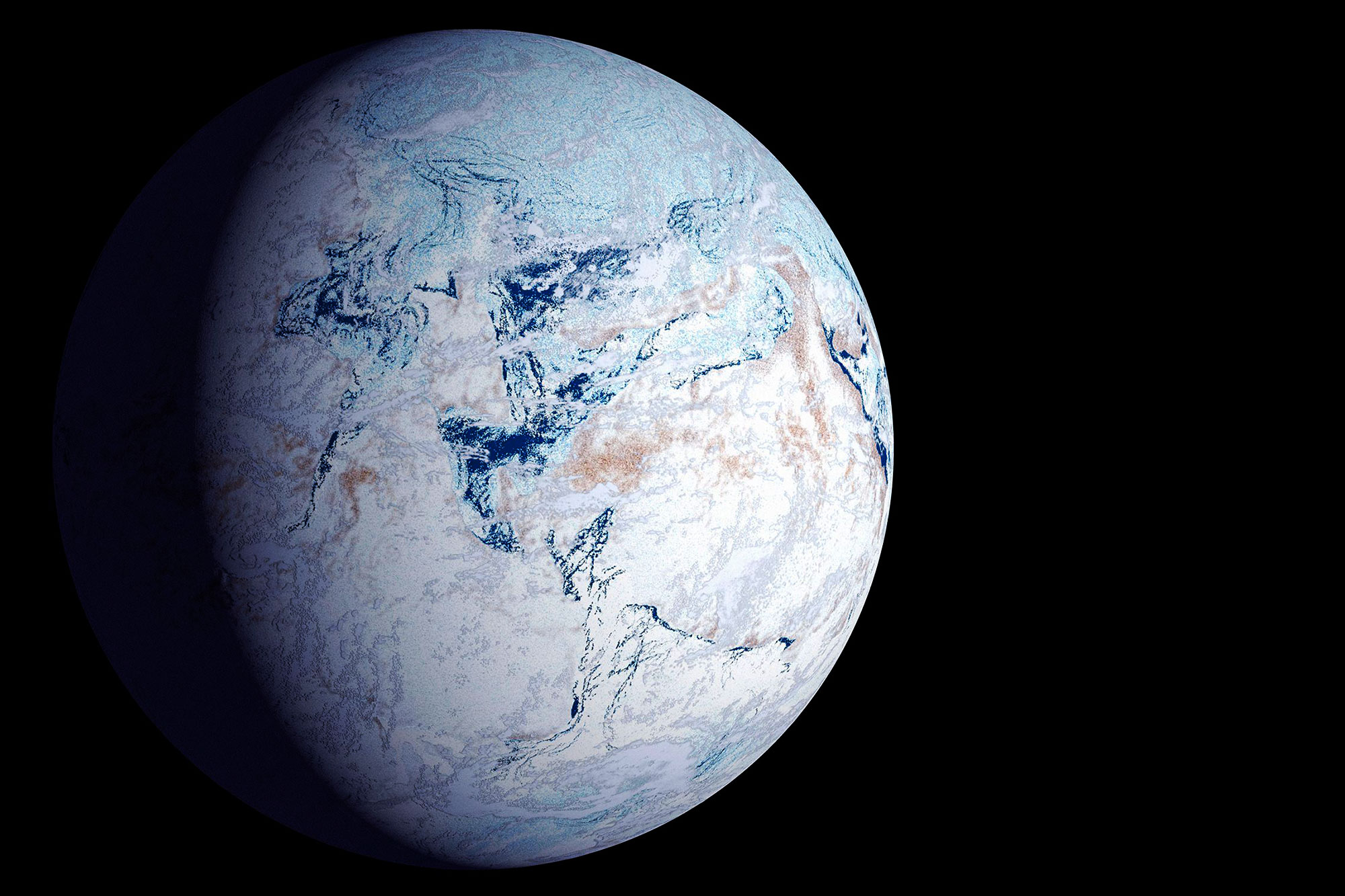
a harsh, alien, icy world.
Yet this deep freeze may have shaped you, me and all life on Earth...
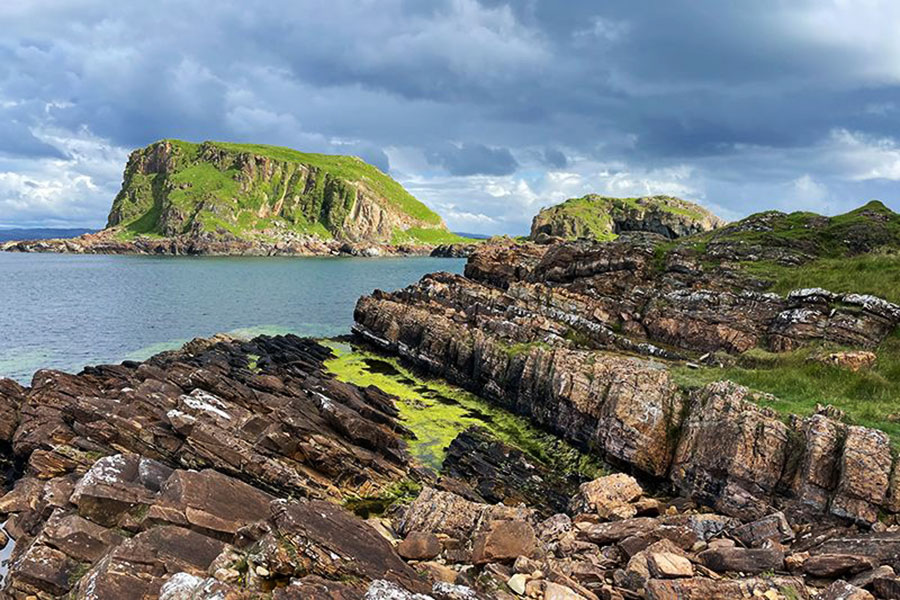
Only reachable during Scotland's short summer, there is nothing between here and North America, and so landing - or rather jumping hopefully onto slippery rocks - is dependent on the kindness of the Atlantic swell.
We've come to see a globally unique suite of rocks, which preserve a precise moment of global significance:
Imagine a planet suffocated by ice, its glaciers stretching unbroken from the poles to the equator.
Such an event, if it transpired on Earth today, would see kilometers-thick ice sheets gouging their way from the Arctic to the Bahamas. Once-diverse ecosystems and climate zones would merge into a single, uniform condition, seemingly destined to be barren.
Scientists once argued that such a 'snowball' state could never have existed on Earth since global glaciation could not be reversed.
However, hard evidence can change even the most fixed mind, and what was once inconceivable is now the prevailing wisdom.
Today's
scientists agree that ice did indeed reach the equator on at least
two occasions between 717 and 635 million years ago, where it stayed
for tens of millions of years.
Quite simply,
And embedded in the rocks of these remote Scottish islands, you can see how it happened.
on the Garvellachs in Scotland
How could biological complexity appear seemingly from nowhere?
Often framed as 'Darwin's dilemma', this enigma was a chief objection against the theory of evolution by natural selection, raised by skeptical geologists such as John Phillips in his book Life on Earth (1860), which he rushed to publication after Charles Darwin's On the Origin of Species (1859).
Although many pre-Cambrian fossils have
been found subsequently, the abruptness of the Cambrian explosion is
still
somewhat of a mystery.
To better understand any possible connection, we need to delve into what happened during Snowball Earth, or as we geologists like to say:
Part of the Proterozoic aeon, this was one of the last
periods before the Cambrian began.
Over three decades, I have asked questions such as:
Most
recently, my attention has turned to the
Garvellach islands in
Scotland, an archipelago I studied as an undergraduate, but
somewhere I hadn't revisited until the COVID-19 'pandemic' prevented
any globetrotting.
to the exact moment when the tropics first succumbed
to the encroaching deep
freeze...
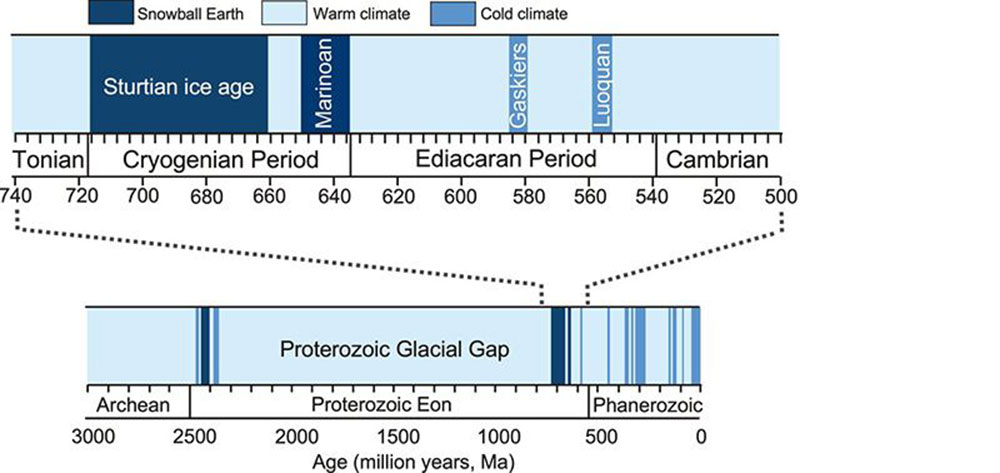
The first of the Cryogenian ice ages, the Sturtian, began around 717 million years ago, and lasted everywhere on Earth for another 57 million frigid years.
A second glaciation, called the Marinoan ice age, lasted from about 645 to 635 million years ago, and marks the end of the Cryogenian.
Both episodes saw
glaciers reach the equator...
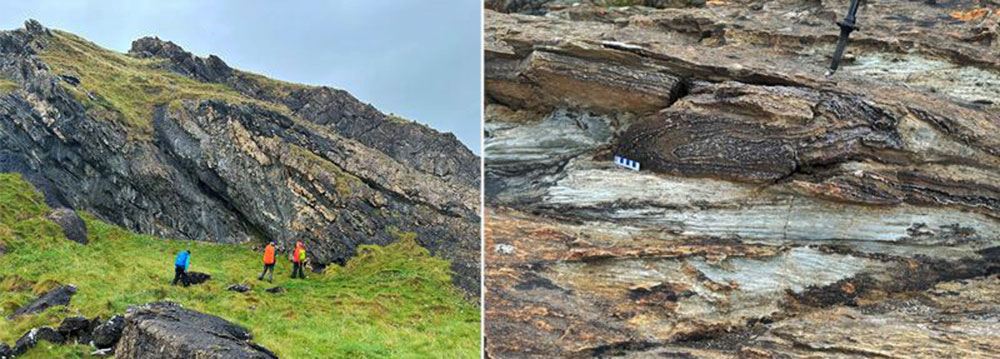
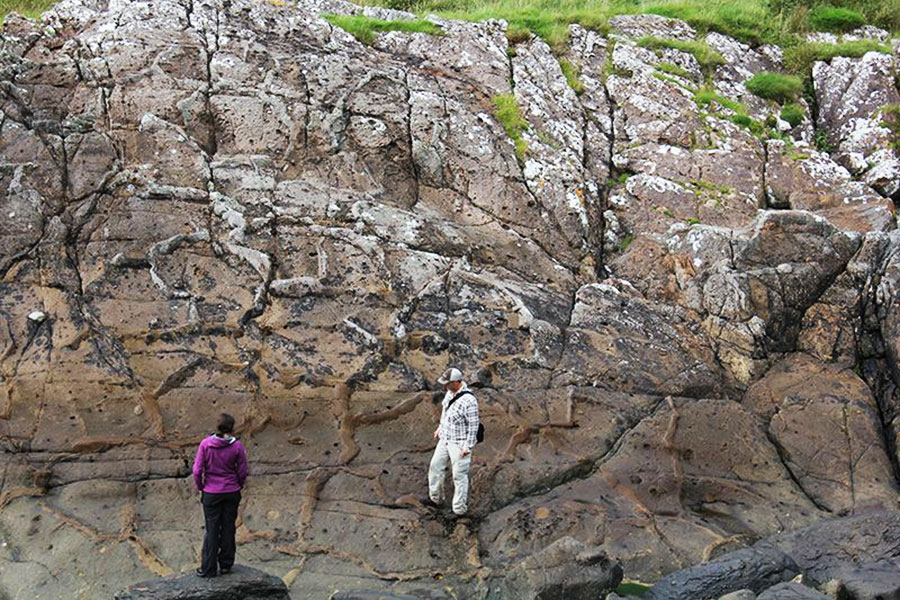
rock layers contorted by the weight of glaciers (right)
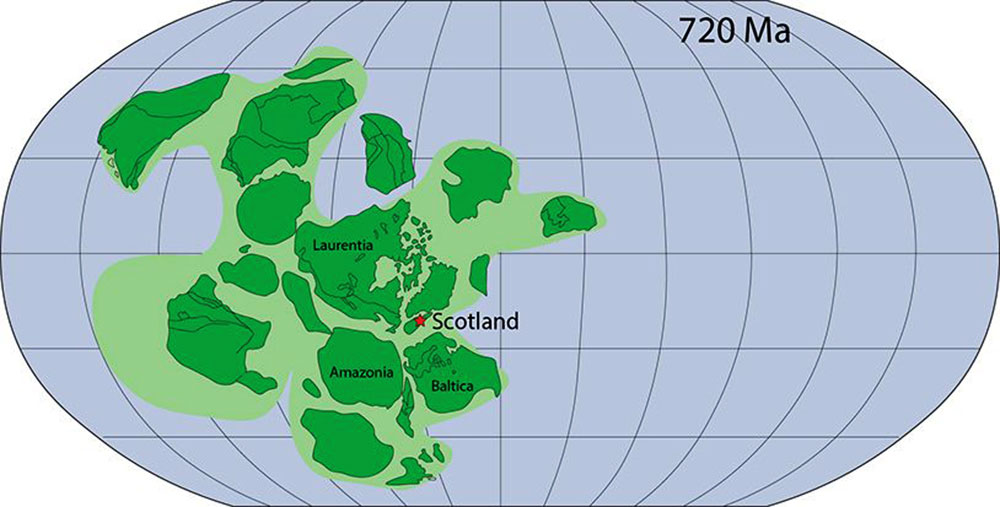
This is because, back then, Scotland was at far lower latitudes than today due to continental drift. Also, the sedimentary layers are exceptionally well preserved.
Only here can we walk
step-by-step through almost 80 meters of rock layers that represent
the slow passage of time and changing climate from balmy shores to
glacial wasteland.
The appearance of frost-shattered ground reveals an increasingly frigid and arid environment that eventually gave way, first to glaciers, and then to towering ice sheets.
Some were so massive, up to several kilometers in thickness, that they carried with them rock debris as large as football fields, gouged out from the underlying carbonate platform.
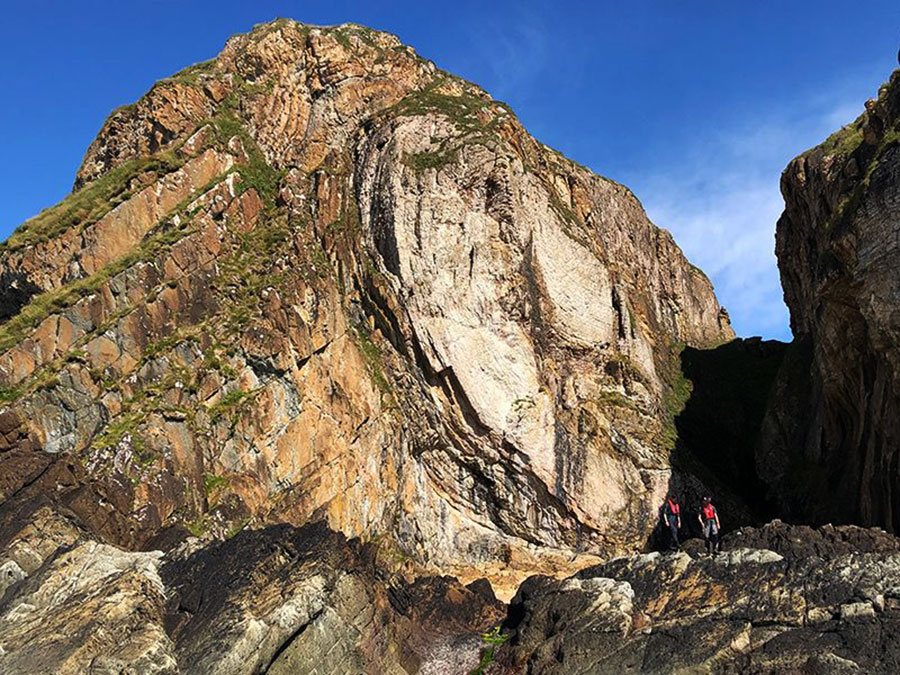
The best example, the 'Bubble', is a huge chunk of white carbonate rock, which now sits in a porridge of smaller fragments.
The layers that once marked out the horizontal seafloor have been so contorted during glacial transport that they now look skyward, having been folded in on themselves as if solid rock were putty.
A modern analogy would be if Australia's Great Barrier Reef were to be lifted out from the sea, only to be kneaded deep inside marauding Antarctic ice sheets.
on the Garvellach islands
On returning from travels that had taken him right across the Atlantic Ocean, Saint Brendan, one of the most famous navigators of all, even founded a monastery on the islands in the 6th century.
Beehive huts, or clochán - meditative igloo-shaped structures of stone flags, made by generations of monks since the time of Columba - can still be seen on Eileach an Naoimh, which some call Holy Isle.
The craggy walls of these huts are all made up of lithified glacial moraine, ancient remnants of Snowball Earth.
The extraordinary 'Bubble' must have been contemplated by
myriad travelers over many centuries without any inkling about its
significance.
Once ratified by the International Union of Geological Sciences, a global boundary stratotype section and point (GSSP) can be established.
Informally, these GSSPs are called 'golden spikes', as decorative metal plates are ceremoniously hammered into rock outcrops whenever a particular locality is declared the global standard.
Not all make the cut though:
The end of the Cryogenian already has a GSSP, to mark the start of the Ediacaran, a time renowned for many discoveries of early animal fossils. However, the beginning does not yet have its own golden spike.
The Cryogenian
GSSP is set to be voted on during the course of 2026, and would
represent the transition into about 70 million years of icy cold,
punctuated by just one, relatively short interval of warmth.
Beginning 720 million years ago, the Cryogenian period was punctuated by two plunges into the deep freeze, commonly referred to as Snowball Earth. Did these extreme conditions shape the evolution of life?
This was undoubtedly an
extraordinary moment in geological time, and extraordinary phenomena
require extraordinary explanations. One of these involves the
unusual arrangement of continents around this time, and goes as
follows.
as Rodinia first bulged upward, and then ruptured to form
a new ocean basin...
Before the Cryogenian, a single supercontinent called Rodinia assembled piece by piece.
Eventually, however, Rodinia had become a vast, arid land mass, resembling a supersized Australia, having been denuded by aeons of weathering and erosion.
Mountain belts would have been low and scarce during this relatively quiet time for the planet, so quiet in fact that some dub this interval the 'boring billion'.
But all this was about to change.
Rodinia was poised to break apart, its bulging interior marking the
sites where volcanoes would burst through, giving birth to embryonic
oceans and the beginning of a new supercontinent cycle.
the supercontinent Rodinia was beginning to break up, coinciding with the start of Snowball Earth
This meant it was greatly affected by the subduction of tectonic plates beneath the supercontinent's margin. We can recognize this destructive tectonic setting by the types of rocks and minerals that form the sedimentary layers beneath the glacial horizon in Scotland and Ireland.
Following glaciation, sediments began pouring in as Rodinia first bulged upward, and then ruptured to form a new ocean basin. Before oceans are born, magma rises from below to fill underground chambers and eventually volcanoes.
Volcanic rocks across North America - also once part of Laurentia - witness this turbulent history. And, crucially, they can be dated to show that this 'rifting' began only a million years or so before glaciation.
This is a critical, although circumstantial, piece of evidence to show that rifting may have triggered cooling, because while volcanoes belch out greenhouse gases, such effects are short-lived compared with the cooling that occurs when extruded lavas are weathered.
The chemical weathering of fresh lava is known to soak up atmospheric carbon dioxide, which is why sprinkling powdered basalt across farmland could help reduce global warming.
The notion that basalt
weathering caused Snowball Earth is often
referred to as the 'fire and ice'
hypothesis.
If
supercontinent breakup triggered Snowball Earth, then why did it
happen only once? There must be something more to the story.
If we could journey back to our ancestors' most formative years, and witness the first animals coming into being, we would find a planet as alien to us as Mars is today.
The Cryogenian, and the Ediacaran that immediately
follows, simply do not conform to our current understanding of how
the Earth system works.
Such oscillatory behavior suggests uniquely strong, positive feedbacks unlike anything Earth experienced before or since.
Perhaps this instability reveals the secret behind the cold climatic malaise of Snowball Earth. Back then, a gentle push in one direction could lead to runaway cooling or warming.
Any negative feedbacks, such as
those that stabilize climate today, must have been so weak that glaciation sometimes set in too hard before they were able to kick
in.
Conversely, if organic matter escapes burial, carbon dioxide can rise to higher levels, leading to global warming.
Over the previous decade, it has become increasingly clear that ancient glaciations were preceded by extremely warm climates:
This is because organic decay scales exponentially with temperature. If no organic matter can be buried, then the greenhouse effect raises temperatures ever higher.
This is a classic positive feedback:
Isotopic oscillations indicate strongly that
glaciations arose when conditions shifted towards greater organic
burial, evidenced by increasingly 'heavy' sedimentary carbon.
and the extreme hothouse conditions
before and after each icy
plunge...
Unsurprisingly, it is this precise sedimentary layer that is being proposed as the golden spike to mark the official start of the Cryogenian globally.
The breakup of Rodinia may well have been the catalyst to cooling, but it was the
bizarrely unstable nature of the Earth system that caused the event
to have such dramatic consequences.
Life, which had thrived on the ocean's margins up to this point, had to survive not only through a deep freeze, but also the extreme hothouse conditions before and after each icy plunge.
Like ancient Romans stepping
between the frigidarium and the caldarium, lifeforms needed to
negotiate repeated shocks to the system, producing a succession of
bottlenecks that not only sped up the rate of evolutionary change
but critically determined who would survive to become our early
ancestors.
Crucially, changes in organic burial would not only have perturbed climate, but also affected oxygen availability, because organic burial allows the oxygen released by photosynthesis to remain in the atmosphere.
It seems likely therefore that oxygen levels also fluctuated wildly throughout those eventful times, causing booms and busts for life on Earth. Oxygen is important for all metabolically energetic animals that build energy-sapping skeletons, muscles and organs.
Without oxygen, no creature can move, grow large or even think.
It is highly
significant therefore that the Cryogenian separates a world with
only single-celled protists before, from the more complex
multicellularity exhibited by true animals after global glaciation.
So let's now return to the question posed earlier:
Profound glaciation, although presumably a shock for life accustomed to tropical climes, would, once established, quickly have become the norm.
Whatever lived on Earth through those times would have ended up well-adapted to extreme cold and dryness. Although fossil assemblages are fairly nondescript during most of the Cryogenian, we know that many types of organisms still alive today survived somewhere, even if we do not know where.
One thing we have learned in recent years, though, is that,
Although we often think of ice caps as barren wastelands, this is untrue.
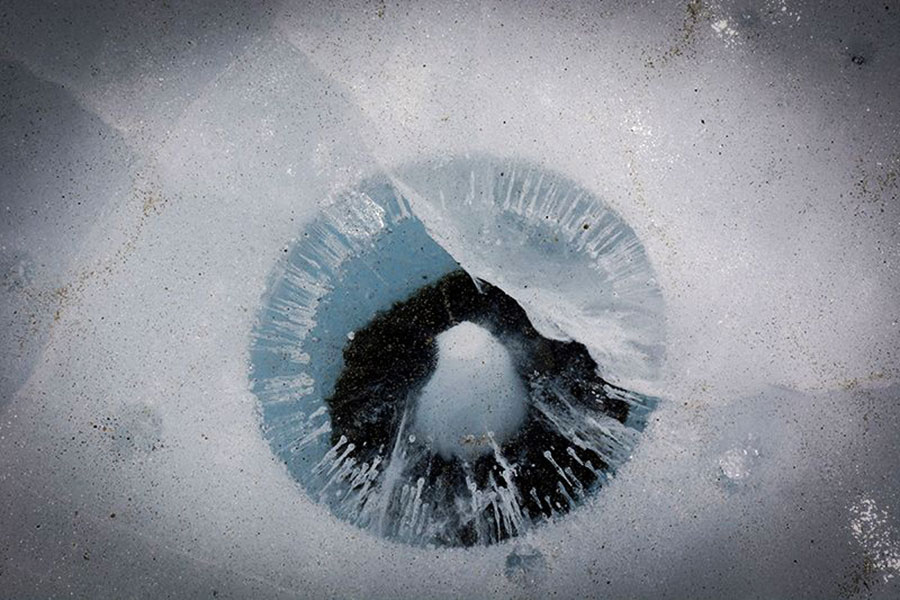
Many organisms that specialize in slow reproduction live in isolated oases on top of the ice. Cryoconite holes are a good example. They form when windblown debris, such as volcanic ash, absorbs heat from the Sun to melt a small patch of ice, which then acts as a tiny, isolated refuge for a surprising diversity of lifeforms.
Today, cryoconite holes provide homes for all the major groups of life:
Fossilized amoebae-like protists that would become the cousins of all animals appeared just before the onset of the Sturtian ice age, and so must have lived through all of the Cryogenian.
Yet fossil evidence may never be found as it has melted
away.
Courtesy of Wikimedia
Although we animals possess the most intricately interconnected organs, we are not the only creatures to demonstrate multicellularity. Even single-celled life forms, such as bacteria, can form colonies of millions of identical cells.
Moreover, cell differentiation is also not unique to us and likely arose more than once in Earth's history:
Amazingly, several of these groups existed well before the Cryogenian.
Indeed, some groups of fungi, green and red algae, as well as the above-mentioned amoebae all made it through Snowball Earth unscathed, as pre-glacial fossils are commonly identical to their living relatives.
Not only that, but molecular evidence shows that algae, as well as our animal ancestors, diversified both during and shortly after the Cryogenian.
This was truly a period of extraordinarily radical
and rapid evolutionary change, characterized by complexification.
a more viable option than, say,
a return to an independent
single-celled existence?
The emergence of
complex multicellularity in the aftermath of Snowball Earth laid the
foundations for the diverse and interconnected
web of life that shapes our
planet's ecosystems today.
In order to achieve such apparent altruism, labour must be divided, sufficient resources allocated and suitable environments maintained, just like in any well-managed city.
Did Snowball Earth make cell cooperation a more viable option than, say, a return to an independent single-celled existence or to a simpler, colonial form of multicellularity?
In this, the jury is still very
much out, but perhaps slime moulds can lend some insight.
The slug soon turns into a fruiting body before expelling its spores to start new colonies elsewhere. Some cells even appear to sacrifice themselves to become a woody stalk, all for the good of the whole.
This seemingly animal-like behavior would be a great strategy to ensure survival in harsh, isolated ecosystems, starved of nutrients.
In such slugs,
on the Garvellach islands
Wild swings between hot and cold, oxygen-replete and oxygen-starved conditions over many millions of years, heralded a biological revolution that redrew the tree of life.
Greater
cooperation between cells eventually led to more energetic,
oxygen-sapping metabolisms, and the arms race that became the
Cambrian explosion.
Although icy conditions fostered the gradual emergence of biological complexity, it was the thaw that likely proved the most pivotal.
Walk along the coast hereabouts and, abruptly, the rocks change:
We have reached the start of the Ediacaran.
The ancestors of you, me and all our
animal cousins must have won that race.
|