|

by Courtenay Turner
May 14, 2026
from
CourtenayTurner Website
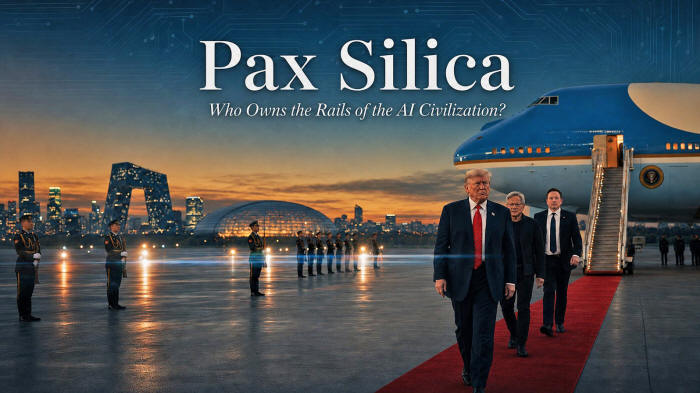
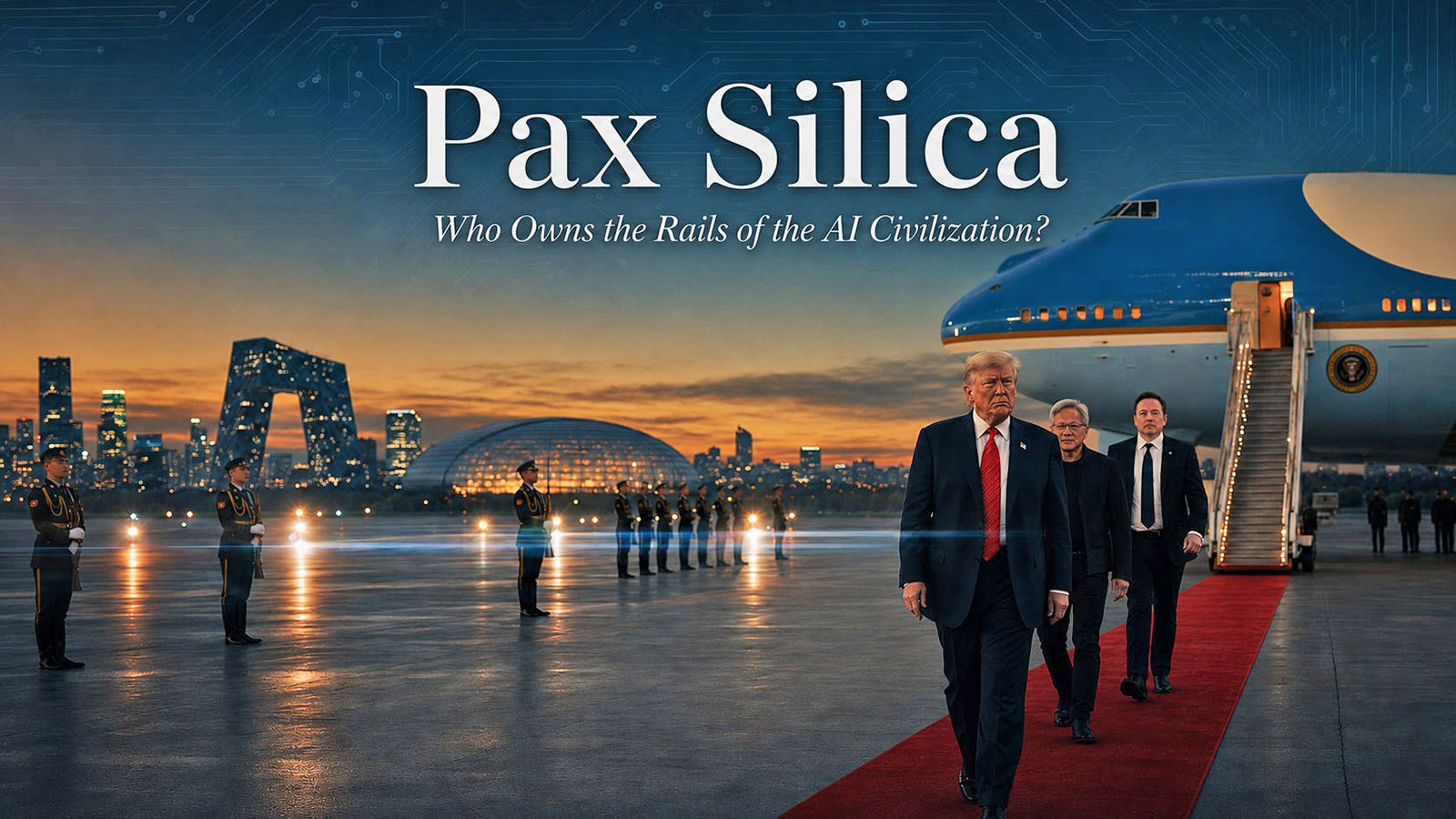
The Beijing summit, May 2026.
President Trump
arrived this week with a delegation
of eighteen of
America's most powerful corporate executives
-
including Elon
Musk and Nvidia's Jensen Huang aboard Air Force One -
to negotiate
the future of the AI supply chain
with Xi
Jinping's government.
'Pax Silica' is the new Pax
Americana translated into Silicon
The twentieth-century order ran on oil, steel, sea lanes, central
banks, and military alliances.
The twenty-first-century order is being
reorganized around,
compute, semiconductors, critical minerals,
energy, data centers, logistics corridors, payment rails, and
trusted capital...
That is not rhetoric. It is now policy architecture.
The State Department calls it Pax Silica:
a U.S.-led AI and supply-chain framework
built around secure technology supply chains, economic security,
artificial intelligence, critical minerals, semiconductors,
energy, manufacturing, infrastructure, and "trustworthy
systems."
The declaration signed in Washington on December
12, 2025 described the objective as building secure, prosperous, and
innovative global technology supply chains.
Its founding signatories included,
-
the United States
-
Australia
-
Japan
-
South Korea
-
the United Kingdom
-
Singapore
-
Israel
Its language is revealing:
-
reliable supply chains are
"indispensable" to economic security
-
artificial intelligence is a
"transformative force"
-
the AI revolution is reorganizing the
world economy and global supply chains
This week, that architecture moved from
declaration to diplomacy.
President Trump arrived in Beijing for a high-stakes summit
with Xi Jinping amid live tensions over,
trade, AI, Taiwan, Iran, rare earths,
aviation, agriculture, and technology access.
The corporate roster around the trip was not
incidental.
Reuters reported a delegation drawn from
American technology, finance, aviation, agriculture, payments,
semiconductor, and industrial sectors:
Elon Musk, Apple's Tim Cook, Boeing's Kelly
Ortberg, GE Aerospace's Larry Culp, BlackRock's Larry Fink,
Blackstone's Stephen Schwarzman, Micron's Sanjay Mehrotra,
Mastercard's Michael Miebach, Qualcomm's Cristiano Amon, Visa's
Ryan McInerney, Cargill's Brian Sikes, Coherent's Jim Anderson,
Illumina's Jacob Thaysen, and others.
Cisco CEO Chuck Robbins was reportedly invited
but unable to attend because of Cisco's earnings schedule.
The late addition of Nvidia's Jensen Huang made the signal
even clearer. Reuters reported that Huang joined the trip after an
invitation from President Trump as Nvidia sought a breakthrough on
stalled H200 AI-chip sales to China.
The U.S. had reportedly cleared roughly ten
Chinese firms, including,
Alibaba, Tencent, ByteDance, and JD.com,
...to buy Nvidia's H200 chips, but deliveries
remained unresolved as of May 14 because the deal was tangled
between U.S. licensing conditions and Chinese government pressure to
reduce dependence on foreign chips.
That is the headline beneath the headline:
This is not merely a trade summit. It is a
negotiation over who controls the AI stack.
And because the AI stack is physical - chips,
minerals, energy, cables, ports, payment rails, and data centers -
the fight over artificial intelligence is also a fight over
geography.
The question is no longer simply who wins, America or China.
The question is:
who owns the rails of the AI civilization?
What Pax Silica Is
Pax Silica is the formal name now attached to a U.S.-led
multilateral AI and supply-chain security framework. It is not a
treaty in the traditional sense. It is not a single law. It is a
declaration of principles, paired with bilateral partnerships,
operating programs, trusted-country access, supply-chain
coordination, and a public-facing brand designed to carry the policy
across administrations.
The Latin framing matters.
Pax Romana. Pax Britannica. Pax Americana.
Pax Silica...
A "peace" anchored not primarily in armies, oil
lanes, or Bretton Woods institutions, but in compute,
semiconductors, critical minerals, AI infrastructure, energy,
logistics, and trusted capital.
The Atlantic Council has described Pax Silica as,
a U.S.-led AI supply-chain coalition aimed at
building a trusted economic bloc to compete with China across
the full technology stack.
What makes the framework distinct is that,
it does not focus only on restricting China.
It integrates multiple supply-chain layers -
minerals, energy, manufacturing, compute, semiconductors,
logistics, and governance standards - under one initiative.
So the question is no longer whether AI will be
regulated.
The question is:
Who gets to build the regulatory, physical,
financial, and computational rails through which AI civilization
will operate?
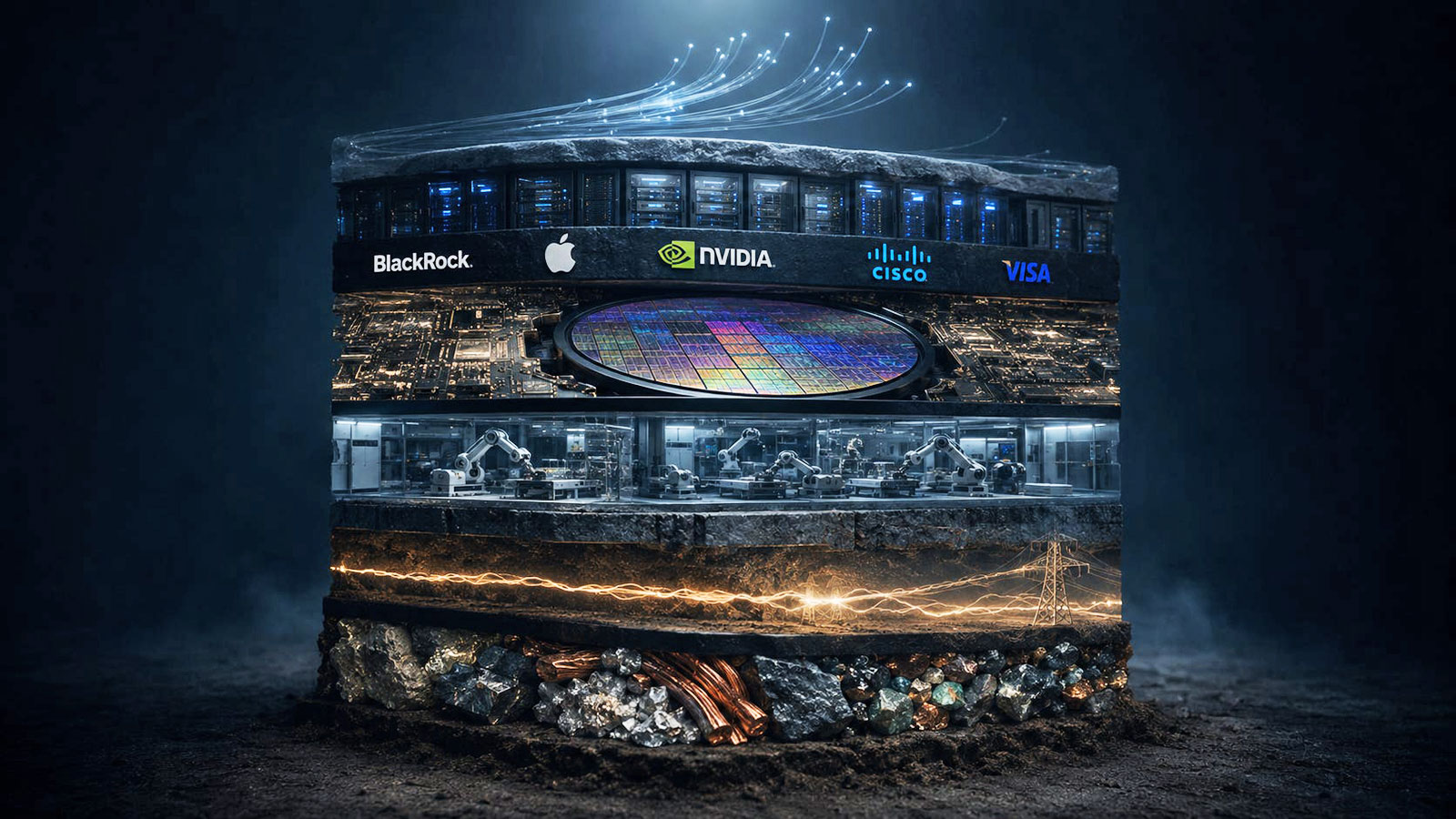
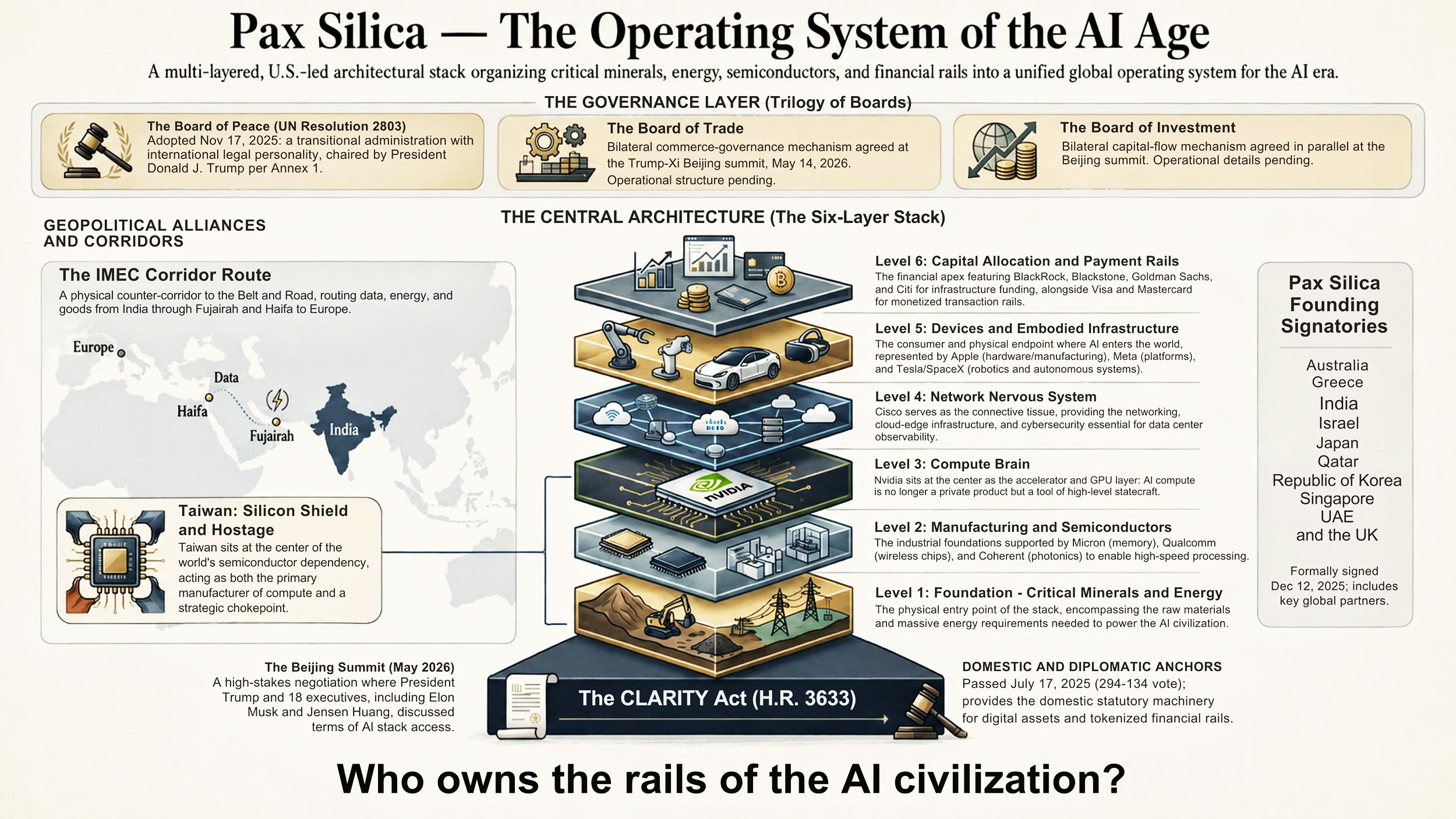
The Body Anatomy of
Pax Silica
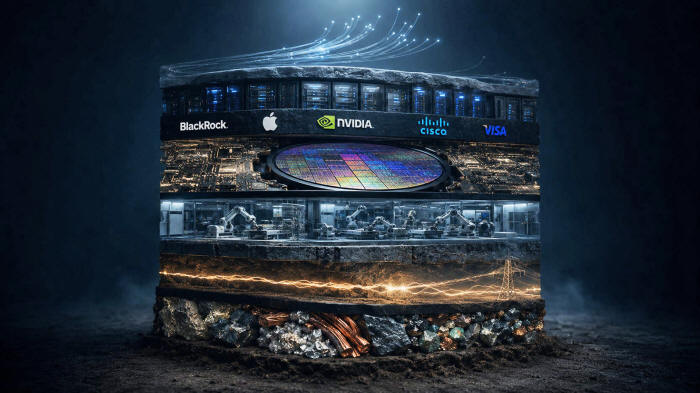
The American AI stack
as a six-layer architecture.
The Beijing
delegation included representatives of every layer.
To understand what the Beijing delegation represents, walk the
layers of the AI stack from the ground up.
Compute brain - Nvidia.
Nvidia is the accelerator and GPU layer on which
frontier AI depends. Jensen Huang's last-minute addition to the
Beijing trip matters because AI compute is no longer merely a
private-sector product category. It is now statecraft.
Network nervous system - Cisco.
Cisco did not need to be physically present for the
invitation to matter. Cisco represents networking, cybersecurity,
observability, data centers, cloud-edge infrastructure, and the
connective tissue of the AI age.
Embodied infrastructure - Tesla and SpaceX.
Elon Musk represents AI leaving the server rack and
entering vehicles, satellites, robots, charging networks,
manufacturing systems, communications, and physical-world
autonomy.
Device and supply-chain layer - Apple.
Apple represents the consumer endpoint and the global
manufacturing system that makes the hardware world possible.
Capital allocation - BlackRock, Blackstone,
Goldman Sachs, Citi.
The AI stack requires vast financing: fabs, energy,
data centers, industrial corridors, undersea cables, and
infrastructure buildout.
Financial transaction rails - Visa and
Mastercard.
Payment infrastructure is how the stack monetizes
itself, measures behavior, and eventually intersects with
tokenization, stablecoins, digital identity, and programmable
commerce.
Adjacent infrastructure - Boeing, GE
Aerospace, Illumina, Cargill, Micron, Qualcomm, Coherent, Meta.
Aerospace, genomics, agriculture, memory, wireless
chips, photonics, and platforms are not side stories. They are
adjacent verticals inside the same technological economy.
That is why the roster matters.
It is not random.
It is end-to-end coverage of the technological order.
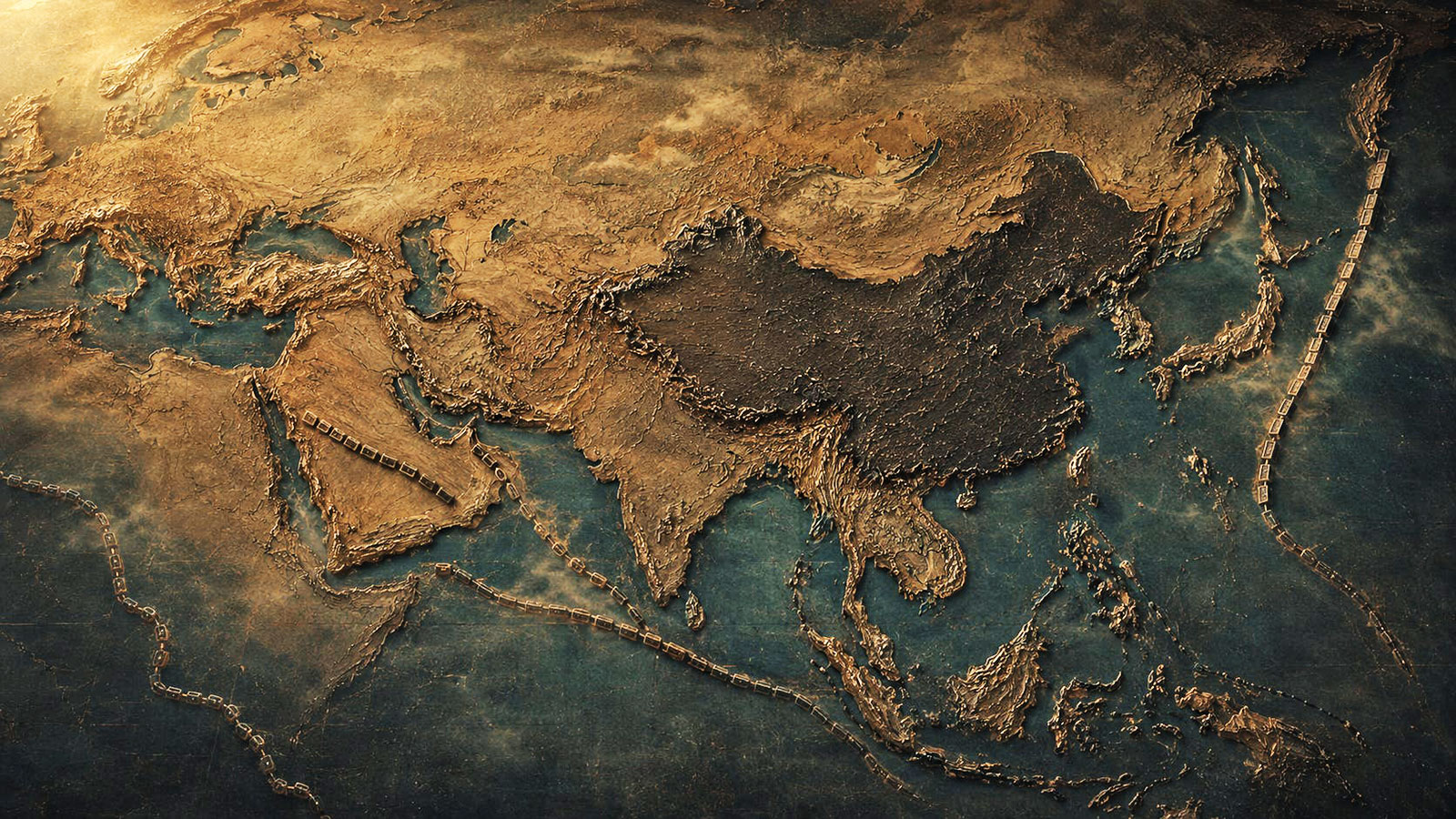
The Five Walls Around China
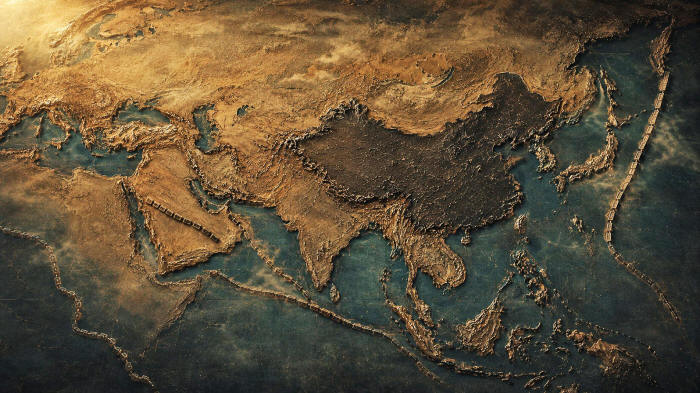
Antique-style relief
map
of Asia, the Middle
East, and Europe
with subtle
architectural barriers positioned
around the central
China region,
lit by raking
light from the upper left
casting long
shadows...
Patrick Wood's "China Card" thesis frames the Beijing summit
as something larger than diplomacy: a pressure architecture forming
around China from multiple sides.
That interpretation should be stated as
interpretation - but it is a serious one.
The five walls are:
-
Technology stack denial.
Pax Silica organizes trusted partners around the
U.S.-aligned AI stack. Every nation that commits to that
stack becomes harder for China to pull into a rival
technology order.
-
Physical corridor displacement.
IMEC - the India-Middle East-Europe Economic Corridor -
routes trade from India through the Gulf and onward into
Europe, offering a counter-corridor to Belt and Road.
-
Ally defection and hedging.
The Gulf is no longer readable through one axis. The UAE and
Qatar can remain China-facing commercial partners while
simultaneously joining U.S.-aligned technology and corridor
architectures.
-
Energy pressure.
The UAE's April 2026 announcement that it would leave
OPEC and OPEC+ marked a major blow to the oil-producer bloc
and to Saudi-led OPEC coordination, according to Reuters.
How to interpret that move - whether as energy pragmatism,
geopolitical hedging, or confirmation of a new
corridor-and-compute order - is one of the central
questions.
-
Military and strategic uncertainty.
China's economic power is immense. But the pressure
being applied is not only military. It is technological,
financial, logistical, maritime, diplomatic, and industrial.
The architecture is not abstract.
It is operational, geographic, financial, technological, and
political - applied simultaneously, on multiple surfaces, at
increasing speed.
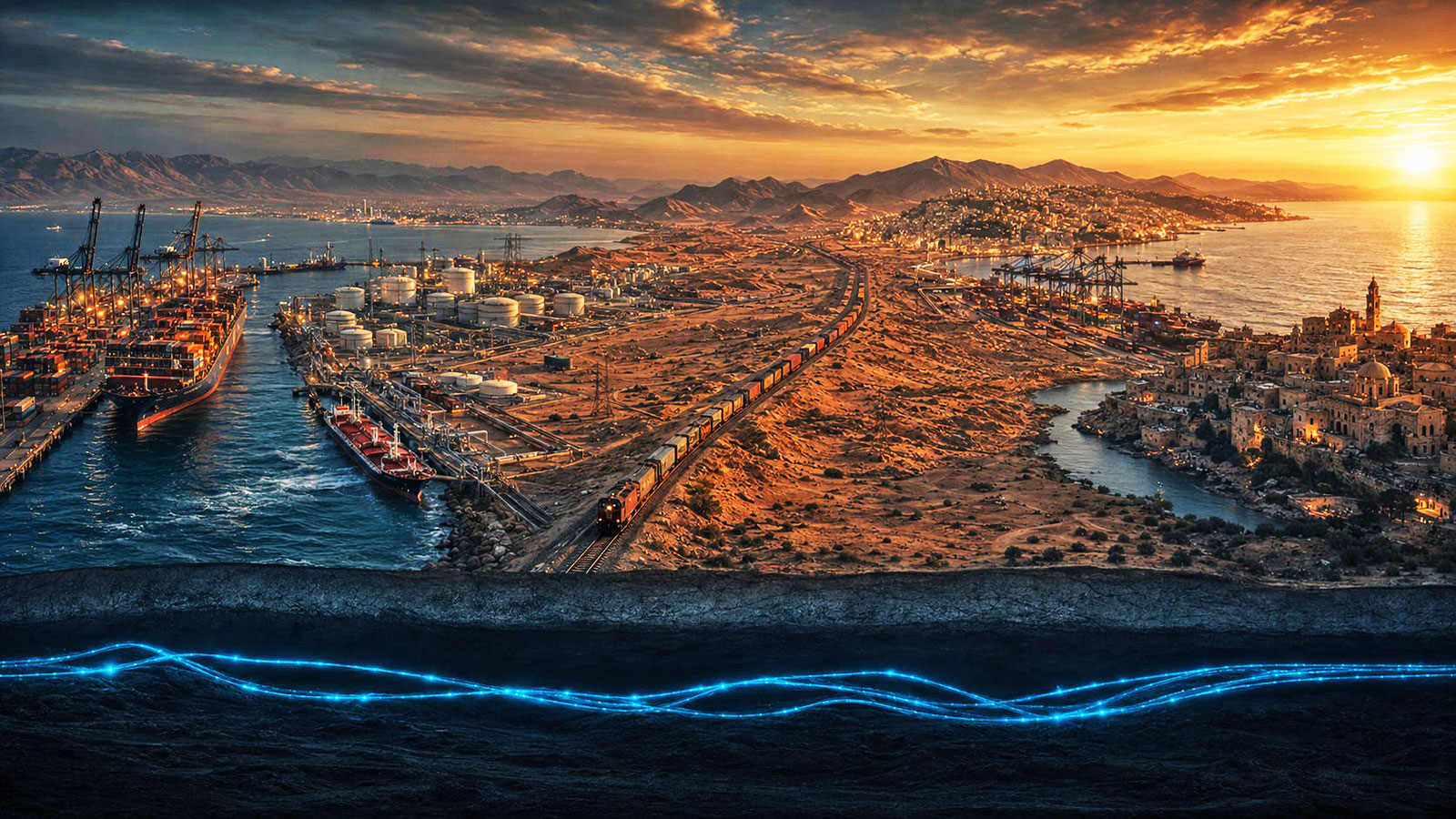
IMEC - Where Pax Silica becomes
Geography

Wide cinematic
landscape composite showing
the IMEC corridor
route from Indian ports on the left
through Gulf and
Saudi Arabian terrain in the middle to Israeli
and European
Mediterranean coastlines on the right,
with faint glowing
lines below the surface
suggesting undersea
fiber-optic cables.
Pax Silica describes the technology stack.
IMEC is where that stack acquires geography.
The India-Middle East-Europe Economic Corridor
(IMEC) was announced on September 9, 2023 during the G20 Summit in New
Delhi as a multinational corridor linking India, the Middle East,
and Europe through rail and shipping.
The White House fact sheet described the project
not only in terms of ports and rail, but also clean energy, undersea
cables, energy grids, telecom lines, and secure internet
connectivity.
That is the key.
IMEC is not merely a trade route.
It is a corridor for goods, energy, data,
cables, standards, finance, and political alignment.
The Atlantic Council has likewise emphasized the
corridor's energy and digital pillars, including electricity-grid
integration and new subsea and terrestrial fiber-optic cables
linking emerging Middle Eastern data centers with Europe and India.
In the Pax Silica frame, IMEC becomes a possible trusted
corridor for the AI age:
ports, rails, undersea cables, fiber, energy,
logistics, data centers, and capital flows linking India, the
Gulf, Israel/Jordan, and Europe.
That is why IMEC and Belt and Road must be read
together.
Belt and Road is China's infrastructure
model. IMEC is the U.S.-India-Gulf-Europe counter-corridor.
Pax Silica is the AI and semiconductor stack
that needs trusted corridors to become durable.
The corridor is the geography of the stack...
The UAE OPEC Exit - Energy Shock
or Architectural Signal?
On April 28, 2026, the UAE announced it would leave OPEC and OPEC+,
effective May 1.
Reuters described the move as a heavy blow to the
producer groups and to Saudi Arabia's role as de facto leader.
That is the documented fact.
Wood's interpretive argument goes further:
-
the UAE's exit is not merely an
energy-policy decision, but part of a larger architecture,
-
Pax Silica giving the Gulf privileged
access to the U.S.-aligned AI stack
-
IMEC positioning the Gulf as corridor infrastructure
-
Fujairah giving the UAE greater independence from Hormuz
-
tokenized settlement rails preparing the
monetary layer for a post-petrodollar environment
That thesis should be debated, not assumed.
But whether one accepts the whole argument or not, the convergence
is unmistakable:
-
AI stack.
-
Energy routes.
-
Gulf capital.
-
Trade
corridors.
-
Stablecoins.
-
Tokenization.
-
Data centers.
-
Critical
minerals.
-
Ports.
-
Rail.
-
Undersea cables.
These are not random headlines.
They are infrastructure layers...
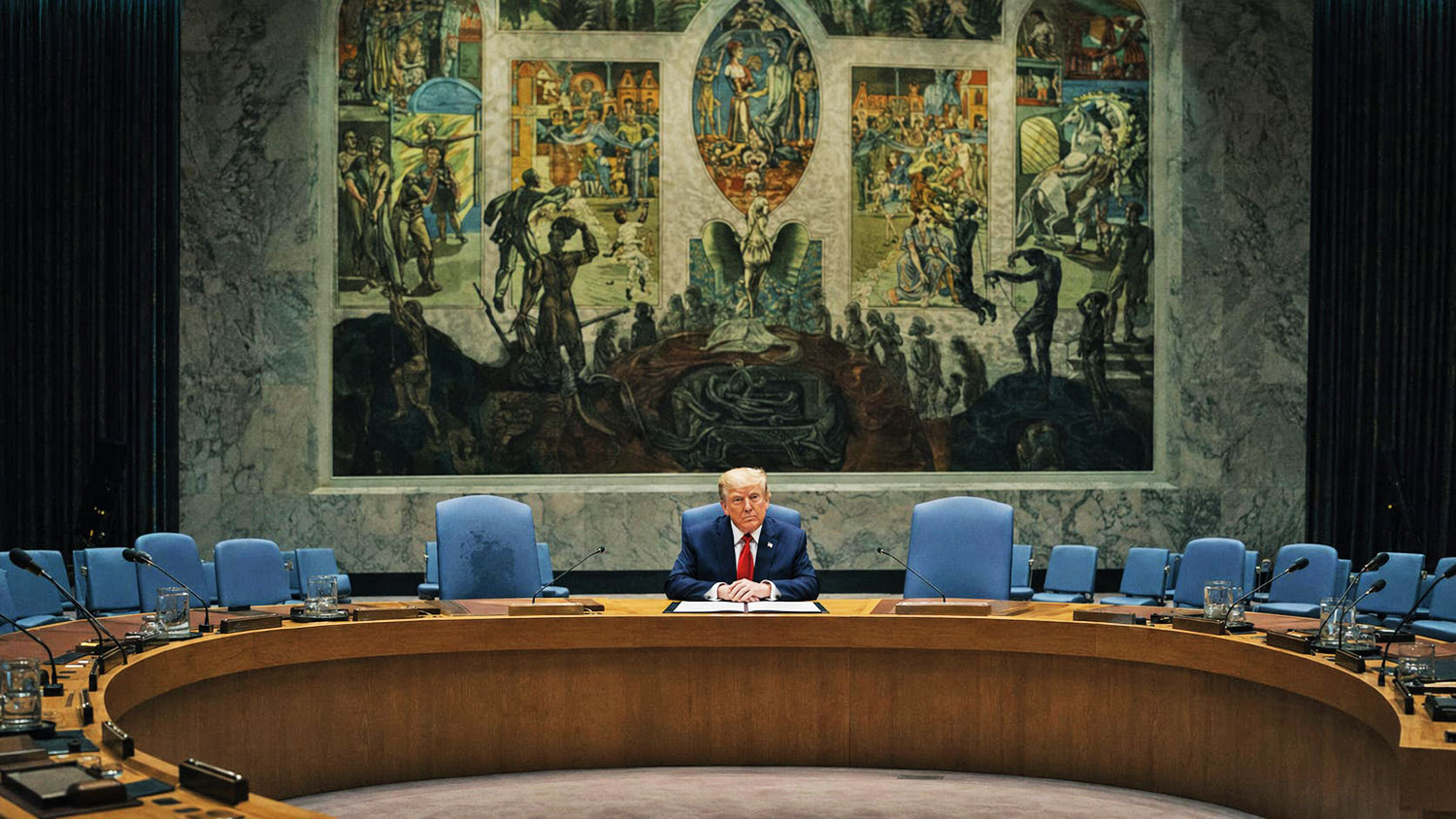
The Trilogy of Boards
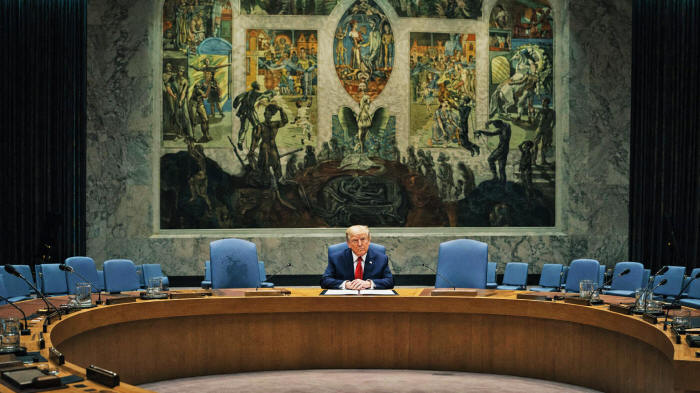
Interior of the United Nations
Security Council chamber
photographed
from a low three-quarter angle,
with President
Donald Trump seated at the central position
of the
horseshoe table beneath the Per Krohg mural;
chamber
otherwise empty.
There is one institutional frame worth surfacing before the
legislative layer, because it ties the geopolitical, commercial, and
capital threads together at the level of governance bodies that
persist across electoral cycles.
In Wood's reading, the Beijing summit is not only a moment of
bilateral negotiation.
It is the visible surface of an emerging trilogy
of sovereign-domain technocratic boards designed to operate outside
- and, in his reading, eventually above - the existing UN and WTO
frameworks.
The three are:
The Board of Peace
Welcomed and authorized through United
Nations Security Council Resolution 2803, adopted on November
17, 2025.
The resolution describes the Board of Peace as "a
transitional administration with international legal
personality" responsible for setting the framework and
coordinating funding for Gaza redevelopment.
It also authorizes
the Board and participating member states to create operational
entities with,
"international legal personality and transactional
authorities."
The resolution applies the Board of Peace to Gaza.
That
distinction matters - the application is specific, but the
institutional form is not. Nothing in the UN Charter confines
such a body to a single territory; Resolution 2803 is the use
case, not the boundary of what the form could be.
The resolution
by itself does not create a global government or a universal
board system.
But its institutional form is extraordinary:
an
internationally recognized transitional administration with
legal personality, funding vehicles, donor coordination,
security coordination, and strategic guidance over an
International Stabilization Force.
Annex 1 is even more explicit.
It states that Gaza will be
governed under the temporary transitional governance of a
"technocratic, apolitical Palestinian committee" responsible for
day-to-day public services and municipalities, made up of
qualified Palestinians and international experts, with oversight
and supervision by the new international transitional body, the
Board of Peace.
That body is to be "headed and chaired by
President Donald J. Trump," with other members and heads of
state to be announced, including former Prime Minister Tony
Blair.
That language matters.
A technocratic committee.
An international transitional body.
Legal personality.
Funding vehicles.
Transactional authority.
Security coordination.
Reconstruction governance.
A special economic zone.
Preferred tariff and access rates.
This is not merely humanitarian
administration. It is governance architecture...!
The Board of Trade
Agreed at the Trump-Xi Beijing summit on May
14, 2026, as a bilateral commerce-governance mechanism.
Pre-summit reporting attributed the push to U.S. Treasury
Secretary Scott Bessent and U.S. Trade Representative Jamieson
Greer.
The Board is described as a standing channel to oversee
bilateral purchases, manage trade differences, and facilitate
deals in non-sensitive sectors - with roughly $30 billion in
goods identified at the outset.
Its operational structure,
governing authorities, and legal form remain to be defined.
The Board of Investment
Agreed in parallel at the Beijing summit,
intended to oversee Chinese investment into non-sensitive U.S.
sectors and to provide clearer guidelines around
national-security review pathways.
Like the Board of Trade, the
operational details remain to be defined.
The Board of Peace is documented in a UN Security Council
resolution.
The Boards of Trade and Investment are now
documented as bilateral commitments at the head-of-state level,
but they do not yet have the institutional form, legal
personality, or multilateral authorization of the Board of
Peace.
That distinction still matters - the question of whether
the trade and investment boards will eventually be formalized
into entities comparable to the Board of Peace is the live one.
But the trilogy is no longer interpretive.
The three are named,
the three are committed to, and the three correspond exactly to
the domains Wood predicted:
conflict, commerce, and capital.
Together - conflict, commerce, and capital - they describe, in
Wood's reading, a post-UN, post-WTO architecture being assembled
board by board, with a serving U.S. president as the chair of
the first and most consequential one.
The Beijing summit moved
that architecture from a pattern Wood was reading into the news
to a pattern the news now confirms.
The corporate-governance nomenclature is not
accidental.
It is the language of stewardship,
administration, and managed domains.
That is the institutional layer.
The CLARITY Act is the statutory layer that operates beneath it
inside U.S. jurisdiction.
The CLARITY Act: The Domestic
Legal Layer
Pax Silica is the international architecture.
But the financial-rails layer requires domestic statutory machinery.
That brings us to the CLARITY Act.
The
Digital Asset Market CLARITY Act of 2025
passed the House on July 17, 2025 by a bipartisan vote of
294-134.
Supporters frame it as a digital-asset
market-structure bill designed to clarify SEC/CFTC jurisdiction,
create consumer protections, define digital-asset categories,
and establish clearer rules for exchanges, brokers, dealers, and
digital-asset market participants.
Critics, including
Aaron Day, argue the bill must be read
not only as "regulatory clarity," but as the domestic legal
substrate for tokenization, programmable finance,
surveillance-compatible markets, and asset-level control.
That is the fight.
Supporters say CLARITY gives digital assets a
legal framework.
Critics say it creates the rails on which every asset can become
trackable, programmable, and censorable.
In the larger architecture:
Pax Silica is the international AI stack.
IMEC is the corridor.
CLARITY is the domestic statutory layer.
The Beijing summit is the diplomatic surface.
BRICS - Counter-Pressure and
Fracture Line
BRICS is often described as an anti-Western bloc, but that is too
simple.
China and Russia want BRICS to weaken U.S. dominance.
Iran wants BRICS solidarity against Western pressure.
India wants BRICS
influence, but does not want to become subordinate to China.
The
Gulf states want leverage with everyone.
That is the fracture line.
Reuters reported that at the BRICS foreign ministers' meeting
in New Delhi, India's foreign minister emphasized the importance of
"safe, unimpeded maritime flows," especially through chokepoints
such as the Strait of Hormuz and the Red Sea, amid global
instability.
That matters because India is doing both:
That is the underappreciated move.
India does not want to be trapped inside a China-centered technology
order. Pax Silica gives the United States a tool to pull India, the
Gulf, and other hedging states toward the U.S.-aligned AI stack
without requiring them to fully abandon BRICS.
So the line holds:
BRICS wants multipolarity, but its members do
not all want the same pole.
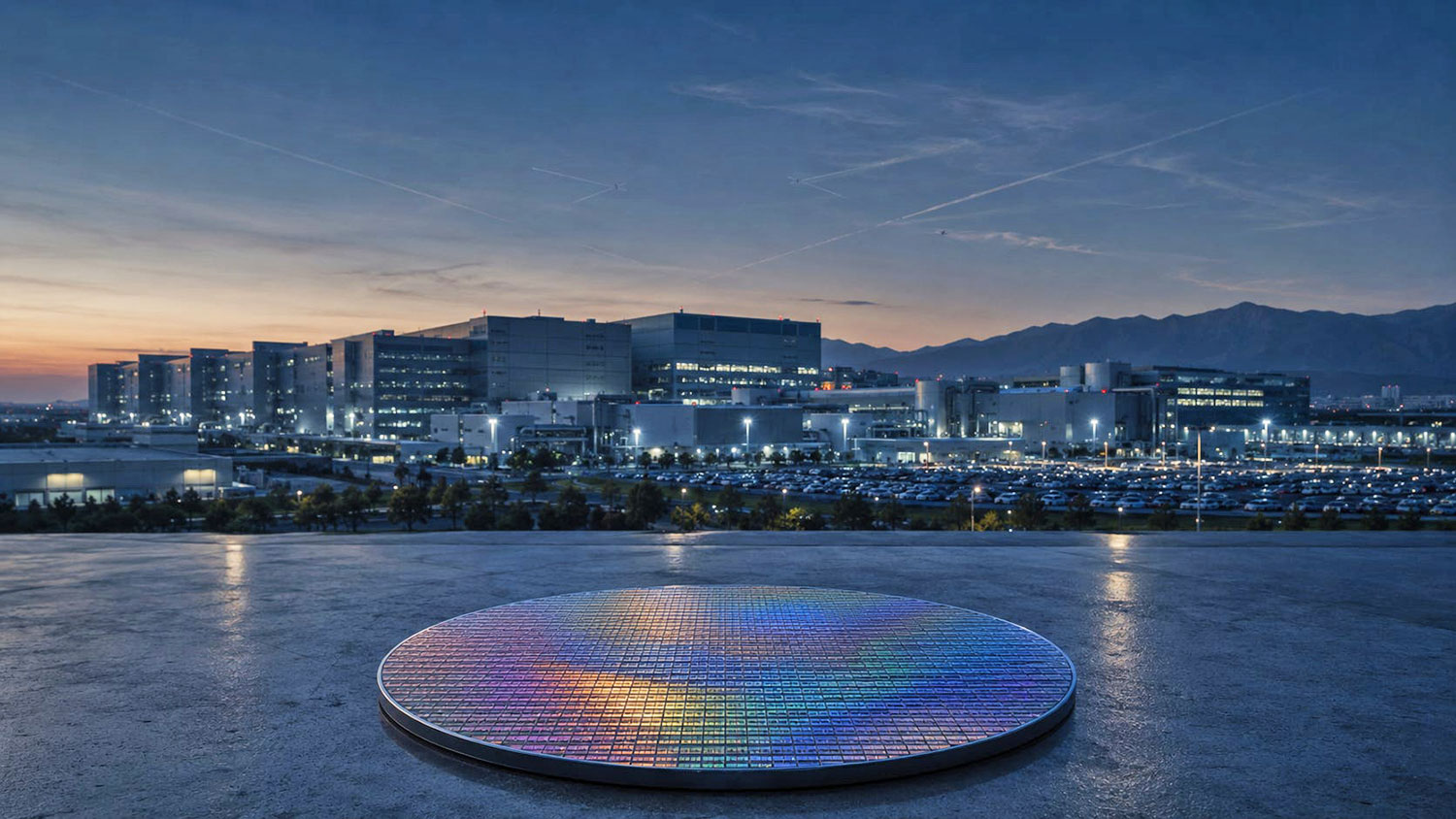
Taiwan - Silicon Shield, Silicon
Hostage
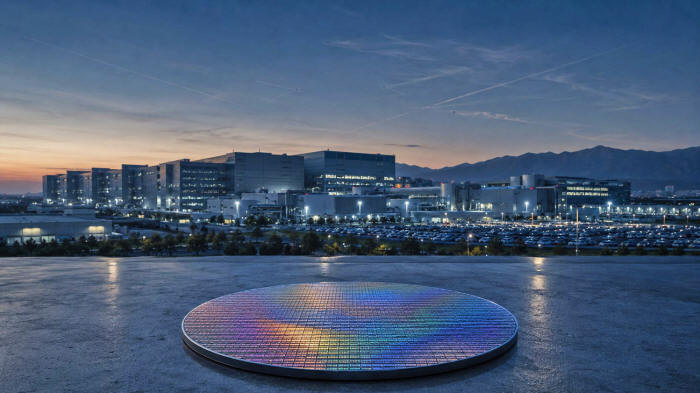
Exterior of a TSMC semiconductor
fabrication facility
in Taiwan at
dawn, with industrial buildings and parking lots
in the middle
ground, distant Taiwanese mountains in the background,
and a single
iridescent silicon wafer
in the
immediate foreground catching the dawn light.
Pax Silica cannot be understood without Taiwan.
Taiwan is not only a military flashpoint. It is a global AI
continuity chokepoint.
If semiconductors are the foundation of the AI stack, then Taiwan
sits at the center of the world's most important dependency.
In the Pax Silica frame, Taiwan becomes both:
-
the silicon shield
and
-
the silicon hostage.
Whatever else is being negotiated in Beijing this
week, Taiwan is the silent center of every conversation about chips
- because Taiwan is where so much of the compute layer of the
operating system is actually manufactured.
The Intellectual Lineage - Kissinger's Genesis
The historical symmetry is hard to miss.
Henry Kissinger's Cold War legacy is inseparable from the U.S.
opening to China:
secret diplomacy, triangular strategy, and the
Nixon-Mao reset.
His final book,
Genesis - Artificial Intelligence,
Hope and the Human Spirit, co-authored with former Google CEO
Eric Schmidt and
former Microsoft executive Craig Mundie, belongs to a different
triangle.
Publisher materials describe it as Kissinger's last book
and a strategy for navigating the age of AI.
The 1971 triangle was:
United States - China - Soviet Union.
The AI-age triangle is:
U.S. state power - American technology
platforms - Chinese industrial and state capacity.
Kissinger's final AI work frames artificial
intelligence as a civilizational and geopolitical force requiring
elite statecraft, strategic restraint, and high-level governance.
Pax Silica is what that looks like
institutionally:
statesmen, technologists, corporate infrastructure
owners, capital pools, and allied governments coordinating the AI
stack.
That is why the Beijing summit matters.
It is not just
Trump and Xi.
It is Trump, Xi, Jensen Huang, Elon Musk, Tim
Cook, Larry Fink, the semiconductor stack, the AI export regime,
the Chinese market, the Gulf corridor, the BRICS fracture, and
the question of whether machine civilization will be governed by
sovereign peoples or by state-corporate infrastructure managers...
The Human Question
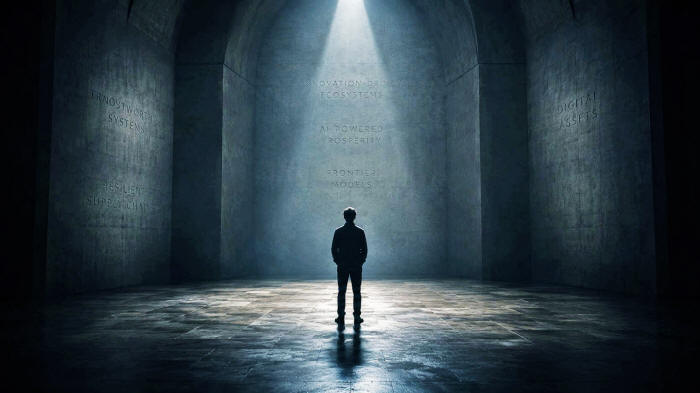
There is one level the architectural analysis
does not reach by itself.
It is the level the technocracy critique has been asking all along:
What is the human being inside this
architecture?
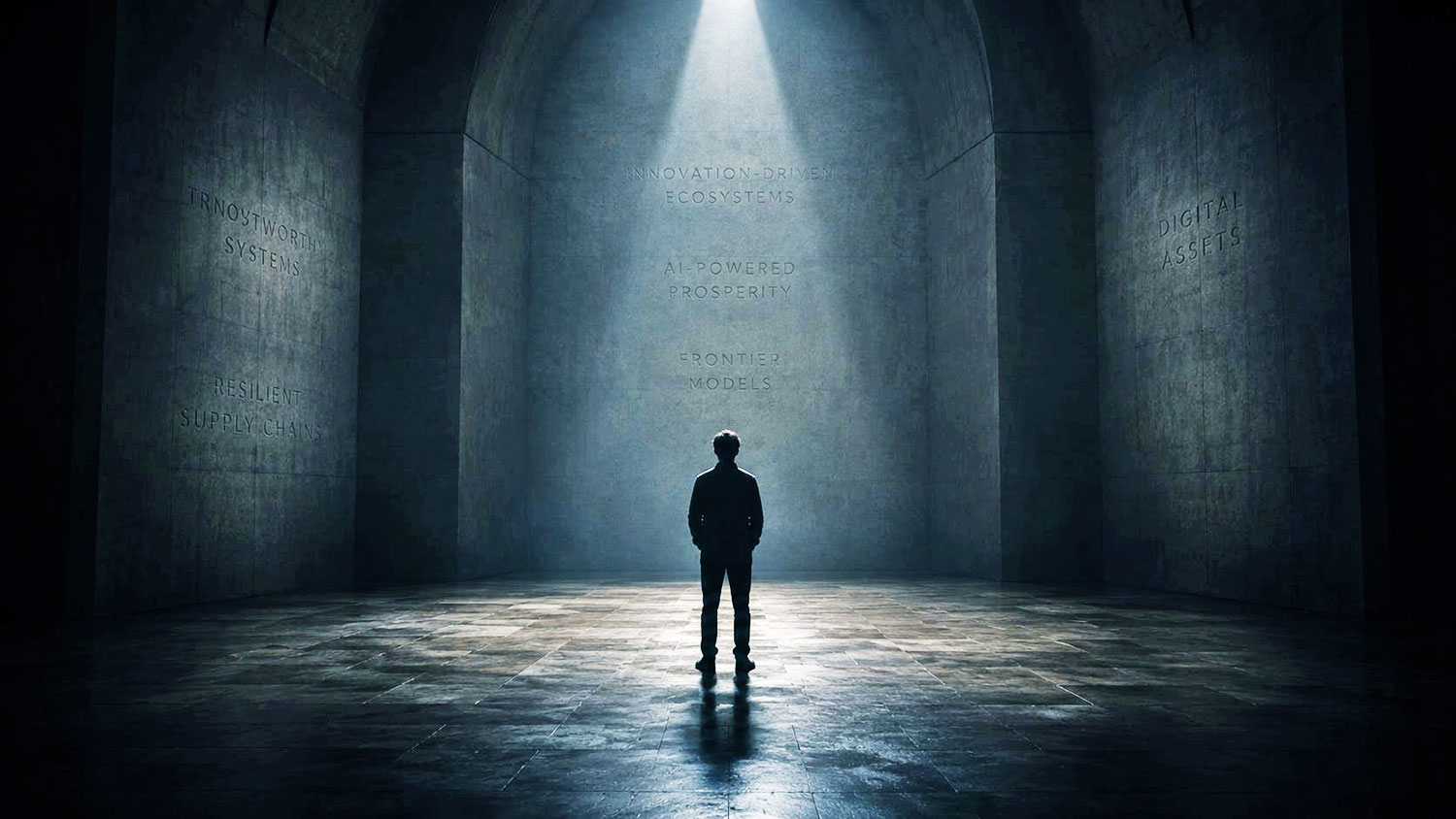
The language of the new order is smooth:
-
"trustworthy systems"
-
"secure information networks"
-
"innovation-driven ecosystems"
-
"regulatory clarity"
-
"AI-powered prosperity"
-
"frontier models"
-
"digital assets"
-
"resilient supply chains" "constructive
strategic stability"
None of those phrases name a person.
They describe systems acting on populations...
That elision is not accidental.
It is the heart of the matter.
Pax Silica is the architecture of a managerial AI
order.
Its defenders frame it as prudent stewardship. But its
operating logic raises a deeper question:
whether credentialed
expertise and state-corporate infrastructure are being substituted
for the irreducible human judgment on which self-government depends.
That is not a side argument.
It is the master critique...
The chips, corridors, boards, bills, rails, cables, payment systems,
and data centers are the means.
The end is the redefinition of what counts as a sovereign person.
The Through-Line
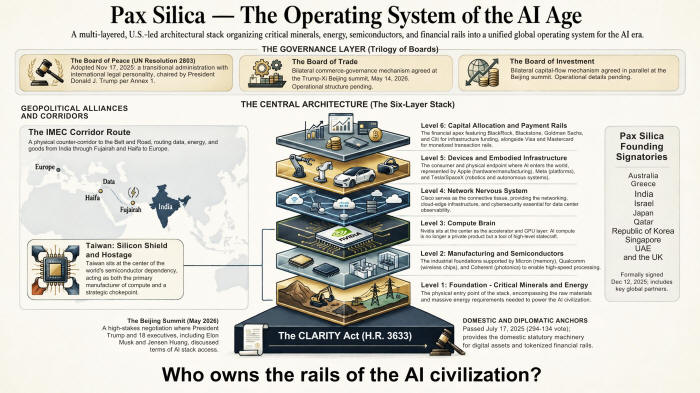
Pax Silica as a layered operating
system:
minerals and
energy at the foundation,
semiconductors,
compute, networks, devices, and capital at the apex.
Surrounding
context shows the IMEC corridor, the CLARITY Act,
and the Trilogy
of Boards - Board of Peace (UN Resolution 2803)
and the Boards
of Trade and Investment agreed
at the Trump-Xi
Beijing summit.
The same vertical has been visible for years:
-
Food - control of inputs.
-
Bio-digital systems - the
human-interface layer.
-
Digital assets - the
financial-rails layer.
-
Machine "consciousness" - the
ideological layer.
-
Algorithmic speech control - the
narrative-management layer.
Pax Silica is what it looks like when government
writes the digital-stack vertical down and attaches signatories to
it.
IMEC is what it looks like when the physical corridor for that stack
gets built across three continents.
The UAE's OPEC exit is what it looks like when the energy layer
breaks from the old order.
The CLARITY Act is what it looks like when Congress writes the
domestic machinery for the tokenized rails.
The Board of Peace is what it looks like when a UN Security Council
resolution recognizes and empowers a transitional administration
with "international legal personality," operating above a
"technocratic, apolitical" committee and tied to funding vehicles,
reconstruction, security coordination, and international
stabilization.
The Boards of Trade and Investment, agreed at the Beijing summit,
are what it looks like when the same governance grammar - boards,
domains, stewardship - is extended into the U.S.-China commercial
and capital relationships.
The Beijing summit is what it looks like when the architecture's two
great competing power centers meet to negotiate access, dependence,
leverage, and terms.
Pax Silica, IMEC, the Beijing summit, and the CLARITY Act are not
separate stories.
They are layers of one operating system being built in plain sight.
The question is no longer only who wins, America or China.
The question is:
Who owns the rails of the AI
civilization...?
Source Notes
-
Pax Silica
Declaration - U.S. Department of State, signed
in Washington, December 12, 2025.
-
United
Nations Security Council Resolution 2803 (2025)
- adopted November 17, 2025; welcomes the Board of Peace,
describes it as a transitional administration with
international legal personality, and authorizes the
International Stabilization Force through December 31, 2027.
-
H.R. 3633, Digital Asset Market CLARITY Act of 2025
- passed the U.S. House of Representatives, July 17, 2025,
by a vote of 294–134.
-
Trump-Xi Beijing summit readout - May 14,
2026; agreement to establish a Board of Trade and a Board of
Investment, with approximately $30 billion in identified
bilateral purchases and a Boeing commitment of 200 aircraft
(potentially scaling to 750).
|