|

by Callie Patteson
June 30, 2026
from
WashingtonExaminer Website
Article also
HERE and
HERE
The World Bank's targets for funding climate-related projects are
set to expire on Tuesday, and amid growing pressure from the
Trump administration, there
doesn't appear to be any clear replacement for the green goals.
U.S. officials have upped pressure on Europe and other Western
allies to abandon climate change-related regulations and policies,
instead urging refinancing for fossil fuel-related industries.
This has resulted in the United States pulling out of the
Paris Climate Accord for a
second time, a delayed vote on a first-of-its-kind carbon tax on the
international maritime industry, increased natural gas exports to
Europe, a likely delay for methane reporting rules, and now, the
expiration of the
World Bank's climate financing.
Following
the United Nations' climate
conference in 2023,
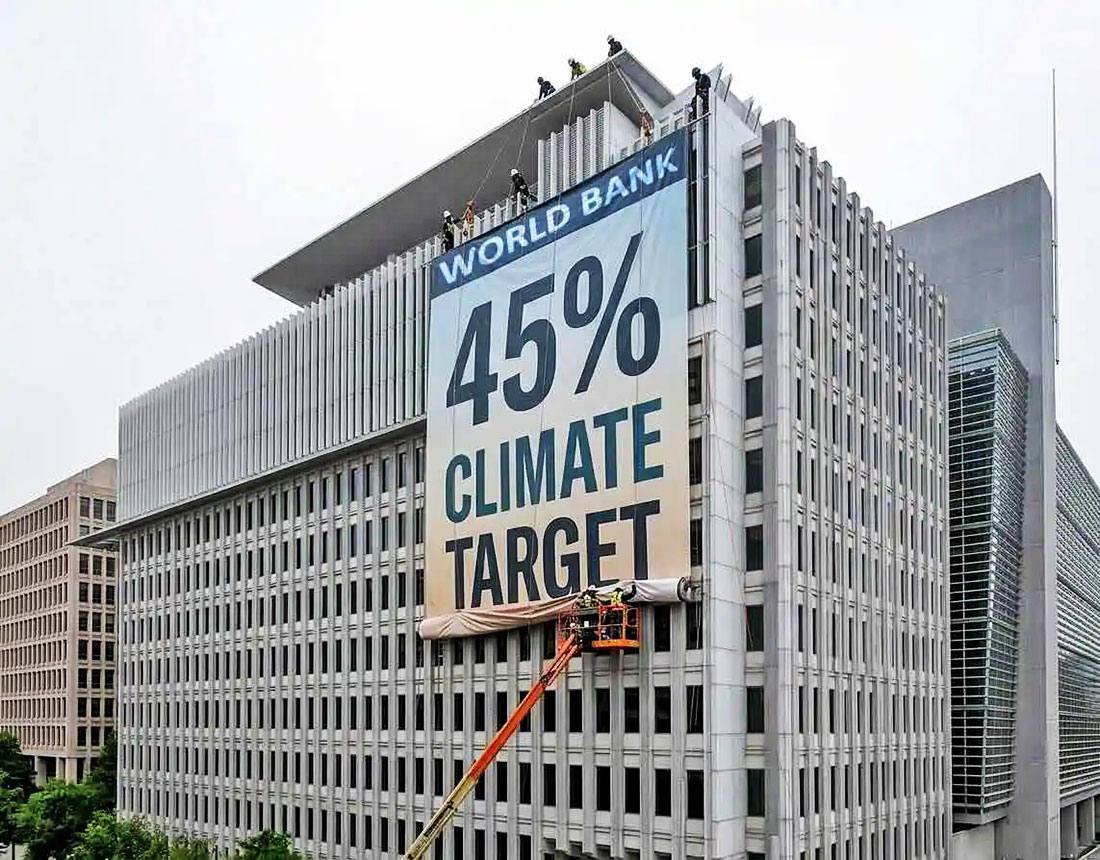
the World Bank said it would pledge 45% of
its funding to climate-related projects by 2025, with the aim
that it would help reduce greenhouse gas emissions from the
largest emitters while also propping up developing countries in
need of resources to adapt to climate change.
The bank exceeded that goal last year,
committing 48% of its financing, or around $39.2 billion, to
climate-related projects.
Better known as the
Climate Change Action Plan, the
funding target
expires on June 30. It was first
developed as a five-year plan in 2021, extending on a similar plan
created in 2016.
Initially, the bank pledged 35% of its
funding to climate projects, though that target was raised two
years later.
Since the plan was first
announced, the bank's climate
financing
nearly doubled from $21 billion
in 2021 to around $39 billion last year.
The Trump administration has called on the
World Bank to do away with this financing target and instead,
increase its investments in traditional
fossil fuels such as natural gas.
The bank officially stopped funding gas
extraction projects in 2019, with a few exceptions allowed in some
of the world's poorest countries.
In April, Treasury Secretary Scott Bessent
said the target,
"breeds inefficiency, distorts economic
decision banking, and moves the Bank away from its core
mission."
"We welcome the coming expiration of the
Climate Change Action Plan, and upon its long-overdue
expiration, expect the Bank to immediately shift its myopic
focus on climate and financing volumes to one that emphasizes
high-quality, durable projects rather than shaping and selecting
projects to chase arbitrary financing targets that do little to
lift people out of poverty," Bessent said.
Last fall, 19 of the bank's 25 executive
directors issued a statement in support of continuing the financing
target.
In addition to the U.S.,
Japan, India, Saudi Arabia, Russia, and
Kuwait declined to sign.
In May, 12 executive directors, led by
representatives from China and Brazil, again called for the targets
to be extended by one year. France made another last-minute plea
with the board to continue the financing last week.
As the U.S. is the largest shareholder of the World Bank,
there are growing concerns among climate activists that the bank's
board of directors will let the financing targets lapse without any
additional extensions or compromises.
Gautam Jain, a senior research
scholar at Columbia University's Center on Global Energy Policy,
told the Washington Examiner via email:
"The reality is that the U.S., as the largest
shareholder of the World Bank, effectively has a veto power over
key decisions.
"With the U.S. controlling 16% voting power, it can
single-handedly block any decision that requires 85%
supermajority," Jain said.
"The US doesn't need to win a vote, just
block consensus, which it can do."
Without a detailed plan to allocate a specific
percentage of funds to climate-related projects, the World Bank
would have no specific guidelines for aligning its lending with the
goals of the 2016 Paris Agreement.
This would very likely significantly hurt
vulnerable and developing countries that are most likely to feel the
impacts of "climate
change," such as rapidly warming temperatures and more
frequent droughts and floods, which rely on wealthier countries to
supply funds needed to help adapt to climate change.
Ben Cushing, sustainable
finance campaign director at the
Sierra Club, told the Washington
Examiner that allowing the plan to expire under pressure from
the Trump administration,
"would be a serious and shortsighted
retreat."
"Climate finance is not a distraction from
the Bank's development mission,"
...Cushing said, adding that helping countries
expand their access to clean energy, ability to withstand effects of
climate change, and strengthen their infrastructure and food systems
is critical to reducing poverty and supporting global economic
growth.
"The Bank's shareholders should not allow one
government's ideological opposition to climate action to weaken
a multilateral institution whose decisions affect countries
around the world," he added.
The bank's climate financing has been criticized
for the types of projects it has pursued in recent years, including
how focused those projects are on mitigating or adapting to climate
change.
One study (Understanding
the World Bank's role in Climate Finance) published last
year by researchers with Swarthmore and Baruch Colleges found that
most of the increased climate financing in the last 10 years went to
projects with,
"low climate components."
The authors found that there did not appear to be
any significant growth in the number of "pure" climate finance
projects focused on mitigation and adaptation, with most of the
funding not going to where it is most needed,
"such as to countries that are more
vulnerable to climate change."
Removing the targets entirely, however, would
make it more difficult to deliver on climate-related goals outlined
in the Paris Agreement, such as lowering greenhouse gas emissions,
Jain said.
During the
2024 United Nations Climate Conference,
nations agreed to contribute at least $300 billion in climate
finance annually, with about half to two-thirds being sourced from
multilateral institutions led by the World Bank.
"With the U.S. not contributing currently, it
will make achieving the target - which is already a fraction of
$1.3 trillion that's needed annually - even more challenging,"
Jain said.
|