|

by Kelvin Kemm
June 06, 2026
from
CFACT Website
Article also
HERE
Italian
version
Ancient Artifacts Prove
Glaciers
Come and Go Naturally.
No CO2
Required...
Physics and archaeology
both point
to the Sun
- not the
atmosphere -
as the
engine behind glacier retreat...
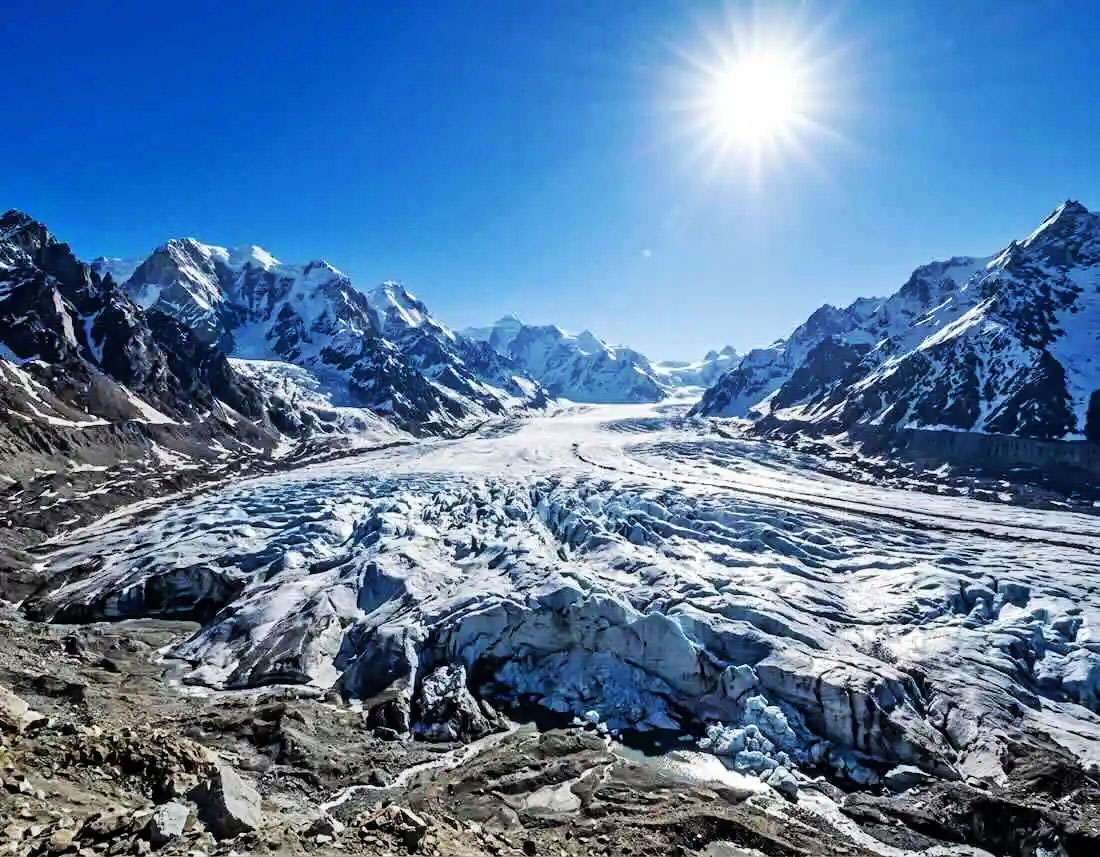
We constantly hear "panic stories" about glaciers melting,
accompanied by hysterical voices calling out that
retreating glaciers are a clear sign of "human-induced"
global warming...
Much of this hysteria is driven by green activists and
politicians who know just enough to be dangerous but
not enough to be sensible.
Scientifically, you can't come to a conclusion, on the basis of a
principle.
You have to look at the real science and
carry out correct measurements.
This is a complex subject but let us have a quick
look at the issue.
What about atmospheric warming?
Well, for starters, we need some physics.
For a gram of cold glacial ice to warm up by
1°C, say from -4°C to -3°C, it takes about two
Joules of heat.
It needs this amount of heat for each degree
Celsius that the ice warms.
Inside a glacier it can be as cold as -50°C,
but let us just consider the top part and, being generous, call
it -10°C.
In other words,
to raise the temperature of a gram of ice
from -10°C to 0°C, we will need about 20 Joules.
So far, so good.
So where would this heat come from? Well, the
global warming enthusiasts say,
'from the atmosphere'...
So, we take 20 Joules from the atmosphere.
That is reasonable.
But now for a bit more physics.
When you melt ice to water, it needs a huge
amount of heat to separate the frozen molecules. In fact, it
takes just over 300 Joules for each gram.
Remember that it takes 20 Joules to raise the
temperature of a gram of ice by 10°C, but 300 Joules to turn
that one gram of ice into water.
So where does the 300 Joules of heat come
from?
'Well, the atmosphere,' say the warmists.
If that much heat is being pulled out of the
atmosphere, why do we not see the air above a glacier cooling off?
After all, the warmists are worrying about
the atmosphere warming by only 1 or 2°C.
So if an entire glacier is melting faster than
before,
where on earth (excuse the pun) is all that
melting-heat coming from?
Remember, millions of grams of ice each needing
300 Joules just to melt. That is a vast amount of energy.
What about an alternative mechanism?
There is another option, that is:
direct sunlight falling on the glacier
surface.
What is known to happen is that sunlight warms
the top couple of millimeters of the ice, which melts quite easily.
So an obvious question is:
Where does that water go?
The simple answer is that it percolates downwards
through the fissures in the glacier.
The water works its way to the bottom, where
the ice lies on the bedrock.
There it acts as a lubricant and reduces the
friction between the ice and the rock.
So the ice can slide faster.
Therefore, the whole glacier becomes more mobile, and more big
chunks can break off at the end of the glacier.
The amount of sunlight falling on the glacier's
surface has nothing to do with the temperature of the atmosphere.
In contrast, it has to do with the amount of
cloud cover, which in turn is linked to the amount of cosmic
radiation coming in from outer space. That in turn is linked to the
magnetic activity of
the Sun, because the Sun
influences the protective magnetic barrier around the Earth.
Where this magnetic barrier 'leaks' is seen at the North and South
poles where we see the spectacular Aurorae which form
curtains of waving light sheets in the night sky.
So we clearly have a perfectly reasonable mechanism for retreating
glaciers,
which has nothing to do with
atmospheric warming...
But there is yet more!
There has been a huge archaeological benefit
resulting from the retreat of some glaciers and melting ice sheets.
What has happened is that melting ice has revealed thousands of
ancient artifacts which have been a bonanza for historians and
archaeologists.
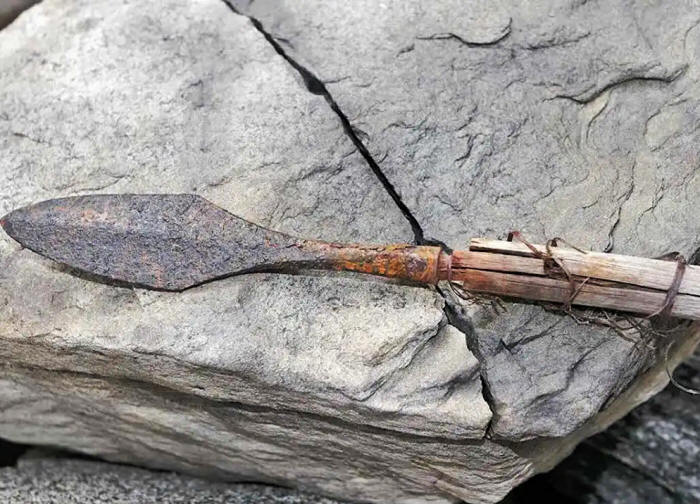
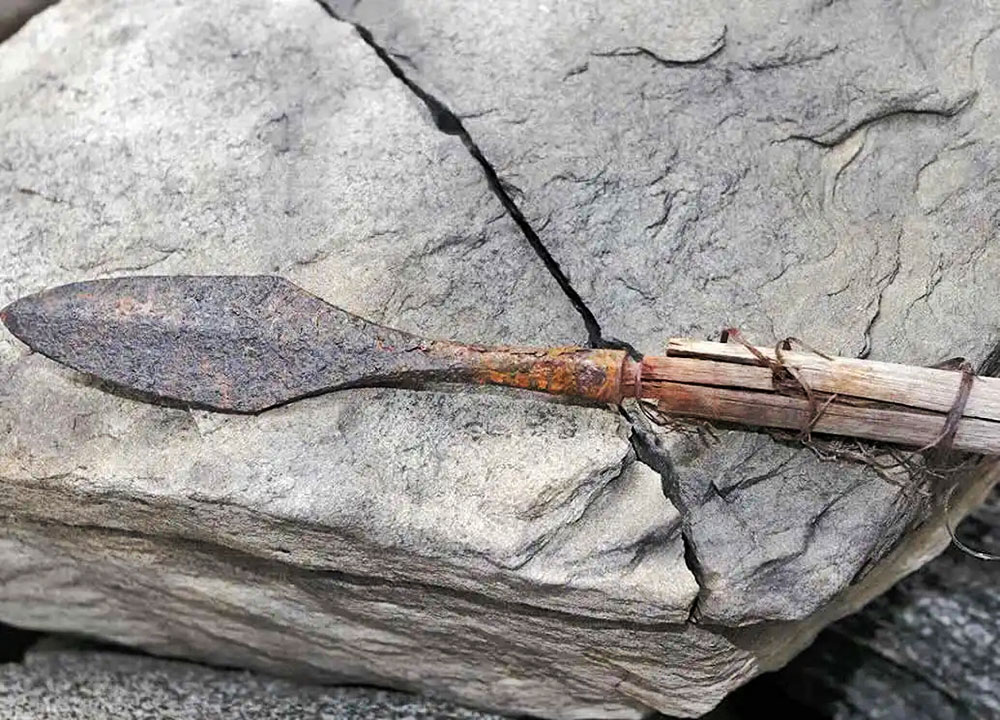
Intact arrows with
quartzite arrowheads,
secured by animal
sinew and birch-bark glue,
were found in a
Norwegian mountain pass
dating back 3,000 to
4,000 years.
Source
For example,
10,000-year-old Atlatl spear-throwing
hunting darts have been found in the Rocky Mountains and the
Canadian Yukon.
Intact arrows have been found in a Norwegian mountain pass
dating to 3,000 to 4,000 years ago.
They have quartzite arrowheads secured by
animal sinew and Birch-bark glue.
A 1,700-year-old Roman-style shoe was also
found in Norway.
In the Schnidejoch pass in the Swiss Alps,
leather trousers, shoes, and birch-bark arrows were found,
dating back to 3,000 to 4,000 BCE.
The list goes on, but what it shows is that there
was no thick ice cover there in the past, at times like 1,700 years
ago, 3,000 years ago, and 10,000 years ago.
This indicates that ice cover and glaciers,
have come and gone on a regular basis
in the past...!
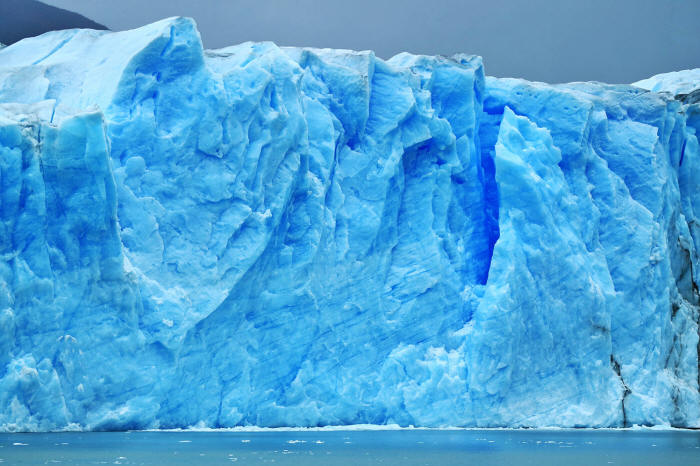
These past changes certainly had nothing to do
with industrially produced carbon dioxide.
But they can be linked to the magnetic activity of the Sun.
|