|

by Prof. Rodrigue Tremblay
February 12, 2026
from
GlobalResearch Website
|
"When every country turned to protect its own private
interest, the world public interest went down the drain,
and with it the private interests of all."
Charles Kindleberger
(1910-2003)
American economic historian,
(in his book 'The World Depression 1929-1939', 1973.
"We are in the midst of a rupture, not a transition...
More recently, great powers have begun using economic
integration as weapons, tariffs as leverage.
Financial infrastructure as coercion. Supply chains as
vulnerabilities to be exploited, You cannot live within
the lie of mutual benefit through integration when
integration becomes the source of your subordination...
If
we are not at the table, we are on the menu."
Mark Carney (1965- )
economist and Prime minister
of Canada, in Davos, Switzerland, January 20, 2026.
"In the Great Depression in which I grew up and remember
vividly, unemployment was over 25 percent, and over 35
percent where I lived.
A
grown man would work all day, 16 hours, for a dollar. I
remember hundreds of people walking by, people who had
come down from the North just to get warm.
They
would come to our house as beggars even though they
might have a college education.
People didn't have money."
Jimmy Carter
(1924-2024)
39th U.S. president
(1977-1981), (in an interview with the St. Louis
Post-Dispatch, on Feb. 4, 2009). |
One year before the end of World War II, in 1944,
representatives of some 44 countries met in an American town in New
Hampshire and cooperated in establishing a new global monetary
system based on the U.S. dollar, which was to be convertible into a
fixed weight of gold. (Note: The U.S. then possessed 70% of the
world's gold reserves.)
This system lasted until 1971, when the Republican administration of
Richard Nixon unilaterally severed the link between gold and
the dollar, making the latter a purely fiat currency,
that is, a currency entirely based on
confidence in the U.S. monetary authorities to maintain its
relative value.
Fifty-five years later, in 2026, the world is
once again faced with the task of adjusting the international
monetary system to new realities, but this time without a shred
of international cooperation.
On the contrary, the current
Trump
administration does not hesitate to insult, antagonize
and sometimes threaten allied nations, many of which are public and
private creditors of the American federal government.
To attack one's lenders is generally not the most
appropriate thing to do...!
What was the Bretton Woods
Monetary System
Since the
Bretton Woods Conference of July
1944, it was agreed by 44 countries that the U.S. dollar would be
used as the principal international means of payments in the post
WWII international monetary system.
It was going to be backed by gold
at the rate of one dollar being exchanged for 1/35 ounce of gold,
(one ounce of gold being worth $35).
Other national currencies would have a fixed exchange rate vis-à-vis
the dollar, to be adjusted only for structural balance of payments
deficits or surpluses, as monitored by the newly created
International Monetary Fund (IMF).
Moreover, central banks would purchase and hold
mainly
American Treasury bonds as
liquidity reserves to stabilize their currencies.
Why the International Monetary
System based on a Fiat U.S. dollar has provided the United States
with some exorbitant economic privileges
For many years, that one-sided international monetary system has
created some exorbitant privileges for the United States.
Indeed, under such a system, the U.S. could not face a balance of
payments problem because it was paying its imports with its own
currency, which it could print at will...!
It also allowed the U.S. government to finance part of its large
budget deficits and its enormous public debt by selling Treasury
bills and bonds, denominated in U.S. dollars, to foreign central
banks, which held them as official reserves, and to other foreign
investors.
That structural demand kept the U.S. dollar
strong in foreign exchange markets and assisted
the FED (the U.S. Federal Reserve
Bank) in fighting domestic inflation.
From a geopolitical perspective, such easy access to foreign savings
and dollar spending has enabled the U.S. government to deploy
military power globally and to finance the building of some
750 military bases around the world, with contributions from
host countries.
Since nothing is one-sided,
there are some disadvantages for a country in
having its national currency used worldwide.
First, the American central bank had
to take into account the dollar's international role when
formulating its monetary policy.
A second disadvantage resulted from net capital inflows
in the U.S., which kept the dollar overvalued and encouraged
domestic consumption and trade deficits.
Thirdly, from a U.S. perspective, has been the ease with
which large U.S. corporations could take advantage of their
technological advances and finance productive investments
abroad, and then repatriate their profits for the benefit of
American investors.
Criticism against a dollar-dominated monetary
system intensified when the U.S. government began weaponizing the
system by imposing financial, economic and political sanctions on
countries that did not bend to its foreign policies.
Therefore, it is to be expected that during the coming years,
especially as the current Trump administration has become
increasingly hostile to the economic interests of other nations,
that the world is going to move away from the
fiat US dollar international monetary system.
This is even more likely since President D.
Trump has openly said that he would welcome a debased U.S.
dollar, going as far as saying that he thinks a weaker dollar would
be "great"!
With large yearly federal fiscal deficits and political pressure to
force the FED to print more money in order to lower short-term
interest rates, this is a recipe for creating a period of
galloping inflation and of slow economic growth, possibly
leaving the U.S. economy in a state of
stagflation...
Many Central Banks have been
gradually Reducing their Stocks of Dollar-denominated Treasury Bills
and Bonds in their official reserves relative to gold
In 2025, central banks around the world crossed an important
threshold.
For the first time in three decades, their
combined gold holdings have exceeded their total holdings of U.S.
Treasury bonds in their international reserves.
This is because the U.S. dollar has become
a heavily indebted fiat currency that is subjected to
persistent inflation.
Gold holdings, on the other hand, serve as a
hedge against inflation and currency debasement.
An indication that the world is slowly moving
toward a gold-based international monetary system is
the fact that about one-fifth (20%), or about nearly 36,200 tons of
all the gold ever mined is now held by central banks.
This was only about 15% at the end of 2023.
In the United
States and in other economies, Lax Fiscal and Monetary Policies
could trigger Financial Crises and an important economic Downturn
After the
2008-2009 Great Recession and after
the
Covid-19 recession of 2020-2021,
nominal interest rates were pushed down, sometimes below the
inflation rate, heralding an era of negative real interest rates.
This was an invitation to borrowers to go
deep into debt.
Governments, corporations and households piled up
their debt levels, even though real economic growth and real income
levels did not follow.
The U.S. experience has been repeated in other economies, in Europe
and in Canada.
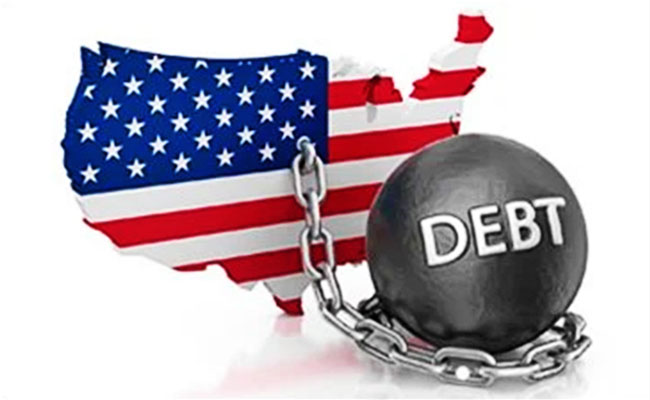
Indeed, the Trump administration's fiscal policy is currently in
disarray, with a yearly federal deficit approaching $2
trillion and federal public debt reaching $39 trillion
(or set at 126 percent of GDP, in 2026), according to the Debt
clock.
If one adds the one trillion of states' public
debts, the total U.S. public debt will likely be $40 trillion, or
129 percent of GDP, later in 2026.
Rather than taking concrete measures to correct such an
unsustainable fiscal situation, the D. Trump administration is
increasing military expenditures, at the same time that it wishes to
place the Federal Reserve Bank (FED) under its direct
control, and when it is pressuring the central bank to artificially
lower short-term interest rates.
All this undermines international confidence in the U.S. government
and encourages other countries to sell part or all of their stocks
of dollar bonds and other dollar assets, while reducing reliance on
the international fiat dollar system.
The end result is to push up medium- and long-term interest rates in
the U.S., with a negative impact on the real economy, employment and
on banks facing rising defaults and bad debts.
Thus, everything would seem to be in place for an
important correction in financial markets in the coming months or
years, not only in the United States but also in many other
economies.
On the International Stage, the
Economic and Trade Wars waged by the current U.S. President are a
source of Instability and Economic Slowdown
Since the very beginning of 2025, President
Trump's second administration
has irresponsibly chosen to launch economic warfare and the 'dumbest
trade wars', (see The Wall Street Journal, Jan. 31, 2025
- also
HERE), against other countries,
including against long-time allies, rather than adopting a posture
of mutually profitable economic cooperation.
This has been a highly deplorable and
counter-productive approach.
Indeed, after just one year in power in Washington, D.C., real
estate mogul turned politician Donald Trump,
has managed to attack and insult almost every
sovereign nation on Earth.
He began by antagonizing two neighboring countries in North
America (Canada and Mexico).
He then set about alienating Asian countries,
starting with China.
His boundless imagination led him to
resurrect the
old Monroe Doctrine of 1823 in
order to turn all of South America against him and steal their
natural resources.
And not to be outdone, he bombed countries in Africa and the
Middle East (Somalia, Nigeria, Iran, etc.).
The icing on the cake was when his foreign policy
document identified Europe's NATO allies as adversaries and
threatened to seize Greenland, under Danish rule, by
force...!
A few more months of the Trump 2.0 regime and the United States
could be completely isolated and will have only one country allied
with it, i.e. Israel, and be in a more or less state of
rupture with the other 191 countries.
Conclusions
We do not know how many years it will take for the world to adopt a
New World Order, based on the
establishment of a new international monetary system...
The reason being that this time, everything is
being done in a context of conflict and disorder, rather than with
studies, analysis and multilateral cooperation.
The U.S. political regime of D. Trump seems to have set itself the
objective of ruining the reputation of the United States around the
world and
accelerating the decline of the American
empire.
However, within the United States, legal, constitutional and
political efforts to force either a resignation or a
disqualification of the current president could change radically the
path followed by the Trump administration 2.0, since January 2025.
Unfortunately, the damage is done and confidence in the U.S.
government is broken.
What this means is that over the coming years,
there will be at least four ways to clear international payments:
-
through the old dollar-based system still
in place
-
with new mechanisms with either
currencies,
-
more and increasingly through the new
BRICS's Unit international
currency, based on 40% gold and 60% of a basket of
national currencies
|