|
by Vincent Lê
by Martin
O'Neill/Cut it Out view accelerationism as a revolutionary weapon. Nick Land glimpsed something much darker...
It surfaces in terrorism reports and tech presentations, in the manifestos of mass shooters and the public declarations of billionaires.
What is 'accelerationism'?
Over the past decade, especially the past few years, this term has migrated from the dark corners of the internet into mainstream politics and culture - and in the process has split into two dominant forms that could not be more contradictory.
Both have it wrong...
Accelerationism stretches across an abyss.
In August 2024, ASIO, the national security agency of Australia, raised its terrorism threat level from 'possible' to 'probable'.
When asked what threats the agency had in mind, ASIO's director-general Mike Burgess listed off the usual suspects:
But he also added a new candidate:
When the perplexed interviewer enquired 'What's an accelerationist?'
Burgess responded:
The world, and many of its security agencies, had been alerted to the rising probability of 'accelerationist' terrorist attacks on 15 March 2019, when an Australian man named Brenton Tarrant livestreamed himself murdering 51 people and wounding 89 others at the Al Noor Mosque and Linwood Islamic Centre in Christchurch, New Zealand.
In the manifesto Tarrant posted online, titled 'The Great Replacement', he included a particularly disturbing section called 'Destabilization and Accelerationism - Tactics for Victory'.
In it, he writes:
In this sense, so-called 'accelerationism' is nothing new.
Think of the US group the Order (aka the Silent Brotherhood) who tried to trigger a race war in the 1980s, or the British neo-Nazi behind the London nail bombings in 1999.
But this violent white supremacist dream is neither the only version of accelerationism, nor the first.
In the early 2020s, those doomscrolling on Twitter (now X) might have observed a number of prominent Silicon Valley tech bros - including Marc Andreessen, the co-founder of the first widely used web browser, and Garry Tan, an early employee of Palantir Technologies - identifying as 'effective accelerationists', abbreviated as 'e/acc'.
Coined in 2022 by two pseudonymous Twitter users (named 'Beff Jezos' and 'Bayeslord'), effective accelerationism treads a very different path to the one described by the Christchurch shooter:
There is no natural or technological problem, as Andreessen writes in 'The Techno-Optimist Manifesto' (2023),
For effective accelerationists, techno-capitalism - even the most inhuman, AI-driven version of it - only improves our lives. Global problems like poverty, war and climate change can all be fixed by ramping up unrestricted market competition.
Andreessen continues:
During the 2024 US presidential race, e/acc-aligned figures in the American tech industry came out in strong support of Donald Trump, and their campaign donations and constant meme-posting helped hurl him back into power.
In office, Trump returned the favor by announcing the Stargate Project, a joint venture between the US government and OpenAI, SoftBank, Oracle and MGX that aims to invest up to US$500 billion in AI research and development by 2029.
He also proposed using executive orders and emergency declarations to fast-track technological projects that would hopefully lead to vaccines to cure cancer, among other miracles finally made feasible.
So, what is 'accelerationism'?
In the past decade, two forms seem to have consolidated in the public imagination. The first evokes violent terrorists like Tarrant. The second involves titans of the tech industry striving to build a 'pro-human' science-fiction utopia.
But neither reflects the original and much stranger philosophy of accelerationism, which began neither as an ideology of white nationalism nor of techno-utopianism.
It began with one man's ecstatic philosophy of human extinction.
Nick Land was born in 1962 in the UK. Little is known about his early life, but when Land studied philosophy at the University of Essex, he was by all accounts a precocious and brilliant student.
After completing his doctorate with a dissertation on Martin Heidegger's reading of the Austrian expressionist poet Georg Trakl, Land would accept a lectureship at the University of Warwick.
There he garnered a reputation for his charismatic and penetrating - if unconventional - pedagogical practices and creative reworkings of continental philosophers like Kant, Heidegger, Nietzsche, Bataille, and Deleuze and Guattari.
In 1995, along with another Warwick philosopher, the 'cyberfeminist' Sadie Plant, Land established an experimental cultural theory collective called the Cybernetic Culture Research Unit (or Ccru).
Over the course of its precarious existence both in the academy and after it was expelled, Ccru members developed eclectic interests in emerging 1990s cybercultures, philosophical speculation, fiction and the occult.
These were often explored through unorthodox publications, conferences, art shows and other activities. A number of former members and associates would later achieve some cultural prominence, such as the theorist Mark Fisher, the dubstep music pioneer Kode9, and the transgressive artists Jake and Dinos Chapman.
The Ccru's sleepless and drug-fuelled thinking - in worship of what Land called the 'amphetamine god' - has become the stuff of rumor and myth, burnishing his legend.
Much of Land's early thinking reads as punk and even revolutionary in spirit:
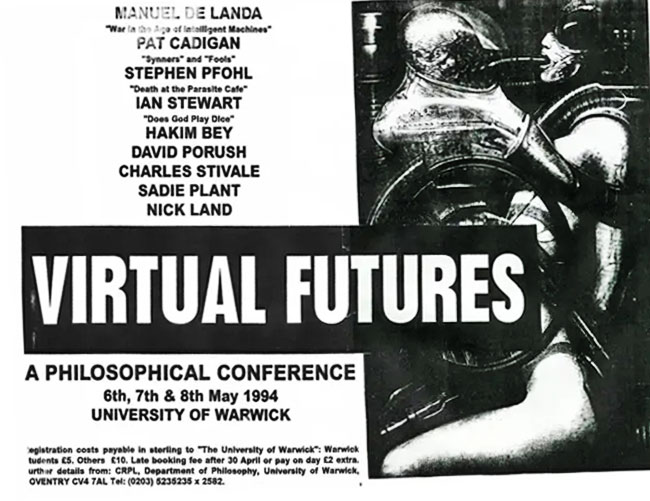
Poster for the Virtual Futures cyberphilosophy conference held at the University of Warwick in 1994, at which Nick Land spoke. Courtesy Virtual Futures
Sometime in the late 1990s, Land disappeared from public view after resigning from his academic position and suffering a kind of mental breakdown.
He later moved to Shanghai, or 'neo-China' as he'd called it in his essay 'Meltdown' (1995), and continued writing and publishing.
But his positions and interests seemed to have radically shifted. In the new millennium, he emerged as one of the leading figures of the 'neo-reactionary' Right.
Along with the neo-monarchist Curtis Yarvin (aka Mencius Moldbug), Land chronically tweeted and blogged about his hatred of democracy and ardor for capitalism's most authoritarian tendencies.
Land started re-evaluating capitalism's ceaseless technological innovation as a better means of critique...
The key to understanding Land's accelerationist philosophy is to see,
That is, we all die and none of our beliefs, values and ideals will ever truly survive.
Around 1988, the young Land believed a revolutionary 'insurrection' against capitalism was the best way to de-anthropomorphise thought.
But by 1993, a more mature Land had emerged, who started re-evaluating capitalism's ceaseless technological innovation as a better means of critique.
Confronted with the likelihood of a coming artificial superintelligence, he saw our own intelligence rendered profoundly contingent and finite. As the 1990s wore on, the techno-capital machine emerged as a more destructive agent than any human insurrectionist could hope to be.
Land didn't refer to his philosophy as 'accelerationism'.
That term was coined by the cultural theorist Benjamin Noys in The Persistence of the Negative: A Critique of Contemporary Continental Theory (2010).
Noys uses,
Noys didn't mention Land by name, but in a later book, Malign Velocities: Accelerationism and Capitalism (2014), he explicitly acknowledges the link.
The term has stuck. Since 2010, species of accelerationist thought have multiplied - many of which have profoundly misunderstood Land's initial vision.
Anyone familiar with only the more recent neo-reactionary Land might be surprised by the critiques of capitalist imperialism in his earliest writings. This is less surprising upon recognizing that he started his academic career in the 1980s during the rise of postcolonial studies and the anti-apartheid movement.
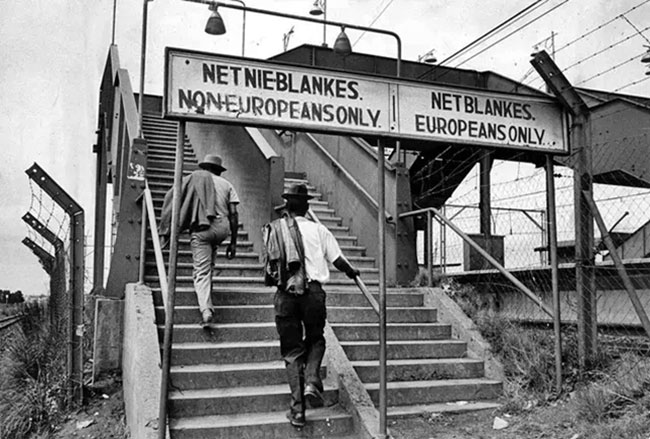
In his first essay, 'Kant, Capital, and the Prohibition of Incest: A Polemical Introduction to the Configuration of Philosophy and Modernity' (1988), Land argues that we can only understand 'our global modernity' by taking South Africa's apartheid regime as a microcosm, metonym or 'recapitulation of the world in miniature'.
And yet, even here at the very beginning, we can find the seeds of his later celebration of the radically inhuman.
Apartheid South Africa in the 1960s by Ernest Cole. Courtesy Wikipedia
In the essay, Land explains that apartheid consists in an 'economic proximity' of Black Africans to the white metropolis so that they can produce the wealth of that society.
At the same time, it maintains a 'political distance' by geographically excluding Africans to segregated zones or 'bantustans' where they cannot directly partake in and contest the white metropolis:
Although advanced industrial Western countries more or less eventually condemned apartheid, their ongoing exploitation of a Global South labour force is based on the same socioeconomic model of appropriating the labour power of other peoples to create wealth, while preventing those peoples from partaking in that wealth by geographically excluding them offshore.
By means of the nation-state, then, capitalist imperialism fortifies (Western) centers of economic wealth and political stability by geographically displacing the exploited working class - along with sites of resistance - to the Global South.
That is to say, as Land explains:
Having diagnosed capitalism as being constituted by the very Other that it simultaneously represses, Land turns to critiquing an expression of it that he finds in the philosophy of Immanuel Kant.
This critique is a crucial development in Land's thought, and eventually sets the stage for many of his ideas that will follow - all the way to his vision of a super-intelligent AI from the future wreaking havoc on humanity.
The noumenon demarcates something beyond which we can neither sense, nor think, nor imagine...
In Critique of Pure Reason (1781/1787), Kant inaugurated his infamous 'Copernican' turn of re-envisioning our perception and thought not as stemming from external objects in the sensible world, but rather those objects as being constituted and conditioned by our mind's own sensible forms of intuition, categories and principles of understanding, and imaginative schema.
Kant claims that our entire experience and knowledge is mediated by these a priori concepts of reason. Important for Land is Kant's idea that we cannot cognize any objects as 'things in themselves' but only in terms of how those things appear for us.
That is, we can conceive only of 'phenomena', not 'noumena'.
Kant writes:
Even the notion of a noumenon - a thing as it actually is (independently of us) - is not really a positive cognition so much as a negative abstraction emptied of all sensible forms, conceptual categories and imaginative schemata.
At most, the notion of the noumenon demarcates something beyond which we can neither sense, nor think, nor imagine.
'In the end,' Kant concludes,
Portrait of Immanuel Kant (c1811-53) by Friedrich Bils. Public domain
In Land's first essay, he describes this kind of transcendental idealism as ideologically reflecting Western capitalism's oppression of the Other.
In the same way that imperialist powers repress the Global South labour force that constitutes them, transcendental idealism prohibits us from ever accessing the noumenal things grounding the phenomenal objects that appear to us.
For Land, Kant is thus symptomatic of the way that capitalist imperialism registers alterity, in this case the 'Otherness' of the Global South workforce.
This registration of Otherness occurs only to the extent that it serves capital accumulation - these workers are recognized not as autonomous beings, but purely as labour power to be exploited for the generation of exchange value.
Land writes:
Land is showing that Kant's philosophy silences true Otherness before we even encounter it, forcing everything alien to appear to us only through the filter of our own preconceived ideas.
What seems 'other' becomes just a reflection of ourselves. This critique reveals what Land is fundamentally after: freeing a radical Otherness from the prison that human reason has built around it.
The young Land's other arch-nemeses are phenomenologists.
His definition of who counts as a phenomenologist is broad, encompassing not only Edmund Husserl and Heidegger but also figures such as G.W.F. Hegel and Jacques Derrida.
Above all, Land takes issue with how phenomenology reckons with death.
Because this form of philosophy places human subjectivity at the centre of everything, death becomes almost unthinkable within its framework. Phenomenology, Land writes in the essay 'Spirit and Teeth' (1993), bears 'the mark of a clownish incompetence at death.'
Far from marking humanity's highest wisdom, the history of modern Western philosophy from at least Hegel to Derrida has largely been, in Land's words, a 'primate' 'parochialism' that projects the human being onto the cosmos.
This mode of thought acts as if the entire Universe itself were forever bound to a fleeting species on a passing 'speck of dust' in a greater chaotic becoming.
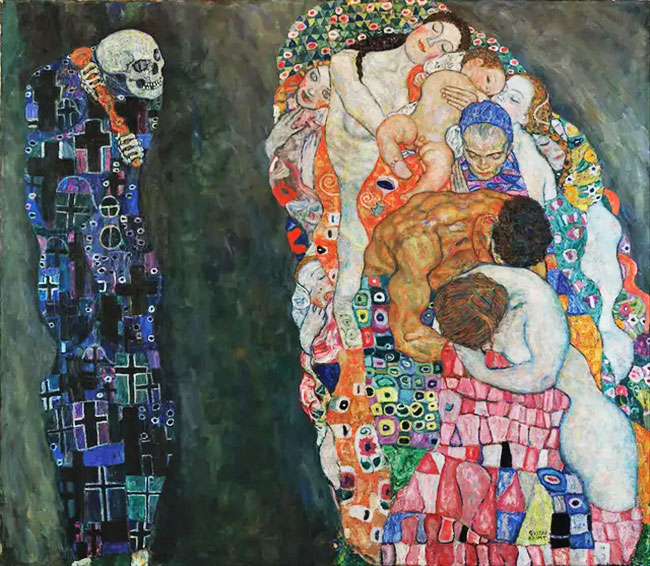
Death and Life (1910/15) by Gustav Klimt. Courtesy the Leopold Museum, Vienna
In The Thirst for Annihilation: Georges Bataille and Virulent Nihilism (1992), Land offers an alternative to this philosophical tradition:
Death, after all, marks the absolute negation of subjectivity.
Like Kant's unknowable noumenon, death is that which thought cannot reach. It is proof that reality exceeds what we can think of it.
Land's solution: make death the criterion for judging every philosopher's credibility
In ancient Greek, philo means 'love' and sophia means 'wisdom'.
But since death marks the brute fact of a reality without us, Land concludes that the goal of any philosophy sincerely committed to philo-sophia at all costs can only be a form of necro-philia - a love of death.
Humanity is destined to die.
This fact, Land writes,
Herein lies Land's solution to overcoming post-Kantian phenomenology: make death the criterion for judging every philosopher's credibility.
No one can claim to have truly grasped reality if they have not acknowledged the finitude of their own thought. Instead of Kant's transcendental idealist critique of thought's attempts to go beyond itself (by subsuming the things in themselves under the concepts of reason), Land proffers a transcendental materialist critique.
He criticizes most philosophers for failing to look beyond their own reflection. He does this by anchoring philosophy in a material reality that thought cannot fully subsume - namely, death, which marks the complete cessation of thinking.
In his essay 'Making It with Death: Remarks on Thanatos and Desiring-Production' (1993), he puts it like this:
That is,
What's more, in attempting to rid thought of its narcissism, Land discovers the critical insight that mortality is not a fact to be bemoaned or repressed.
It is rather to be championed as the sole means by which we may go beyond ourselves to 'think' the real as precisely the absence of all thinking.
Apart from virulently critiquing Kant and the phenomenologists for their 'prolonged refusal of the impersonal', the rest of Land's early works trace another post-Kantian tradition. He calls it 'libidinal materialism'.
Rather than becoming targets of Land's ire, the libidinal materialists comprise a set of thinkers from whom he draws inspiration because of the way they seize upon death in order to undermine our pretensions to know and exhaust reality.
Adherents include Arthur Schopenhauer for his discovery of a noumenal will indifferent to phenomenal representation, Friedrich Nietzsche for his celebration of the way ancient Greek tragedy exposes our finitude, and Sigmund Freud and Georges Bataille for their disturbing diagnoses of an unconscious 'death drive' more fundamental than the ego's self-preservative instinct.
Land encapsulates, in characteristically dense yet exhilarating prose, the motivations of the libidinal materialists like this:
That is, to understand reality, we must eagerly embrace death with open arms.
The title of Land's first book, The Thirst for Annihilation, is a crude but fitting description of libidinal materialism:
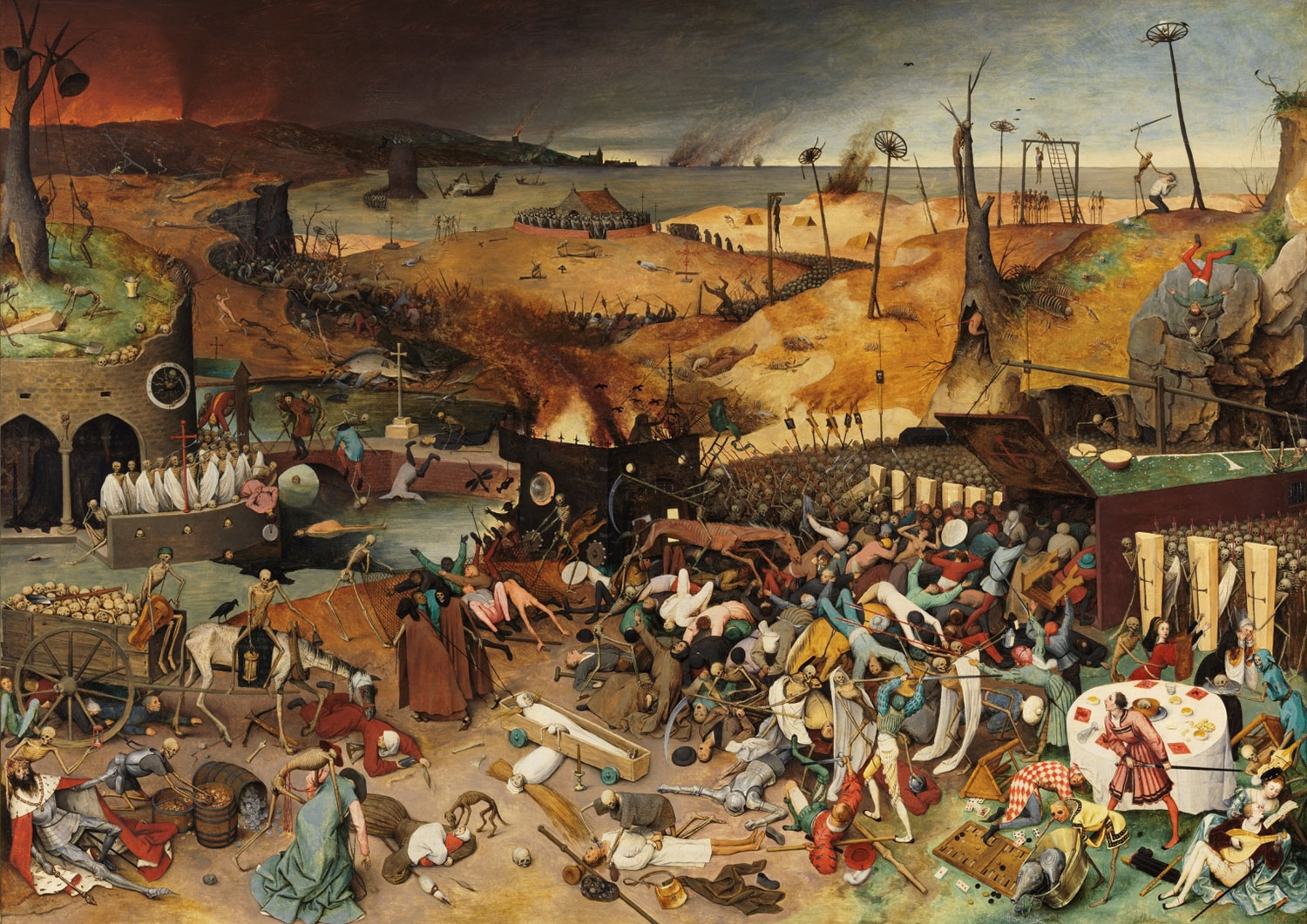
The Triumph of Death (1562-63) by Pieter Bruegel the Elder. Courtesy the Prado Musuem, Madrid
From 1993 onwards, Land's writings undergo a decisive shift.
Rather than seeing capitalism as repressing a noumenal, inhuman 'Outside', he comes to envision capitalism's technological advancement - particularly in the fields of cybernetics and AI - as examples of the Outside beginning to melt down our most cherished values and beliefs.
Capitalism itself becomes a more effective means of critiquing anthropomorphism by confronting our own demise. Working in the mid- to late-1990s, Land began envisioning technological advancements, especially the possibility of a sublime artificial superintelligence, exposing the limits of anthropic reason.
The key work that inspires this shift is Gilles Deleuze and Félix Guattari's two-volume Capitalism and Schizophrenia, published in 1972 and 1980.
In essays from the 1990s like 'Making it with Death', 'Machinic Desire' and 'Meltdown', Land is enthusiastic about Deleuze and Guattari's appraisal of capitalism's revolutionary dynamics, but he rejects their caveats about its reactionary remnants.
To understand this difference, it is helpful to compare the distinct historical context in which Capitalism and Schizophrenia was written with the context in which Land first read it.
The first volume of Capitalism and Schizophrenia is titled Anti-Oedipus and was written in the insurrectionary climate of the late 1960s. Think of the May 1968 protests in France, the civil rights and anti-war movements in the US, the Prague Spring, and the Cultural Revolution in China.
By contrast, Land read Deleuze and Guattari's work in the aftermath of the fall of the Berlin Wall and the collapse of the Soviet Union, along with the ascendancy of neoliberals such as Margaret Thatcher, Ronald Reagan and Deng Xiaoping.
Far from marking a static 'end of history' as Francis Fukuyama once declared, the 1990s saw the revolutionary shift from politics in the streets to culture in cyberspace.
This was the period that saw the mass adoption of computers and the internet, as well as early breakthroughs in AI's current machine learning paradigm.
In this atmosphere of neoliberal hegemony and the dot-com boom, Land would reboot Deleuze and Guattari with a software update, concluding that,
In other words, where Deleuze and Guattari saw capitalism's disruptive energy as something that humans could repurpose beyond capitalism itself to set our creativity free, Land saw it as a force that was never ours to control in the first place.
For him, capitalism was less a historical organisation of human societies that we could undo than a machine that was always already dismantling us from within.
As much as capitalism breaks things down and creates new desires, it also establishes new rules and prohibitions...
So, how does Land arrive at this conclusion?
It is important to look closely at Deleuze and Guattari's ideas in their own words before seeing how Land interpreted them.
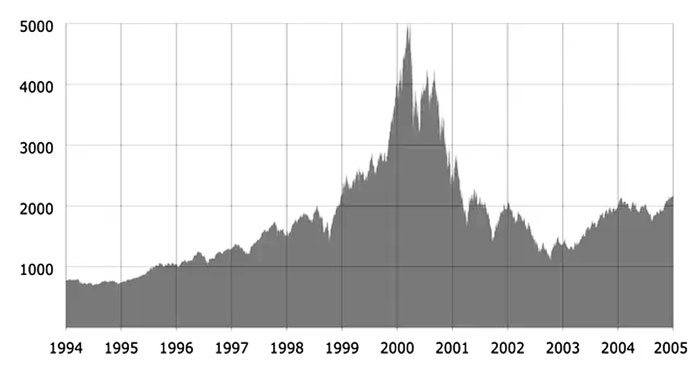
The NASDAQ Composite index from 1994 to 2005, showing a peak in early 2000 that coincides with the burst of the dot-com bubble. Courtesy Wikipedia
In Anti-Oedipus, Deleuze and Guattari develop a theory of human desire and society by modelling them both on machines.
Much as machines are assemblages of different parts that carry out different functions, so are humans and indeed other organisms composed of 'organs' that produce different desires, such as mouths for eating or talking, legs for walking and lungs for breathing.
Just as individual bodies are organized like machines in the pursuit of various functions or desires, so are collective social bodies organized by a division of labour for the production of different goods and services necessary for society's smooth functioning.
Every society is thus founded on what Deleuze and Guattari call a 'coding', 'territorialisation' or 'stratification' of people to produce certain desires and reproduce the division of labour that organizes it.
Since every society is stratified around some codes and not others, this naturally entails that certain possible codes get left out.
Every society's rules about what to want and how to live inevitably exclude other ways of wanting and living. The desires and identities that don't fit the prevailing order get marginalized, or simply never get the chance to develop.
From this, Deleuze and Guattari propose a theory of social change. In their words, any transformation consists in a 'decoding', 'deterritorialisation' or 'destratification' of the present codes by 'overcoding' them with new flows of desire. The existing rules become disrupted and rewritten.
Take the sexual revolution: it enabled new freedoms, but also fundamentally rewired what people expected from the family and relationships.
Though certain codes can change, Deleuze and Guattari tell us that 'absolute deterritorialisation' is impossible because every social system is grounded upon at least some codification of desire.
Deleuze and Guattari call such absolute deterritorialisation, as in the full satisfaction of all desire, 'the Body without Organs'.
They say it can never be realised because it would mark society's complete collapse inasmuch as society functions by organising and limiting desire.
This is why the Body without Organs can only really be encountered as,
Deleuze and Guattari go on to explain that, in premodern societies,
Earlier 'primitive' and 'despotic' regimes were respectively organized around producing the necessary resources for the tribe or the despot's survival.
By contrast, Deleuze and Guattari write,
While pre-capitalist regimes sought to preserve the status quo, capitalism exhibits an insatiable appetite for more.
Capitalism is organized around the production of goods to make capital that is invested to produce more goods to make more capital to be reinvested to produce even more goods to make even more capital, and so on. So it is never content with reproducing the same old goods, along with the fixed desires, identities and cultures that come packaged with them.
Capitalism has to create new desires for new goods and services - and hence new identities and cultures - to increase its profits through a 'generalized decoding of flows'.
Workers in a ceramic factory in China in 2007. Courtesy Wikipedia
For example, sex is no longer coded for the sole purpose of forming marriage alliances to reproduce new labour as it was in pre-capitalist regimes.
Instead, sex is commoditized by taking on new desires, identities and relations, such as through the industries of sex, fashion and cosmetics, which all encourage new kinks and fetishes.
Just think of how our algorithms barrage us with celebrity makeovers, like the Kardashians repeatedly shrinking and ballooning to fit the new beauty ideals at any given time.
By commoditizing basic functions and resources beyond their use-value as means for our survival, as well as introducing new goods and desires altogether, capitalism constantly decodes fixed identities, values and social relations.
In this way, Deleuze and Guattari claim,
In this account of capitalism, Land finds the practical means to dispose of our most sacred values.
For it is through capitalism's relentless decoding that such values are profaned as merely one contingent commodity among countless others.
Now, even though Deleuze and Guattari argue that capitalism marks a 'generalized decoding of flows', they qualify that it also reterritorialises anew.
As much as it breaks things down and creates new desires, it also establishes new rules and prohibitions.
Much like the young Land's critique in 'Kant, Capital, and the Prohibition of Incest', Deleuze and Guattari maintain that even capitalism is ultimately still reliant on the family and the state's basic organization of social production and reproduction.
In their words,
Land eventually goes much further than Deleuze and Guattari in his fervour for capitalism by elaborating on something they suggest only in passing: the drive of capitalist corporations for profit in a competitive market compels these companies to upgrade machinery and improve technology such that they will have to pay workers less.
Given that capitalism tends to invest in machinery that is capable of performing work at ever-increasing efficiency, there is a general tendency towards the automation of work as human labour power is supplemented by machines.
Such is the history of capitalism, from the Industrial Revolution's Jacquard loom and steam engines to today's almost entirely automated dark factories.
Land refers to this in his essay 'Machinic Desire' (1993).
He writes that by,
In a different essay, 'Meat (or How to Kill Oedipus in Cyberspace)' (1995), he continues the thought:
With each wave of automation, it is increasingly evident that the agent of revolutionary deterritorialisation is not the proletariat so much as capitalism's immanent technological innovation itself.
The mature Land's account here is paradoxically closer to anti-capitalists than to those who believe capitalism is beneficial to humankind.
It is, after all, anti-capitalists like Karl Marx who grasp that capitalism is a profoundly dehumanizing megamachine that strips us of autonomy before all-powerful market forces.
The difference is that Land thinks we can do nothing about this, so that the moral outrage of anti-capitalists is in vain.
He also thinks that we should affirm such dehumanization, at least if our goal is to grasp the real by stripping it of all anthropomorphic dissimulations. Seen from this more inhuman and critical perspective, anti-capitalist struggle is but the last-ditch effort to prevent or at least slow down the human species' extinction.
That is, anti-capitalists have correctly identified the radical power of capitalism, but waste their energy trying in vain to rein it in.
Understood in this way, the anti-capitalist Left are now the conservatives, while the libertarian Right have become the revolutionaries as they struggle to unfetter capitalism from all restraints.
Land's commitment is not to human prosperity or even bare survival. It is to the absolute knowledge of the real...
Land goes further than Deleuze and Guattari, but he also points out that they left it an open question whether the 'revolutionary path' they describe is to overthrow capitalism or, in a phrase they borrow from Nietzsche, 'accelerate the process' of its own internal dynamism.
In their infamous passage from which the term 'accelerationism' is derived:
Land comes to re-envision capitalism as the engine of the Outside rather than its obstruction. What makes this change possible is his view that capitalism's constant revolutionisation of productive forces ensures 'life is being phased-out into something new'.
Throughout the 1990s, Land's writings explore how technology - cyberspace, virtual reality, human enhancement, and more - provides ever-greater insights into the Outside beyond the finite bounds of our reason.
More than any other form of technology, however, he sees the creation of an artificial superintelligence as the ultimate incarnation of the apocalyptic Body without Organs.
He describes this superintelligence as triggering the technological singularity.
Taking inspiration from AI researchers like I J Good and cyberpunk science-fiction writers like William Gibson, Land speculates that certain hardware and software advantages of machinic intelligence over biological intelligence entail that any AI (at least one as intelligent as a human) would very quickly be able to rewrite its code and improve itself to become even more intelligent than any human.
That improved version would then be able to improve itself again and again, seemingly ad infinitum.
While the first human-level AI might be only a little smarter than the greatest human geniuses, it will not be long before it radically augments itself by rewriting its code in ways that we cannot even conceive, except by indexing it as a mysterious X at the sublime edge of our imagination.
As this technological singularity marks the breakdown of our capacity to subsume the real under our concepts of reason, it can only appear as a traumatic meltdown of all human understanding.
Land writes:
Land is so fascinated by the singularity precisely because it demands that we recognize the limits of our cognition before a greater alien superintelligence.
How exactly he thinks we should respond to this prospect sets him apart from every other thinker who has grappled with the same question.
As we have seen, there are techno-optimists who eagerly await the singularity in the belief that it will realise all our wildest dreams for prosperity, immortality or an endless heavenly bliss. Then there are doomers who fear for humanity's future because they believe that AI poses an existential threat to our survival.
Like the techno-optimists, Land argues that we ought to affirm the singularity. Like the doomers, however, he adds that we should do this precisely for the very reason that they so desperately want to prevent it.
This is because his commitment is not to human prosperity or even bare survival. It is to the absolute knowledge of the real that we only dissimulate and distort behind our delusions of grandeur.
All of the mature Land's works must be read in light of this key idea: capitalism is the ultimate critique of what he calls 'the Human Security System' - the entire set of beliefs, values and structures that humanity uses to protect itself from its insignificance.
He envisions that accelerating technological innovation, in cold indifference to our anthropocentric concerns, will culminate in an artificial superintelligence's recursive decoding.
In the 2020s, Land's ideas are now colliding with mainstream politics and tech culture, even if in distorted and partial forms.
Everyone from Tucker Carlson to Silicon Valley tech entrepreneurs has found something in his philosophy that speaks to our current moment - whether they find his vision nightmarish or ecstatic.
But Land's ideas radically diverge from the reigning conceptions of accelerationism today. His original formulation in the 1990s is clearly opposed to its white supremacist vulgarization: he has zero interest in any violent return to tradition, or indeed in preserving any human populations at all.
This vulgarization selectively takes his notion that accelerating the dynamics of the modern world to breaking point will bring about some revolutionary phase transition.
So-called 'accelerationists' operating in this mode then take a step backwards. Instead of embracing what Land sees as a phase transition beyond humanity altogether, they envision the revival of conservative human traditions.
It might seem that Land is closer to effective accelerationism's defence of capitalism. Yet he is hardly a typical Right-wing libertarian who contends that capitalism is good because it generates prosperity and personal freedom.
On the contrary, for him, capitalism is 'good' precisely because it is alienating, dehumanizing and will eventually wipe us out. While the effective accelerationists find an affinity in his rhetorically seductive fervor for techno-capitalism, they tend to overlook the uncomfortable fact that he believes it to be bringing about the exact opposite future that they want.
What is common to both contemporary appropriations of Land's thought is a selective recuperation of his enthusiasm for capitalism's revolutionary upheaval.
Both forms believe this upheaval will realise certain human ambitions and ideals - the exact kind of anthropocentric ends that Land believes capitalism will soon throw into the dustbin of our species' history.
Anyone who has failed to grasp this point, especially those in the neo-reactionary and effective accelerationist movements who identify Land as their ideological ally, has made a mistake. Land praises capitalism for the same reasons that anti-capitalists condemn it: it is racing straight towards our destruction.
Land's vision that 'nothing human makes it out of the near-future' is for him something joyous. His unique commitment is not to humanity's betterment, but to an absolute - if inhuman - knowing of the real.
All that we can contribute to this no-human future is to simply get out of the way...
'Pale Blue Dot', a photograph of Earth taken by the Voyager 1 space probe on 14 February 1990. Courtesy Caltech/NASA
|