|
by Dr. Joseph Mercola
June 29, 2026
from Mercola Website
PDF Version
Story at-a-glance
-
Newly declassified government records suggest a U.S.
national laboratory considered a laboratory origin
for COVID-19 to be just as plausible as a natural
origin as early as May 2020, raising new questions
about what officials knew during the pandemic's
early months
-
The released documents describe federally funded
coronavirus research that included spike protein
engineering, receptor adaptation experiments, and
testing in humanized mice, helping explain why those
techniques later became central to debates over the
virus's origin
-
According to the report, declassified records show
Anthony Fauci participated in a 2021 intelligence
briefing on COVID-19's origins, prompting new
scrutiny over whether his later congressional
testimony matched the documented timeline
-
Internal emails and reviewer-selection discussions
described in the records suggest scientists and
intelligence officials continued debating competing
origin theories behind the scenes even as the public
conversation increasingly focused on a natural
origin
-
The documents underscore why reviewing original
records, following the timeline and comparing
private discussions with public statements gives you
a stronger foundation for evaluating major
public health claims
|
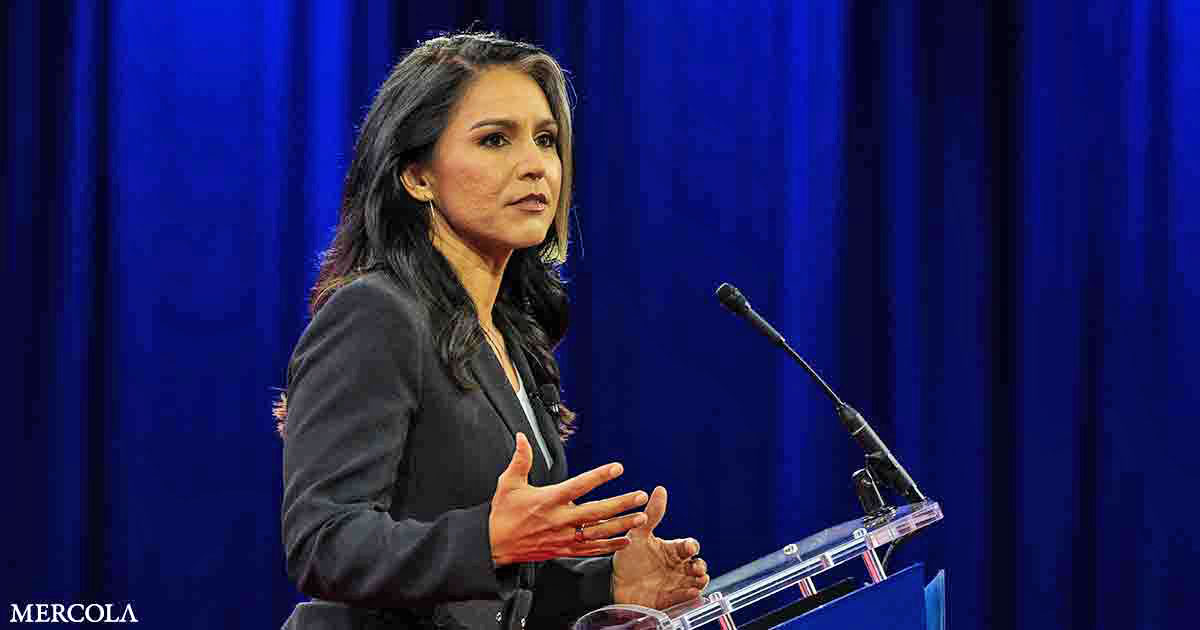
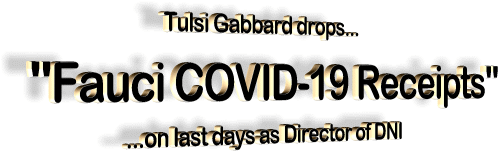
In her final days as Director of National Intelligence
(DNI),
Tulsi
Gabbard released a collection of newly declassified documents that
reignite one of the
COVID-19 pandemic's most consequential
unresolved questions:
where did COVID-19 come from, what did
government officials know - and when? 1
The records, which span intelligence assessments, internal
communications, grant reports and scientific research documents,
paint a picture of a far more complicated behind-the-scenes
discussion than the public was told at the time.
They also raise
specific questions about,
whether senior officials shaped, or
suppressed, the public narrative around those origins.
This story reaches far beyond any one scientist or government
agency.
It's about transparency, oversight, research funding and
whether the public received a complete picture during a global
crisis that reshaped daily life, health care and public policy.
Looking at what these newly released files actually claim, what
evidence they contain, and why the details continue to fuel debate
allows you to evaluate the record for yourself rather than relying
on anyone else's conclusions.
Declassified Files Tie
COVID Research, Intelligence, and Fauci Together
A report published by ZeroHedge centers on the
declassified documents that describe
federally funded coronavirus research tied to the years before
and during the COVID-19 'pandemic'...
2
The documents seek to determine whether important evidence about the
virus's origin and related research activities was known inside
government long before the public learned about it.
•
The declassified files rely heavily on
government records to build their case
The evidence includes intelligence
assessments, internal emails, National Institutes of Health
(NIH) grant reports, briefing records and other official
documents rather than recollections or interviews alone.
Together, those records create a timeline
that compares what government agencies, researchers and
senior officials reportedly discussed behind closed doors
with what was later communicated publicly.
The article
argues that differences between those internal records and
later public statements raise important questions about how
information regarding
COVID-19's origins evolved over time.
•
The grant records describe research that
extended well beyond basic virus surveillance
According to the report, Year 5 progress
documents for
EcoHealth Alliance's NIH grant outlined several planned
laboratory activities, including,
-
sequencing spike genes from
bat coronaviruses
-
creating mutant viruses to evaluate their
ability to recognize human receptors
-
performing
receptor-binding experiments
-
conducting infection
studies in humanized mice
Humanized mice are specially bred
laboratory mice that carry human cells or tissues so
scientists can study how diseases behave inside a living
system that more closely resembles people.
•
Several research projects also overlapped
with earlier proposals
The article states that the work
described in the grant report paralleled elements of the
2018 DEFUSE proposal involving,
-
EcoHealth Alliance
-
Peter Daszak, president of EcoHealth Alliance
-
Ralph Baric, a coronavirus researcher at the University of North Carolina
-
researchers at the
Wuhan Institute of Virology
The DEFUSE proposal is significant
because
DARPA - the Defense Advanced Research Projects
Agency - reportedly reviewed and rejected it in 2018,
meaning federal officials had already evaluated this type of
research before the pandemic began.
According to the
released documents, that proposal discussed creating chimeric bat coronaviruses...
A
chimeric virus combines
genetic material from different viruses so researchers can
study how individual pieces influence behavior.
The relevance is straightforward - if a
chimeric virus combining bat and human-adapted elements were
created in a lab and accidentally released, it could look,
genetically, like something that evolved naturally.
The
proposal also described receptor adaptation studies,
consideration of furin cleavage site insertion and testing
in humanized mice.
•
Understanding these technical terms helps you
evaluate the debate yourself
Spike proteins act like keys that help
viruses enter cells.
Receptors serve as the locks on those
cells.
Receptor adaptation experiments examine whether
changes to the virus improve its ability to fit those locks.
Furin cleavage sites are sections of a
virus that make it easier for human enzymes to activate the
virus before it enters cells.
These laboratory techniques
became central topics during later debates over COVID-19's
origin.
•
The files also show that some people had
already been exposed to bat-related coronaviruses
According to the report, surveillance
work performed under the same NIH grant tested 1,497 rural
residents in southern China and found that nine people, or
0.6%, carried antibodies against bat SARS-related or HKU10
coronaviruses.
Antibodies are proteins your immune
system creates after exposure to an infection, making them
useful markers that show whether someone encountered a virus
in the past.
Researchers often conduct antibody surveys to
understand how frequently viruses circulate among people who
live near wildlife reservoirs.
A 0.6% exposure rate may sound small, but it
confirms that,
bat coronaviruses were already making the jump to
humans in the region - quietly, before any outbreak was
recognized.
That baseline matters:
if officials monitoring this
research knew related viruses were reaching people in southern
China, the question of what they concluded about COVID-19's
origin, and how urgently they acted, becomes harder to answer
with a simple "we didn't know"...
The Declassified Records
Raise New Questions about Fauci's Testimony
According to the ZeroHedge report, the newly
released records show that
Anthony Fauci, then director of
the National Institute of Allergy and Infectious Diseases (NIAID),
participated in a June 4, 2021, secure briefing with,
-
Central
Intelligence Agency (CIA) personnel
-
National Security Council
officials
-
other intelligence representatives,
...to discuss COVID-19
origins, including pangolin research, reports of sick Wuhan
Institute of Virology researchers and competing origin theories.
The report states that Fauci also recommended
scientists for the intelligence community (IC) to consult.
•
The article argues these records conflict
with Fauci's later testimony
According to the report, Fauci testified
during a 2024 congressional interview that he had no
knowledge of or participation in discussions with
intelligence officials about viral research.
The declassified files, according to the
report, describe the June 4, 2021, briefing in specific
detail - including the attendees and topics discussed.
Because that account directly contradicts Fauci's
congressional statement on the same question, the report
concludes he provided false testimony.
•
Internal communications suggest scientific
disagreements continued behind the scenes
One example involves a June 8, 2021,
email that referenced a 2016 meeting at the New York Academy
of Medicine where Daszak reportedly discussed colleagues in
China,
"manipulating the spike protein on coronavirus to make
them more virulent."
The report also describes internal
discussions that referenced a Department of Defense report
concerning a "suspicious added furin-site" and FBI reporting
that examined unusual genetic characteristics.
•
The timing of these internal discussions adds
context to one of the most influential scientific
publications of the early pandemic
In March 2020, a paper titled
The
Proximal Origin of SARS-CoV-2, published in
Nature Medicine,
argued strongly against a laboratory origin and was widely
cited by public health officials and media as definitive.
3
According to the declassified records
described here, government scientists and intelligence
analysts continued to privately examine competing theories
and unresolved technical questions over the following months
and into 2021, raising questions about whether the
scientific consensus presented to the public reflected the
full range of evidence being considered behind closed doors.
•
Other communications reflected disagreement
rather than complete consensus
According to the article, one analyst
warned that complex scientific information could easily
confuse people without specialized training while still
arguing that the evidence deserved additional scrutiny.
Another internal observation stated that,
"the IC took direction straight from NIH... the people that
funded the Wuhan Lab" and referred to "a complex web of
money and politics influencing analysis."
•
The released files also describe efforts to
select outside reviewers for COVID-origin assessments
According to the report, July 2021 emails
evaluated several candidates before rejecting them because
of political sensitivity or perceived conflicts of interest.
The article states that,
-
James Clapper was
viewed as politically "hot"
-
Anthony Fauci was flagged because
of his NIH funding connections
-
Michael Morell was considered
"too public"
-
Sue Gordon and another individual identified
only as "Beth" were also set aside...
Whether those decisions strengthened or
weakened the review process remains contested.
Standard
scientific review practice requires that evaluators disclose
financial relationships, prior collaborations and public
statements relevant to the subject under review, precisely so
readers can weigh those factors themselves.
By that measure, the
selection discussions described here raise questions worth
examining.
Taken together, these documents don't resolve
the question of COVID-19's origin, but they do reveal how much
was being debated behind closed doors while public officials
presented a narrower picture.
That gap between private
deliberation and public messaging is exactly why developing your
own framework for evaluating health and science claims matters.
How to Protect Yourself
from Misleading Public Health Narratives
The newly released documents suggest the public
was not shown the full picture...
According to the records described in this
article, government officials privately considered a laboratory
origin to be a credible explanation while influential scientific
publications and public officials publicly promoted a natural origin
and dismissed competing views.
This underscores why I believe your strongest
protection is learning to examine the evidence for yourself, instead
of relying on
official narratives alone.
1.
Start with the original records, not the
headlines
Headlines often tell you what to think.
Original documents allow you to decide for yourself.
Intelligence assessments, grant reports,
internal emails, and hearing transcripts provide a timeline
of what officials knew, when they knew it, and how those
discussions compared with later public statements.
The closer you stay to primary documents,
the less likely you are to be influenced by selective
reporting.
2.
Compare what was said privately with what was
said publicly
One of the strongest themes running
through these documents is the difference between internal
discussions and the public narrative.
According to the records summarized here,
government scientists and intelligence officials continued
examining a laboratory origin even while much of the public
conversation shifted toward a single explanation.
Whenever those two stories diverge, it
deserves careful scrutiny rather than dismissal.
3.
Follow the money and the timeline together
Research funding, grant proposals,
scientific collaborations and intelligence briefings become
much more meaningful when viewed chronologically.
Put those events in order. Look at when
research was proposed, when meetings occurred, when
intelligence assessments were written and when public
statements followed.
Patterns often become much easier to
recognize once the full timeline is laid out.
4.
Ask who shaped the scientific discussion
Science advances through open debate, not
by discouraging competing hypotheses.
Whenever reviewer selection, funding
relationships or conflicts of interest become part of the
story, pay attention. Transparency strengthens confidence in
scientific conclusions.
Efforts that limit debate or discourage
scrutiny deserve the same level of examination as the
scientific evidence itself.
5.
Remain open to new evidence instead of
defending old narratives
Scientific understanding changes as new
documents, testimony and data emerge. If newly released
records strengthen or weaken a conclusion you previously
accepted, let the evidence lead you.
Your goal is not to defend a position.
Your goal is to understand what happened as accurately and
completely as the available evidence allows.
FAQs about the Newly
Released COVID Documents
Q:
What do the newly
declassified documents claim about COVID-19's origins?
A: According to the
documents described in this article, a U.S. national
laboratory concluded in May 2020 that a laboratory
origin was just as plausible as a natural origin.
The
records also suggest government officials continued
discussing the lab-origin hypothesis privately while the
public narrative largely emphasized a natural origin.
Q:
What type of coronavirus
research do the declassified records describe?
A: The records
describe federally funded research involving bat
coronaviruses, including spike protein engineering,
receptor adaptation experiments, testing in humanized
mice and discussions about furin cleavage sites.
These
research methods later became central to debates about
SARS-CoV-2's characteristics.
Q:
Why do the documents
raise questions about Fauci's testimony?
A: According to the
report, the newly released records show that Fauci
participated in a June 4, 2021, intelligence briefing
about COVID-19's origins.
The article argues those
records conflict with Fauci's later congressional
testimony that he had no knowledge of or participation
in discussions with intelligence officials about viral
research.
Q:
Why are the internal
emails and reviewer discussions important?
A: The documents
describe internal scientific disagreements, intelligence
discussions and efforts to select outside reviewers for
COVID-origin assessments.
Together, they provide
additional context about how government agencies and
researchers evaluated competing explanations for the
pandemic's origin behind the scenes.
Q:
What's the biggest
lesson from these newly released records?
A: The documents
underscore the importance of examining original evidence
instead of relying only on headlines or official
summaries.
Looking at intelligence assessments, grant
reports, internal communications and timelines allows
you to better understand how scientific conclusions and
public messaging developed over time.
Sources and
References
|